



The Door Opens, and Scent Arrives Before Light – The Fragrance Speaks the Resort's First Sentence
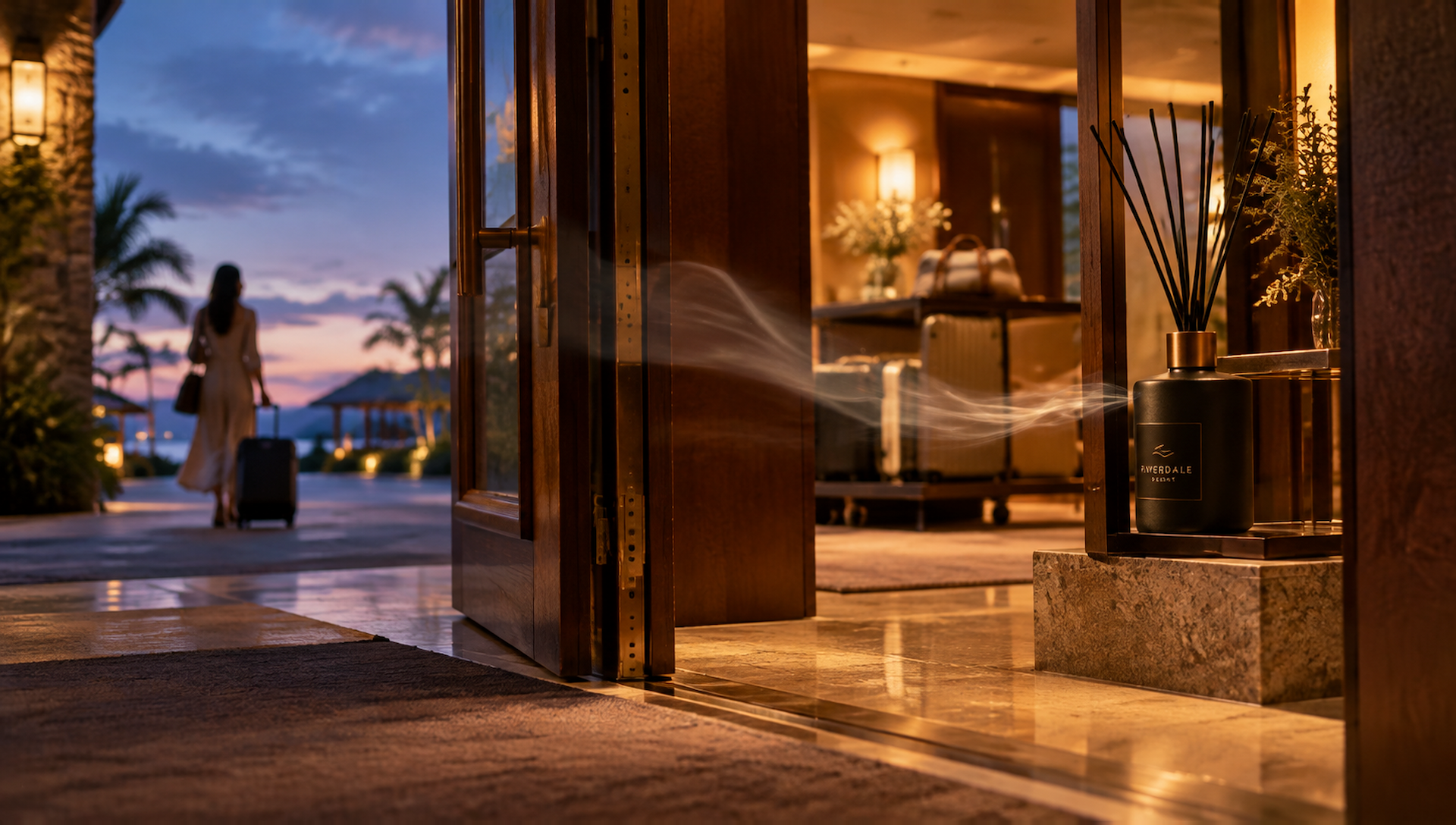
At the entrance of a resort, there is a time gap almost no one notices. The instant the door is pushed open, airflow pushes the indoor air outward first – so scent reaches the guest earlier than light. Light requires the eyes to adapt for dozens of seconds. Scent does not – it delivers a conclusion directly. A guest's first sentence of evaluation about a resort is often already spoken in their mind before they can clearly see the lobby. Smokeless fragrance diffusers are becoming more common in such scenarios not because the concept is new – but because they can work at the entrance for long hours without leaving smoke odour or particles.
Guest Experience: In the Three Seconds the Door Opens, Smell Completes Its Judgment Before Sight
Guests drag their luggage in. Their eyes are still adjusting to the light – but their nose has already started working. In those three seconds, what they confirm is more than what they see in the next thirty.
Is the air clean or stuffy? Smell can distinguish almost immediately.
Is there a damp smell? Especially obvious on rainy days and during the plum rain season.
Has the smoke left by the previous guests been treated?
Has this place just been cleaned? The smell of cleaning agents speaks first.
Is anyone waiting in the lobby? When crowded, the air's turbidity changes.
Light takes dozens of seconds to reveal details. Scent has already set the tone in that time.
Guests will not say these thoughts aloud – but they combine into a vague impression: "This place is nice," or "This place feels a bit stuffy."
Guest Experience: Why Scent Arrives Before Light
This is not a literary expression – it is the combined result of airflow and the senses. The instant the door opens, the pressure difference between inside and outside pushes the air.
When the door opens inward, indoor air is squeezed out – scent reaches outside before the person's silhouette.
Lobby lighting is evenly spread. Scent has a clear concentration gradient.
Vision requires adaptation. Smell does not – it connects directly to memory and emotion.
Scent is the only information that does not require guests' active attention. It bypasses judgment and takes effect directly.
The position of the air conditioning return vent determines whether scent moves toward the door or gets extracted. The same lobby can have two different results.
If there is an air curtain or revolving door at the entrance, scent gets cut into segments. What guests feel is intermittent.
Understanding this layer explains why diffusion points placed in the centre of the lobby are often ineffective – the fragrance simply cannot reach the entrance.
Product Competitiveness: The Entrance Is Not the Lobby – It Is a Transition Zone
The vestibule, the inside of the revolving door, the luggage drop area – these positions together are only a few square metres, yet they are the most expensive few square metres in the entire resort.
Guests typically stay here only a few seconds to a dozen seconds. Concentration must be set for short-term exposure.
Airflow in the transition zone is fastest. Scent dwell time is short. Diffusion intensity should be slightly higher than in the lobby.
The temperature difference from outdoor to indoor temporarily dulls the sense of smell – especially when entering from cold wind in winter.
When carrying luggage, guests look down at the path. Their vision is occupied – the weight of smell becomes higher.
Three entrances must be handled separately: main door, garage elevator lobby, side door. Any break in the chain disrupts the overall impression.
Airflow on rainy days and sunny days is completely different. Entrance concentration settings should ideally have one adjustable tier.
Hotel Operations: The First Sentence Most Fears Saying the Wrong Thing
What the first sentence most fears is not "not fragrant enough" – it is "fragrant in the wrong way." Several wrong approaches appear repeatedly at properties.
Excessive concentration is read as covering something up. Guests suspect there is dampness or smoke smell here.
Sweet, cloying fragrances amplify the sticky feeling in hot and humid weather. Guests want to open windows upon entering.
Scent clashes with coffee from the lobby bar or cooking fumes from the restaurant. The nose receives a chaotic signal.
Sensitive individuals experience headaches and sneezing. Such feedback usually does not get written on comment cards.
Families with children are especially alert to open flames and smoke. Seeing candles, they actively avoid them.
Too faint a scent equals none. Guests only feel the lobby air is average.
The most frequently remembered sentence is "there was a smell as soon as I walked in." This sentence can be praise – or a negative review.
Hotel Operations: The Diffusion Point Should Be Inside the Door, Not in the Centre of the Lobby
This is the easiest thing to get wrong – and the easiest to fix. If the position is wrong, all subsequent parameters are wasted.
Placed in the centre of the lobby, it is almost undetectable at the entrance. The guest's first sentence is empty.
Placed in the return-air zone inside the door, scent spreads along the airflow, covering the transition zone.
During peak season when doors are constantly open, scent is continuously carried away. Replacement cycles must follow foot traffic, not the calendar.
Staff are in the same environment every day. Olfactory fatigue dulls their judgment. The fainter they perceive it, the more they add.
Open-flame products require supervision. Fire safety and insurance typically do not accept unattended long-duration burning.
If the lobby's cleaning agent smell is strong, it stacks with the fragrance into an indescribable odour.
Responsibility for entrance scent between housekeeping and engineering is often unclear. When problems arise, both wait for the other.
Resorts with multiple entrances without a unified standard – guests coming up from the garage feel like they have entered a different property.
Product Competitiveness: What "Smokeless" Solves Is Not Just Smoke Detection
Resorts choose smokeless types mostly not because they dislike smoke – but because the space does not allow smoke.
The higher the lobby ceiling, the more easily combustion particles gather at the top – leaving visible traces over time.
If linen rooms and guest room corridors are near diffusion points, the problem of fabric absorbing scent becomes more obvious.
In areas with sensitive smoke detectors, the placement freedom of open-flame products is very limited.
Smokeless types can provide continuous low-intensity output – perfectly matching the entrance's need to be online for long hours.
Product Competitiveness: Breaking the First Sentence into Four Verifiable Metrics
Fragrance is a sensation – but entrance fragrance can be quantified. With four metrics written clearly, the property and the factory have a common language.
Top notes should be light – because the entrance is a transition zone. Heavy top notes push people the moment they walk in.
Middle notes carry recognition. What guests remember is usually this segment.
Base notes determine whether scent follows guests upstairs. A base note that is too clingy fills guest rooms with lobby scent.
Volatilisation rate must match space volume. High-ceiling lobbies cannot be configured with small vestibule parameters.
Reed types suit stable output. Flameless diffusion suits large areas. Cold-air diffusers suit scenarios requiring adjustable intensity.
Carrier selection for smokeless fragrance must follow the movement flow. Entrance needs stability. Lobby needs coverage. Corridors need adjustability.
Bottles and refills must consider the replacement action. Entrance positions usually have no operating surface.
Marking suitable coverage area and recommended replacement cycle on the label is more useful than writing poetry.
Profitability: The First Sentence Is the Only Advertisement That Can Pass Through the Door Gap
Entrance scent requires no QR code scan and no looking up. It arrives on its own.
Once set correctly, it is experienced daily by everyone entering and leaving. Marginal cost is extremely low.
Once a signature scent stabilises, it becomes the way guests recognise this resort.
When guests buy the same diffuser after checkout, they extend one stay into months of memory.
Scent-related negative reviews are highly damaging – because guests describe physical reactions, which are very hard to argue against.
When entrance fragrance is right, the lobby lighting and floral arrangements behind it have a chance to be noticed.
This type of investment does not show in room rates – but it affects whether guests are willing to return.
Product Competitiveness: An Entrance Fragrance Checklist You Can Use Directly
Stand one metre outside the door. Can a faint scent be detected within three seconds of the door opening?
Walk from the entrance to the front desk. Is the scent a smooth transition or intermittent?
Test again on a rainy day. Confirm humidity has not suppressed the scent.
Enter from the garage elevator lobby. Is the scent consistent with the main entrance?
Smell the air after lobby cleaning. Confirm there is no odour clashing with the fragrance.
Check whether the diffusion point is in the return-air zone inside the door – not in the centre of the lobby.
Confirm the product is flameless, can run all night, and does not trigger smoke detectors.
Record replacement dates and actual foot traffic. Use data to determine the next cycle.
Frequently Asked Questions
Q: Does a strong fragrance at the entrance mean better results?
A: No. The entrance is a transition zone. Excessive concentration is read by guests as covering odours. The ideal state is a faint layer that becomes clearer as one walks into the lobby.
Q: The lobby is already large. Why manage the entrance separately?
A: Because fragrance from the centre of the lobby cannot reach the entrance. The airflow direction when the door opens determines that scent moves outward. The diffusion point must be placed where the airflow passes.
Q: Is smokeless fragrance necessarily fainter?
A: Not necessarily. Smokeless means no combustion and no particles. Volatilisation intensity is determined by the carrier and formula. For entrance scenarios, it is actually more suitable for continuous stable output.
Q: If one entrance is set up, can the others be ignored?
A: No. When guests enter from the garage or side door, if the scent breaks, they feel like they have entered a different property. Multiple entrances must be set up separately according to the same standard.
Whether you operate a seaside resort or a hot spring ryokan in a valley, choosing a fragrance that works quietly at the entrance all day is choosing to let guests like you before they see you. Browse our Smokeless Fragrance Collection – from entrance diffusion to guest room reeds and refills, and full private-label solutions, all covered in one stop. Our flexible production line supports small-batch orders with flexible MOQs. Every product has passed continuous operation and smoke detector compatibility testing.
latest articles
 Oct 20, 2026The Door Opens, and Scent Arrives Before Light – The Fragrance Speaks the Resort's First Sentence
 Oct 19, 2026Tube Toiletries Are Quietly Returning to Five-Star Hotels – Not Because They Are Cheap, but Because Guests' Way of Opening Bottles Has Changed
 Oct 15, 2026The One Hotel Detail Solo Travelers Care About Most: The Smell in the Room After the Lights Go Out
 Oct 13, 2026An Outdoor Hot Spring Fragrance Diffuser Left in the Rain All Night – Can It Still Be Used the Next Day?
Ask For A Quick Quote
If you are looking for more information on our services, or how we could potentially help, we would love to hear from you!