



Tube Toiletries Are Quietly Returning to Five-Star Hotels – Not Because They Are Cheap, but Because Guests' Way of Opening Bottles Has Changed
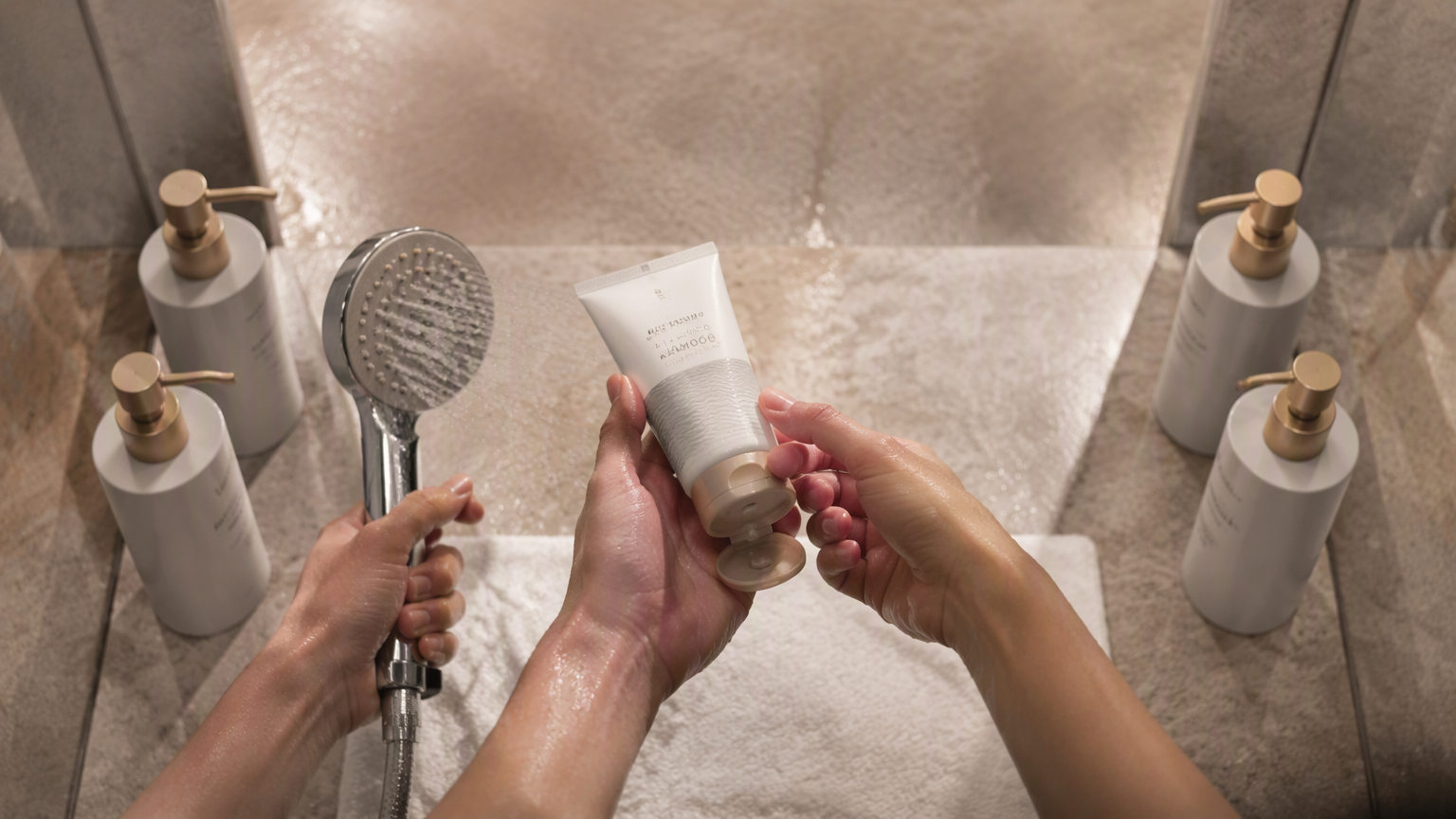
Housekeeping has noticed a change while inventorying bathroom amenities: guests no longer pick up bottles and pour into their palms. They habitually squeeze with one hand while the other hand still holds the showerhead. The dispensing logic of rigid toiletry bottles is built on the premise that both hands are free – a premise that almost never exists in a real bathroom. Tubes are returning to five-star hotels not because they are cheap, but because they change the dispensing action from two hands to one. This change is perceived by the body earlier than any formulation upgrade.
Guest Experience: In the Bathroom, Only One Hand Is Actually Free
One hand holds the showerhead, one hand dispenses. This is the real posture of the vast majority of guests.
Guests with long hair use more product and need to dispense three or four times repeatedly. The repeated action is amplified.
Unscrewing caps with wet hands has a low success rate – especially small-diameter round caps.
Once the cap is unscrewed, there is nowhere to put it. It ends up on the wet countertop or the floor.
Pump heads require palm force – and the palm is often holding a towel.
Guests using their teeth to bite open flip caps is direct evidence of packaging design failure.
These actions happen millions of times daily – yet rarely enter packaging review meetings.
Review meetings usually look at appearance and cost – not whether one wet hand can complete the action.
Product Competitiveness: The Four Actions of Rigid Bottles – Each Requires Two Hands
Pick up, unscrew, pour, put back. Two of these four actions require two hands.
Pouring dosage relies on feel. The first pour is always too much. The rinsed-away portion is never calculated.
Residue at the bottle opening runs down the body – becoming a sticky ring the next day.
After refilling, the seal between bottle opening and pump head is often inferior to the original.
Rigid bottles need thick bases to stand. Actual usable capacity is compressed.
Rigid bottles resist compression well in transport – but weight and volume are both higher.
The advantages of rigid bottles are stability and texture. This should not be denied.
Product Competitiveness: What Tubes Change Is Not Packaging – It Is the Action
The thumb-flip cap is the most critical design of a tube. It compresses the opening action into one joint.
Squeeze dispensing lets fingers control dosage. Guests with long hair no longer need to pour too much and rinse away.
Tubes can stand in a corner or hang on a rail. The countertop is freed up.
After being squeezed flat, volume decreases – easier to take in luggage.
Less residue at the tube opening – no sticky ring the next day.
Tubes are better suited to single-serve. One per person – stronger sense of belonging.
None of these changes involve the formula – yet they directly change guests' judgment of whether this set is easy to use.
Hotel Operations: The Change – From Refilling to Replacing
The refill process for rigid toiletry bottles is: retrieve bottle, rinse, dry, fill, label, return.
Tubes compress these six steps into one: take a new one and put it in.
After the refill process is shortened, the housekeeping turnover window is more easily met.
But tube inventory management is more demanding – more specifications, more colours, easy to mix up.
Rigid bottle shells can be reused; tubes cannot. This is a change in cost structure.
Tubes are vulnerable to compression in transport. Boxes need support, stacking heights must be reduced.
Aluminum tubes are more stable at low temperatures. Plastic tubes require confirmation of body toughness.
Replenishment shifts from counting by barrel to counting by unit. Inventory counting criteria must follow.
Product Competitiveness: Tubes Have Their Own Problems – Do Not Look at Only One Side
The problem of tubes not standing upright must be solved by shoulder design. Not all tubes can stand.
After the tube body is squeezed flat, appearance is compromised. Guest room display needs shaping.
Filling precision requirements are higher. Poor tail sealing causes leakage.
Labels wrinkle easily in wet areas. Lamination and material must be chosen correctly.
Tube recycling sorting is more complex than rigid bottles. Material simplification is important.
Single-serve tubes are harder to split-purchase for small properties.
These problems can all be solved – but must be raised at the sampling stage.
Product Competitiveness: Five Gates Tubes Must Pass
The first gate is opening force. Can the thumb flip it open in one motion – even with wet hands?
The second gate is squeezing force. Tube body too hard cannot be squeezed; too soft dispenses too much at once.
The third gate is seal strength. Tail sealing must withstand transport and compression.
The fourth gate is opening residue. The flip-cap structure determines whether it is clean the next day.
The fifth gate is standing and hanging. Shoulder angle and cap flat surface must be designed together.
Materials should prioritise biodegradable tube bodies and aluminum tubes – balancing texture and recycling.
The role of the container has shifted here – from a shell that holds things to a tool for dispensing.
Sampling must be tested by people with wet hands – not by people with dry hands in the sample room.
Profitability: One Smooth Dispensing Action Buys a Remembered Experience
The unit structure of tubes is different – but what truly changes is labour and turnover.
Shortened refill process means longer room availability. This is the most easily overlooked benefit.
One tube per person increases guests' trust in hygiene.
Takeaway tubes are natural传播 objects – more practical than cards.
The brand feel left by rigid bottles can be continued in tubes through body printing and materials.
The irritation from one unsmooth dispensing action gets recorded as the experience of the entire room.
The standardisation of tubes makes tiered configuration by room type easier to implement.
Five-star hotels using tubes is not a downgrade – provided the texture is right.
Product Competitiveness: What to Ask Clearly When Selecting a Supplier
Ask about opening force and squeezing force. Require testing with wet hands.
Ask about tail seal strength and transport testing conditions.
Ask about tube body material and recycling path. Single material where possible.
Ask whether both standing and hanging shoulder designs can be produced.
Ask about label tolerance in wet areas. The difference between lamination and transfer printing.
Ask about minimum order quantity and sampling cycle.
Request retention samples. Compare squeeze feel and opening residue batch by batch.
Frequently Asked Questions
Q: Are tubes being re-adopted because they are cheaper than rigid bottles?
A: No. The cost structure of tubes is not necessarily lower. The real reason is that the dispensing action better matches the real posture in the bathroom.
Q: Do tubes seem less premium?
A: Texture comes from tube body material, printing, and shoulder structure. Aluminum tubes and thick-wall tubes do not feel cheap in the hand.
Q: Can tubes be refilled?
A: Most tubes are not suitable for repeated filling. The tail seal is single-use. Reuse must be carried by large-capacity press bottles.
Q: Should guest rooms and bathhouses use the same type of tube?
A: Capacity and dispensing method can differ. Guest rooms use medium tubes. Bathhouses use single-serve small tubes. Tube type can be unified.
Browse our Custom Hotel Toiletry Set Wholesale Collection – from thumb-flip tubes to biodegradable tube bodies and aluminum tubes, and full private-label solutions, all covered in one stop. Our flexible production line supports small-batch orders with flexible MOQs.
latest articles
 Oct 20, 2026The Door Opens, and Scent Arrives Before Light – The Fragrance Speaks the Resort's First Sentence
 Oct 19, 2026Tube Toiletries Are Quietly Returning to Five-Star Hotels – Not Because They Are Cheap, but Because Guests' Way of Opening Bottles Has Changed
 Oct 15, 2026The One Hotel Detail Solo Travelers Care About Most: The Smell in the Room After the Lights Go Out
 Oct 13, 2026An Outdoor Hot Spring Fragrance Diffuser Left in the Rain All Night – Can It Still Be Used the Next Day?

Ask For A Quick Quote
If you are looking for more information on our services, or how we could potentially help, we would love to hear from you!