



Bulk Miniatures vs Refillable Dispensers: The Real Cost per Room
The choice between small bottles and refillable dispensers looks like an environmental statement on the surface. Underneath, it is a ledger question. Industry experience suggests that for properties with more than forty guest rooms, switching to refillable dispensers typically brings the amenity cost per occupied room-night down by 30% to 50%, with a payback period mostly within eighteen months. This article uses a real housekeeping amenity ledger to calculate both options down to the last line item, from four perspectives – guest experience, hotel operations, product competitiveness, and profitability – to help you judge which procurement route suits your property.
A Housekeeping Amenity Ledger
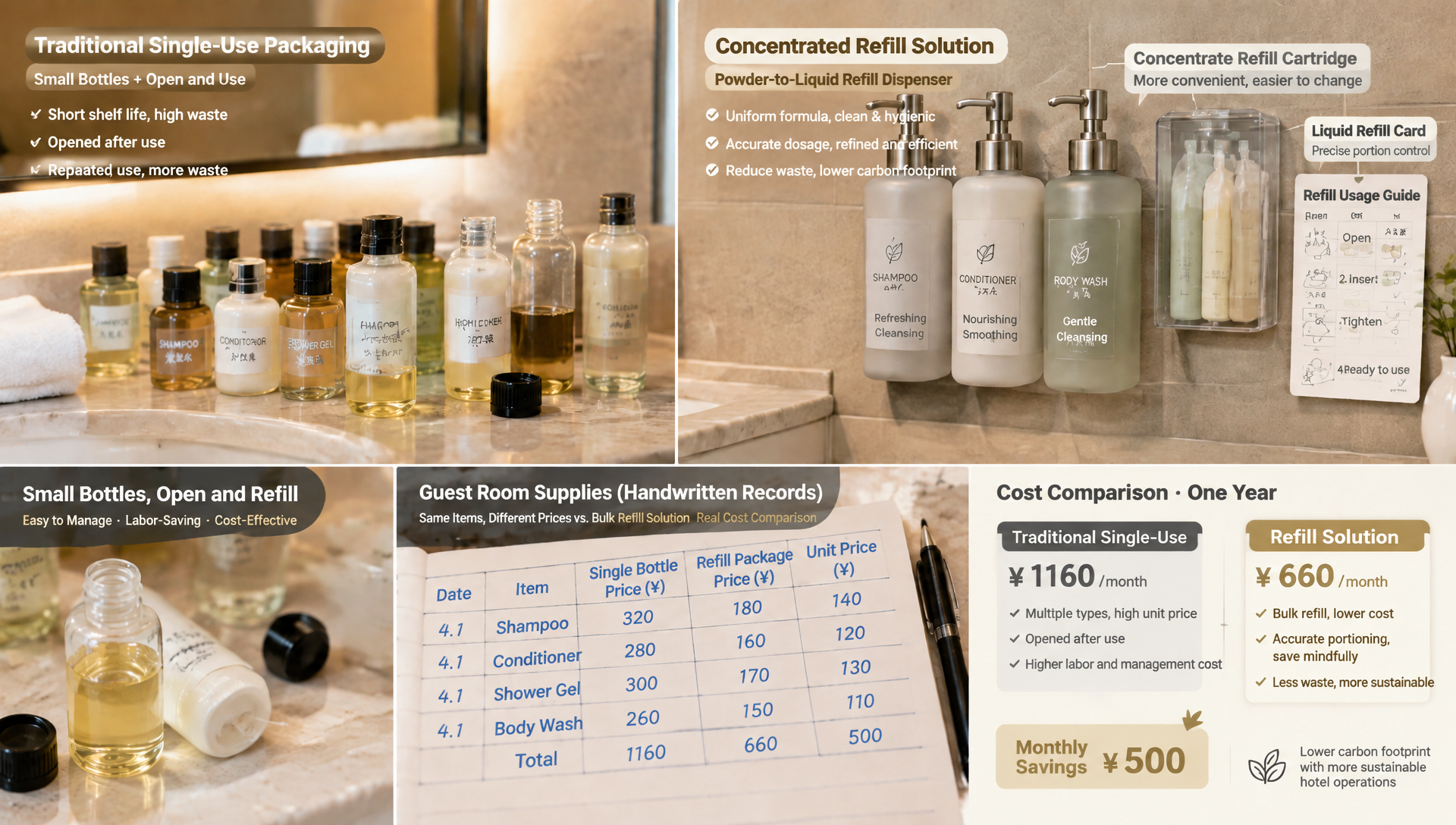
A housekeeping amenity ledger records the real consumption per occupied room-night. In the small-bottle option, three easily overlooked costs hide within the spending: the residual liquid discarded after opening but before use, the labour of handling and storage, and the work hours of replenishing item by item after checkout. The dispenser option has a different cost structure: a one-time hardware investment, followed by rolling purchases according to the refill-cartridge cycle. Only when both structures are placed in the same ledger does the gap become clear.
How to Calculate Amenity Cost per Occupied Room-Night
The numerator of this equation is the total amenity spending for the month. The denominator is the actual occupied room-nights for the month. The key is not the numerator but the line items. Miss one item, and the comparison becomes distorted.
Liquid consumption: calculated by signed sample weight multiplied by occupied room-nights.
Packaging loss: the small-bottle option includes the bottle body and paper card box.
Labour hours: replenishment, counting, and warehouse handling.
Discarded residue: the portion guests open but do not finish.
The Booked Difference Between the Two Options
The small-bottle option purchased through hotel toiletry bulk procurement channels often looks better on paper in the first year, because the hardware investment is deferred. Extend the observation period to three years, and the trend changes direction.
Guest Experience: Handfeel and Signal Each Hold a Chip
Guests' judgment of amenities is half based on handfeel. A dispenser fixed to the wall delivers a stable pump output. The packaging quality is carried by a frosted bottle and a metal pump head, making it feel more like a proper hotel than a small plastic bottle printed with a generic logo. The environmental signal also plays a role. More and more guests proactively mention reduced plastic waste in reviews. Dispensers turn this goodwill into something visible. Conversely, the small-bottle option wins on hygiene perception. Individually packaged and unopened, it is a source of reassurance for hygiene-conscious guests. Each option holds a different experience chip. The trade-off depends on the property's guest profile.
Hotel Operations: Reconstructing Movement Flow and Labour Hours
Housekeeping's movement flow is a hidden ledger. The small-bottle option means six to eight items must be replenished item by item at every checkout. During peak season, the cumulative replenishment hours are considerable. Refillable dispensers turn replenishment into cycle-based cartridge replacement, handled centrally by floor. The labour structure shifts from high-frequency fragmented work to low-frequency concentrated work. Risk also moves: cartridge replacement requires training, improper clip installation can cause leakage, and liquid-level checks must be added to room inspections. The housekeeping operations manual must be updated accordingly.
Product Competitiveness and Profitability: Volume Is the Watershed
From the factory perspective, the two production lines correspond to two types of competitiveness. The small-bottle line competes on filling scale and MOQ flexibility. The dispenser line competes on hardware design, tamper-proof structure, and cartridge compatibility. From the hotel profitability perspective, the value of dispensers lies in turning amenity cost per occupied room-night from a fluctuating value into a predictable one. Liquid is purchased by cartridge, usage follows a pattern, and there is no last-minute scramble for stock during peak season. The ranking improvement on booking platforms brought by better reviews turns environmental investment back into direct revenue. For small properties with fewer than forty rooms, the equation may reverse: the flexibility and low threshold of the small-bottle option may be more suitable. Room count is the watershed of this choice.
Selection Decision Checklist
For properties with more than forty rooms, prioritise calculating the payback period of the dispenser route.
For properties with fewer than thirty rooms or B&Bs, first use the small-bottle option to establish a consumption baseline.
For multi-property chains, unify dispenser hardware and keep cartridge specifications consistent across properties.
For premium positioning, choose frosted bottles with metal pump heads – the texture must match the room rate.
If budget is tight, adopt a hybrid transition: dispensers in public areas, small bottles retained in guest rooms.
Before deciding, pull the ledger from the past six months and use real data – do not decide by intuition.
Frequently Asked Questions
Q: Do dispensers raise hygiene concerns?
A: In proper solutions, the pump head and liquid path are enclosed. Replacing the cartridge replaces the entire segment. With regular housekeeping checks of liquid level and appearance, hygiene risk is controllable. This is also why premium hotels in Europe and North America widely adopt them.
Q: Do small bottles still have a price advantage?
A: In the short term, yes. Buying stock through hotel toiletry bulk procurement channels requires the lowest first-year investment, suitable for new openings or fast-turnover properties. But over three years, dispensers usually overtake.
Q: What is the typical payback period?
A: It depends on room count and occupancy rate. Industry experience is around eighteen months. The larger the room count and the more stable the occupancy, the faster the payback. Properties under forty rooms need separate calculation.
Q: Can the two options be mixed?
A: Yes. Use dispensers in public areas and gyms, retain small bottles in guest rooms. Or pilot on selected floors, establish the ledger, then roll out to the whole building.
Browse our Hotel Toiletry Wholesale Collection – from pump bottle packaging to formula R&D, and full private label solutions, all covered in one stop. Our flexible production line supports small-batch orders with flexible MOQs.
latest articles
 Oct 28, 2026Bulk Miniatures vs Refillable Dispensers: The Real Cost per Room
 Oct 26, 2026The Hotel's Theme Is Desert – Oceanic Notes Should Not Appear in Its Fragrance
 Oct 22, 2026Copying Lobby Fragrance Concentration into Guest Rooms Is the Most Common Mistake Luxury Hotels Make
 Oct 20, 2026The Door Opens, and Scent Arrives Before Light – The Fragrance Speaks the Resort's First Sentence

Ask For A Quick Quote
If you are looking for more information on our services, or how we could potentially help, we would love to hear from you!