



Copying Lobby Fragrance Concentration into Guest Rooms Is the Most Common Mistake Luxury Hotels Make
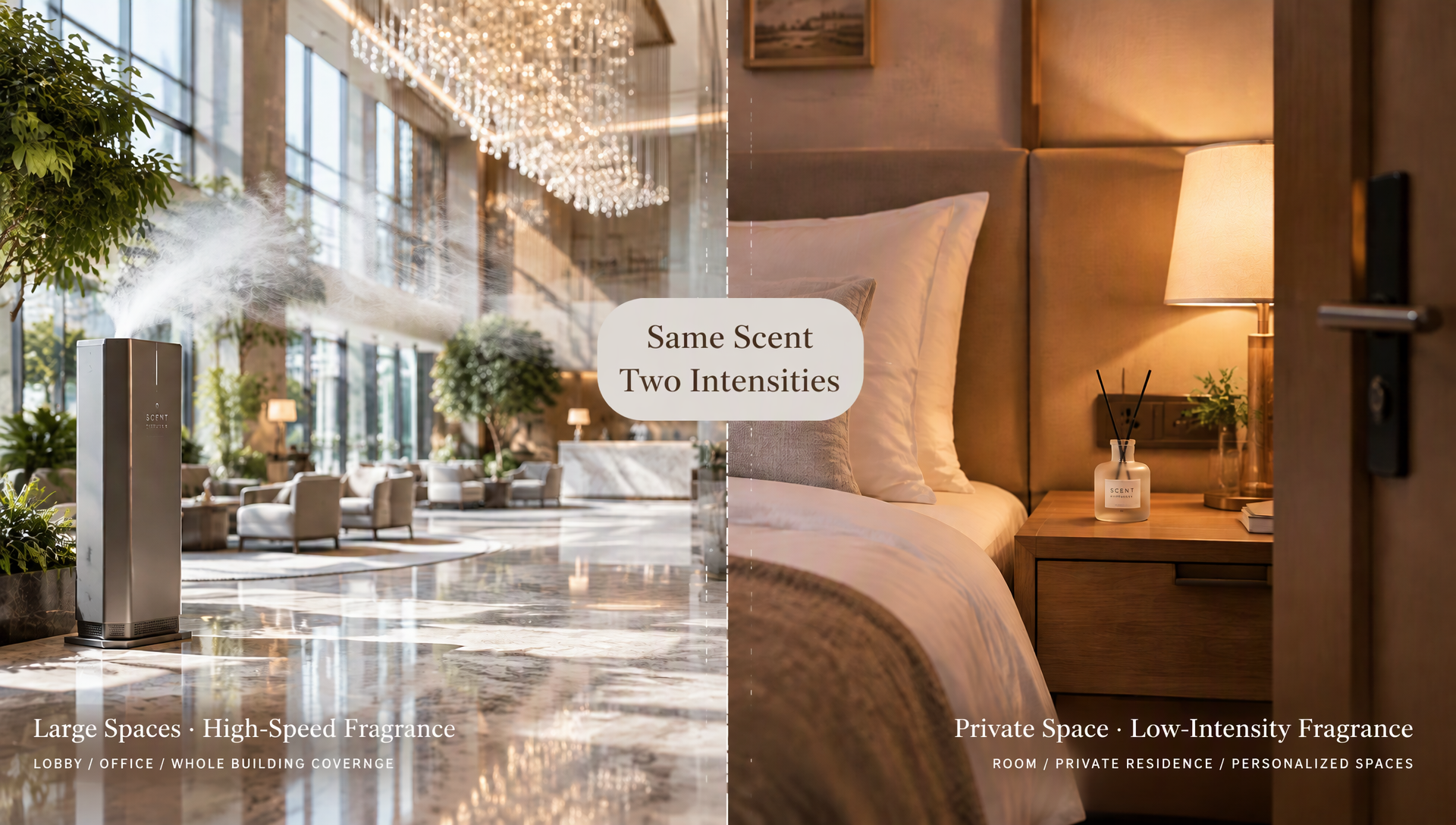
Luxury hotels are willing to invest in lobby fragrance – yet often copy the same concentration directly into guest rooms. The result: the lobby smells premium, the guest room smells stuffy. The lobby is an open space with ceilings dozens of metres high. The guest room is a closed box with the door shut overnight. The same concentration entering a guest room is like turning the volume up dozens of times. This article explains, from four perspectives – guest experience, hotel operations, product competitiveness, and profitability – the fragrance concentration gap between lobby and guest room, helping you avoid this most common and most easily overlooked mistake in your next smokeless fragrance solution.
Guest Experience: The Lobby's Fragrance Shouts; the Guest Room's Fragrance Can Only Whisper
The fragrance guests smell in the lobby is a version diluted many times over by air. Entering the guest room, the same fragrance has no such air to make way for it – opening the bottle is like playing the original recording. A guest room with excessive concentration will show three signals in sequence: the moment the door opens, the fragrance hits the nose sharply; after half an hour, guests begin to feel stuffy; the next morning, the curtains and bedding carry a bitter residual smell. The most frustrating part is that guests will not say "the fragrance is too strong." They will only write in a review "the room smelled uncomfortable," or simply request a room change. Behind that room change is an entire housekeeping re-inspection movement flow. Fragrance in the lobby is a bonus. Entering the guest room, it can become a penalty. The difference lies only in whether you have re-adjusted the concentration for the space.
Hotel Operations: The Bill for Excessive Concentration Arrives at Housekeeping at Month-End
Fragrance overdose is rarely reported as an operational issue. It always disguises itself as something else in the daily log. Guests complain the air is stuffy. Engineering checks the fresh air system – no problem found. In fact, the fragrance concentration has overpowered the ventilation's air-exchange feel. Guests request a room change. The front desk follows the full-occupancy procedure – but changing three rooms makes no difference, because the problem lies in the uniform setting of the refill devices. Bedding in the linen room absorbs odour, forcing washing frequency to increase – in fact, fragrance molecules have long since taken up residence in the fabric fibres. What housekeeping fears most is this type of complaint with no root cause. Each is handled as an individual case. At month-end, the summary reveals the room change rate quietly rising – and the true source is that diffusion device copying lobby parameters.
Product Competitiveness: The Air Volume of One Guest Room Differs from the Lobby by Dozens of Times
Most fragrance solution parameter sheets have only one concentration tier – because the equipment is selected together for lobby and public areas, and guest rooms get carried along. But the spatial difference is physical. Lobby air is diluted by ceiling height and airflow. Guest room air is breathed all night during sleep. People's tolerance threshold for odour in small spaces drops noticeably. The same fragrance is background in the lobby. Entering the guest room, it becomes the protagonist. And the protagonist should have the protagonist's volume. Adjusting concentration for guest rooms first requires acknowledging that this is not discounting the lobby solution – it is starting a separate parameter set. Carrier release rate, refill time window, top-middle-base note ratios – all must be recalculated for the small space.
Product Competitiveness: Concentration Tiering Is the True Threshold of Fragrance Customisation
A mature solution makes the same fragrance into a tiered product line – not one bottle for everywhere.
Lobby tier. High release rate. Spreads through public areas with airflow. The more foot traffic, the more stable.
Circulation tier. Medium rate. Handles fragrance connection between elevators and corridors. Avoids discontinuity.
Guest room tier. Low-rate slow release. Works silently at night. Fades just right by morning.
Fabric tier. Overnight-friendly formula. No bitter base note. No staining of bedding and curtains.
Refill tier. Guests can adjust themselves. Less fragrance – fewer reeds. More fragrance – full reeds.
Sampling tier. Retention cards at the sampling stage. Same fragrance in three concentrations for overnight comparison.
When we sample for hotels, we first request a list of room volumes and ventilation methods. The same fragrance in a guest room with a fresh air system and one with natural window ventilation requires concentration parameters one tier apart. This is the engineering part that distinguishes smokeless fragrance from generic perfume.
Product Competitiveness: A Table Showing Concentration Strategies for Four Spaces
Profitability: When Fragrance Is Right, the Guest Room Becomes a Communication Position
The lobby's fragrance is responsible for making guests take photos. The guest room's fragrance is responsible for making guests want to return. The most valuable type of review is "the room smelled wonderful." It means guests stayed all night in a small space and what remained was goodwill. This is closer to repeat booking than any lobby wow moment. Conversely, an overly fragrant guest room only harvests room change requests and early checkouts. The guest room's fragrance is also the quietest communication position. The thought of buying the same fragrance home often arises the next morning when putting on a coat – the coat carries just the right base note. Getting the guest room concentration right is like installing an invisible reputation device in every room. Investment does not increase – only the parameters change.
Frequently Asked Questions
Q: Can the lobby and guest room use the same fragrance?
A: Yes. The same fragrance can be output in tiers. The lobby uses the high-rate tier to cover public areas. The guest room uses the low-rate slow-release tier. Fragrance memory stays unified – concentration adapts separately.
Q: How do I quickly remedy an overly fragrant guest room?
A: First stop the refill device and open windows to disperse. Then ventilate bedding and curtains separately. Before reusing, test with guest room tier parameters at low dose for one night. Confirm feedback before finalising the tier.
Q: Can small hotels implement concentration tiering?
A: Yes. Sample by room volume and ventilation method in tiers. First request retention cards for overnight testing. Confirm the base note does not turn bitter before finalising parameters.
Q: What carrier is suitable for guest room diffusion?
A: Reed slow release suits silent operation. Plug-in models suit adjustable tiers. Both carriers can be customised to guest room tier parameters and mixed by room type.
Whether you operate a city luxury hotel or a mountain resort B&B, the lobby's fragrance handles the first opening line. The guest room's fragrance handles the last night's memory. Browse our Smokeless Fragrance Collection – from lobby diffusion to guest room reeds and refills, and full private-label solutions, all covered in one stop. Our flexible production line supports small-batch orders with flexible MOQs. Every product has passed tiered concentration and overnight retention testing.
latest articles
 Oct 22, 2026Copying Lobby Fragrance Concentration into Guest Rooms Is the Most Common Mistake Luxury Hotels Make
 Oct 20, 2026The Door Opens, and Scent Arrives Before Light – The Fragrance Speaks the Resort's First Sentence
 Oct 19, 2026Tube Toiletries Are Quietly Returning to Five-Star Hotels – Not Because They Are Cheap, but Because Guests' Way of Opening Bottles Has Changed
 Oct 15, 2026The One Hotel Detail Solo Travelers Care About Most: The Smell in the Room After the Lights Go Out
Ask For A Quick Quote
If you are looking for more information on our services, or how we could potentially help, we would love to hear from you!