



Frosted, Glossy, Pearlescent – Three Surface Finishes Deliver Completely Different Visual Effects Under Hotel Bathroom Lighting
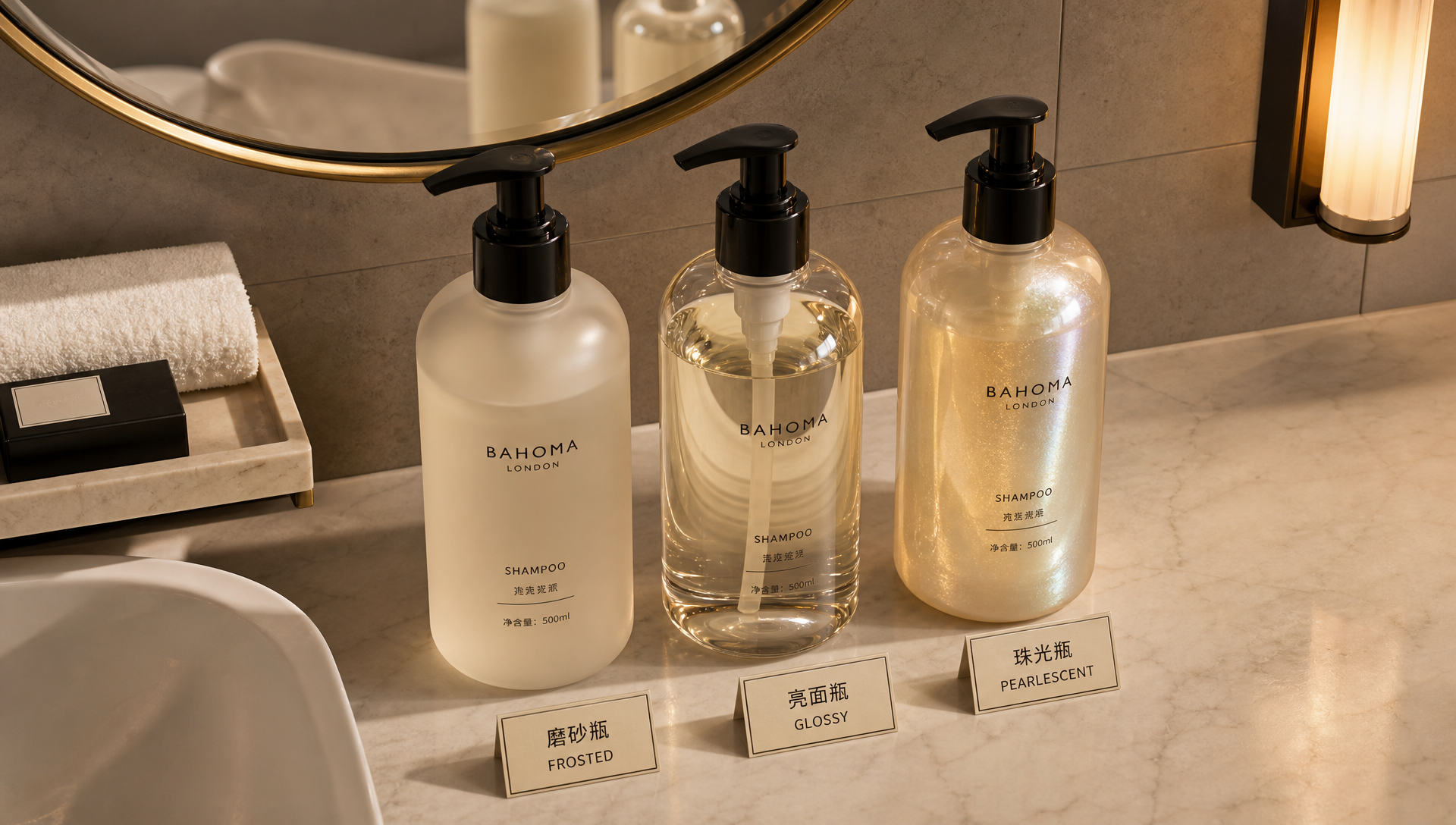
We filled three bottles of the same shampoo into three different surface finishes – frosted, glossy, and pearlescent – and observed them under three hotel bathroom lighting scenarios: overhead direct light, mirror light fill, and low evening illumination. The core finding: with the exact same formulation, guests' perception of quality was almost entirely determined by the bottle surface. Lighting amplifies the surface finish – frosted bottles appear quiet and premium under warm white light, glossy bottles reflect every reflection from the mirror into the bottle body, and pearlescent bottles deliver a custom-grade soft glow. Yet the cost difference between the three finishes is minimal.
Guests judge toiletries before they even unscrew the cap – and the judgment happens right there under the bathroom light. Frosted bottles completely conceal the contents – liquid level, colour depth, and any sediment are hidden – visually the most stable, giving guests a clean, crisp impression. Glossy bottles, under the mirror light, reflect the entire bathroom back onto the bottle – tile lines, water spots, and overhead light tubes all become bright spots on the bottle. Guests cannot pinpoint what is wrong, but the bottle looks dirty. Pearlescent bottles shift their shimmer with the viewing angle, like the inside of a seashell – the first glance already signals that this is not cheap. All three bottles contain the same shampoo. Frosted looks clean, glossy looks transparent, pearlescent looks premium. The guest's psychological expectation of the same formulation is completely different – and that is the power of bottle surface finish.
The blind spot on the hotel operations side is even larger. Procurement specs list material, capacity, and pump head – rarely the surface finish. Quality inspection reports only measure dimensions and weight. Glossy bottles are most susceptible to fingerprints and soap scum – housekeeping must wipe them one extra time daily, and bathroom humidity makes the stains even more visible. Frosted bottles hide dirt better, but once oily stains adhere, they are hard to clean – leaving shiny water marks in the wiped areas. Pearlescent bottles have batch-to-batch variation in masterbatch concentration – one batch may look grey, another greasy. Two different appearances in the same row of guest rooms lead to complaints that are hard to trace. Lighting differences amplify the problem – the same bottle looks like two different products in south-facing vs north-facing rooms, a contrast that quality inspection never catches.
Surface finish is not an appearance issue – it is an optical issue. Performance under different lighting must be evaluated separately. The lighting comparison for the three bottles is as follows.
Lighting matching is a deeper consideration. Under mirror light, the pearlescent finish shows its shifting shimmer most clearly – exactly where guests' eyes naturally fall when looking in the mirror. Under overhead diffused light, the frosted finish delivers its quiet presence most effectively – the bathroom looks tidy and uncluttered. Glossy finishes suffer the most under low illumination – with only the wall sconce on in the evening, the highlight spots disappear, and the bottle becomes a dull dark block – exactly why glossy bottles look aged in dim older bathrooms. The same bottle, placed in different lighting environments, looks a full grade different.
From a hotel profitability perspective, the calculation should be on perceived value, not process cost. With the same shampoo, a different surface finish changes the guest's judgment of the room's quality grade – and that judgment goes directly into reviews. The cost impact of pearlescent masterbatch on each bottle is minimal, yet it achieves a near-custom look – this is spending money where guests can see it. Frosted bottles do not add an extra millilitre of shampoo – but they make guests feel this product is reliable. Surface finish determines whether guests want to give a positive review – it is perceived value, not process parameters – and perceived value is precisely where hotels should spend small money for big returns.
To test which surface finish works best with your bathroom lighting, send us a batch of empty bottles. We will fill them with the same shampoo, place them under your actual bathroom lighting for comparison, and have both your housekeeping manager and guests rate them separately. A visual comparison report will be ready in seven days.
Frequently Asked Questions
Q: Will frosted bottles make guests think there is less shampoo?
A: No. Frosted bottles completely conceal the contents – guests cannot see the liquid level, so they do not worry about quantity. This is precisely why many hotels choose frosted bottles.
Q: Will the pearlescent effect be uneven?
A: The pearlescent effect is determined by both masterbatch concentration and injection moulding process. When concentration is kept within a stable range, the same batch will have consistent appearance. We recommend confirming the target gloss level through sampling before mass production.
Q: How can the fingerprint issue on glossy bottles be addressed?
A: Glossy bottles can be paired with frosted labels to reduce visual contrast, or repositioned away from direct mirror light. Cleaning frequency will be slightly higher than for frosted bottles.
Q: Is the cost difference between the three surface finishes significant?
A: For the same material and capacity, the cost impact of surface finish on each bottle is minimal. Pearlescent masterbatch is slightly higher; frosted and glossy are essentially the same. The gap in perceived value is far greater than the cost gap.
latest articles
 Sep 01, 2026Frosted, Glossy, Pearlescent – Three Surface Finishes Deliver Completely Different Visual Effects Under Hotel Bathroom Lighting
 Aug 28, 2026Sealed 48-Hour Bottle Odor Test: Why Do Some Bottles Smell "Clean"?
 Aug 26, 2026When Hotel LOGOs Disappear from Bottles, Leaving Only a Color Block – The "De‑Branding" Trend in Premium Toiletries and the Brand Confidence Behind It
 Aug 24, 2026Hotel Bathroom Humidity Stays Above 70% Year-Round – Is the Bacterial Count on Your Shampoo Bottle Surface Up to Standard?
Ask For A Quick Quote
If you are looking for more information on our services, or how we could potentially help, we would love to hear from you!