



Sealed 48-Hour Bottle Odor Test: Why Do Some Bottles Smell "Clean"?
We filled five shampoo bottles of different materials and processes with the same batch of shampoo, sealed them, and opened each one after 48 hours. The result: the strongest odours did not come from the plastic – they came from the seal rings and adhesives. The bottles that truly smelled "clean" relied not on extra wiping before filling, but on raw material grade, demoulding process, and seal structure – all the invisible details. This article breaks down the three-second scent judgment when opening a shampoo bottle from four perspectives – guest experience pain points, hotel operational pain points, product competitiveness, and hotel profitability – to help procurement managers allocate budgets to the critical parts of the bottle.
Five Bottles, 48 Hours
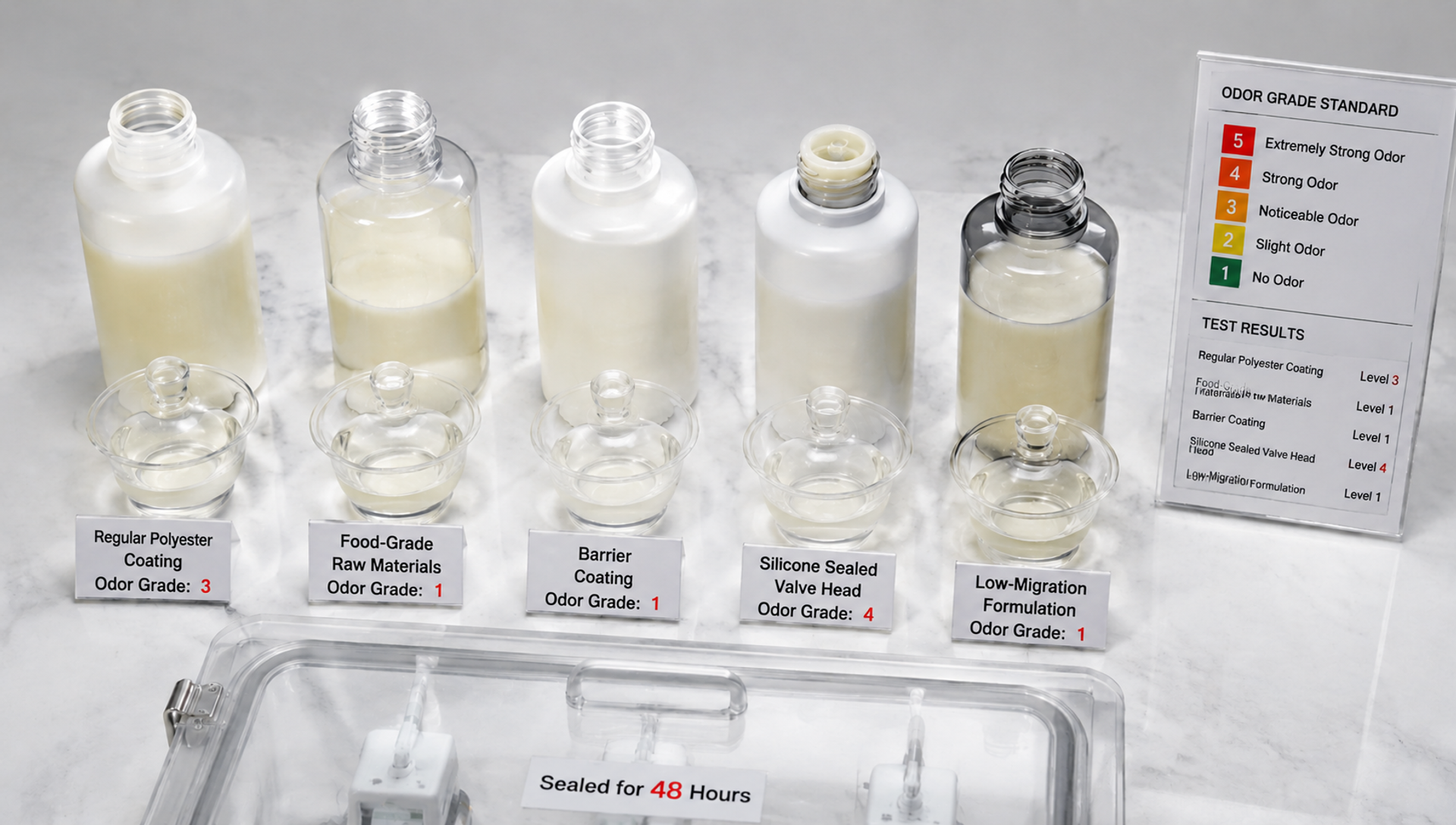
The experiment was designed to be as realistic as possible. Five bottles from different processes were filled with the same batch of shampoo, sealed at the same time, and placed in a room-temperature warehouse for 48 hours. At the moment of opening, five housekeeping staff independently recorded what they smelled in the first three seconds – without discussing with each other.
The five bottles were: standard polypropylene, food-grade material, barrier inner coating, silicone seal ring pump head, and low-migration formula. The results were more concentrated than expected.
Standard polypropylene – a faint plastic musty odour upon opening, like a newly unsealed storage box.
Food-grade material – almost odourless, only a neutral trace detectable close to the opening.
Barrier inner coating – odourless and the most stable, but with the highest process cost.
Silicone seal ring pump head – the biggest surprise of the test – the rubber odour was the most prominent, even overpowering the bottle material itself.
Low-migration formula – close to odourless, with a clean finish.
The ranking of odour sources is clear: seal ring rubber comes first, followed by label adhesive, and finally bottle material volatiles. In other words, whether a bottle smells clean depends not largely on the bottle itself – but on that small, easily overlooked seal ring.
Guest Experience Pain Points: In Three Seconds of Opening, Guests Have Already Scored the Bottle
In the three seconds guests take to open the shampoo bottle, they are not smelling the fragrance – they are scoring the bottle. A plastic musty smell directly equals "cheap." A rubber smell equals "unhygienic." No matter how good the shampoo inside, the odour has already made the conclusion – and that conclusion is hard to reverse with the subsequent experience.
Even more problematic is migration. Under sealed conditions, odour molecules released from the inner wall slowly dissolve into the shampoo. The longer it sits, the more the shampoo takes on the bottle's scent. Hotel warehouse stock and guest room turnover bottles often sit for more than half a month – by the time guests use them, they smell the designed fragrance mixed with a hint of the bottle. Guests attribute the fragrance complaint to the brand and product – when the problem is actually the bottle that contains it.
This is especially critical for hotels with premium fragrances. The more refined the fragrance, the more vulnerable it is to interference – like a speck of dust in a cup of clean tea.
Hotel Operational Pain Points: Batch Variation – Quality Control Staff Are the First to Smell It
When opening a new delivery, the staff responsible for quality control can directly smell batch differences. Some batches have a heavier musty odour – others are almost odourless. Complaints are always concentrated on the same batch – because that batch used a different raw material supplier, or the demoulding curing time was insufficient, sealing the odour into the bottle during filling and sealing.
The problem is that odour issues are invisible on the procurement side. Quality inspection sheets do not include an odour column. Sample reports only test capacity and appearance. By the time guests complain, the hotel realises a particular batch of bottles has a problem. The return/exchange cycle takes two to three weeks – during which the hotel has to substitute with other bottles. Guests are far more sensitive to temporary brand substitutions than we imagine.
There is a more insidious trap some hotels have stepped into: sourcing from different suppliers to cover shortages. Two different batches of bottles sit side by side in the same row of guest rooms – one clean, one musty – and guests can tell the difference just walking down the corridor. Batch consistency is the most easily overlooked requirement in bottle procurement.
Product Competitiveness: Odour Is the Sum of Process Details
Whether a bottle smells clean is the product of four variables: raw material grade, demoulding curing time, seal ring material, and label adhesive用量. Cutting corners on any one of these will be exposed in a 48-hour sealed test.
There is a counterintuitive conclusion worth noting: the most expensive solution does not necessarily have the best odour performance – and the cheapest solution does not necessarily have the worst. Both the barrier inner coating and low-migration formula are close to odourless – but the silicone seal ring pump head, at a mid-range price point, had the strongest odour because of that seal ring. This shows that the cost-effective point for odour management lies in the seal ring and demoulding process – not in blindly stacking materials.
Another overlooked detail is demoulding curing time. The same batch of material – cured for 48 hours before filling vs filled immediately after demoulding – shows a very clear difference in opening odour. This is a time cost in the process that does not appear in the unit price – but directly determines the guest's three-second judgment.
Hotel Profitability: Spending Money on the Invisible Seal Ring
Shifting budget from bottle wall thickness to seal ring material and demoulding process increases cost only slightly – but significantly reduces complaint risk. This is a classic low-investment, high-perception improvement – because guests contact the bottle at least three times a day, and the odour is the one experience point that is verified every single time.
Look at the lifecycle ledger. A bottle's lifespan in a guest room – from filling to empty – often spans dozens of days, most of which is spent in a sealed state. The hidden cost of one odour-related negative review – including customer service handling, replacement shipping, and the guest experience rating drop – far exceeds the cost of switching to a low-odour seal ring. This ledger is hard to calculate directly at the procurement negotiating table – but it is clearly visible in guest complaint records.
For hotels planning fragrance differentiation, low-odour materials are a prerequisite. No matter how complex the fragrance, a single layer of bottle odour ruins it. Conversely, a clean bottle supports a richer fragrance structure – letting guests remember the scent the brand wants them to remember. From monthly procurement reviews to seasonal fragrance changes, making odour testing a routine step for every incoming batch can intercept most problems before complaints occur.
Frequently Asked Questions
Q: How is the odour inside a sealed bottle produced?
A: It comes from three main sources: seal ring rubber, label adhesive, and bottle material volatiles. Under sealed conditions, these are trapped inside the bottle – concentration rises over time and dissolves into the shampoo. The longer it sits, the more noticeable it becomes.
Q: Why do some bottles in the same batch have a heavy musty odour while others are almost odourless?
A: Usually due to insufficient demoulding curing time or raw material batch variation. The odour is already present in the bottle wall before filling – once the cap is sealed, it is all trapped inside.
Q: How can I assess a bottle's odour risk when procuring?
A: Ask the supplier for sealed samples – fill them, seal for 48 hours, then open and compare. This step can screen out most problematic batches.
Q: Will switching to low-odour bottles affect fragrance performance?
A: No. Low-odour materials actually make the fragrance cleaner – guests smell the designed scent, not the bottle's scent.
Before your next order, ask the supplier to send empty bottles. Fill them with your own shampoo, seal them for 48 hours, and then open them. The three-second odour is the first impression your guests will have of you.
latest articles
 Aug 28, 2026Sealed 48-Hour Bottle Odor Test: Why Do Some Bottles Smell "Clean"?
 Aug 26, 2026When Hotel LOGOs Disappear from Bottles, Leaving Only a Color Block – The "De‑Branding" Trend in Premium Toiletries and the Brand Confidence Behind It
 Aug 24, 2026Hotel Bathroom Humidity Stays Above 70% Year-Round – Is the Bacterial Count on Your Shampoo Bottle Surface Up to Standard?
 Aug 20, 2026When Guests Still Smell Your Hotel Lobby Scent on Their Clothes After Returning Home – That's the Repeat-Booking Driver of a Signature Scent
Ask For A Quick Quote
If you are looking for more information on our services, or how we could potentially help, we would love to hear from you!