



Hot Spring Resort Fragrance Guide: No Open Flame, Still Beautifully Scented
There's an interesting observation. Have you ever smelled a burning candle in the lobby of a hot spring resort? Probably not. It's not a budget issue, nor is it that procurement forgot — it's that the hot spring environment and open flames share a physical boundary that will never intersect. Humidity, ventilation, wood‑structure fire codes, guest safety as they walk from the poolside to the lounge in bathrobes — so many variables叠加 together that candles, the simplest fragrance solution, are effectively removed from the options list. Yet this does not stop the best hot spring resorts from letting you smell, within three seconds of entering the lobby, a scent that belongs exclusively to that space — not too strong, not too light, consistently present.
This is the domain of flame‑free fragrance, and among all flame‑free solutions, the reed diffuser is a severely underestimated category.
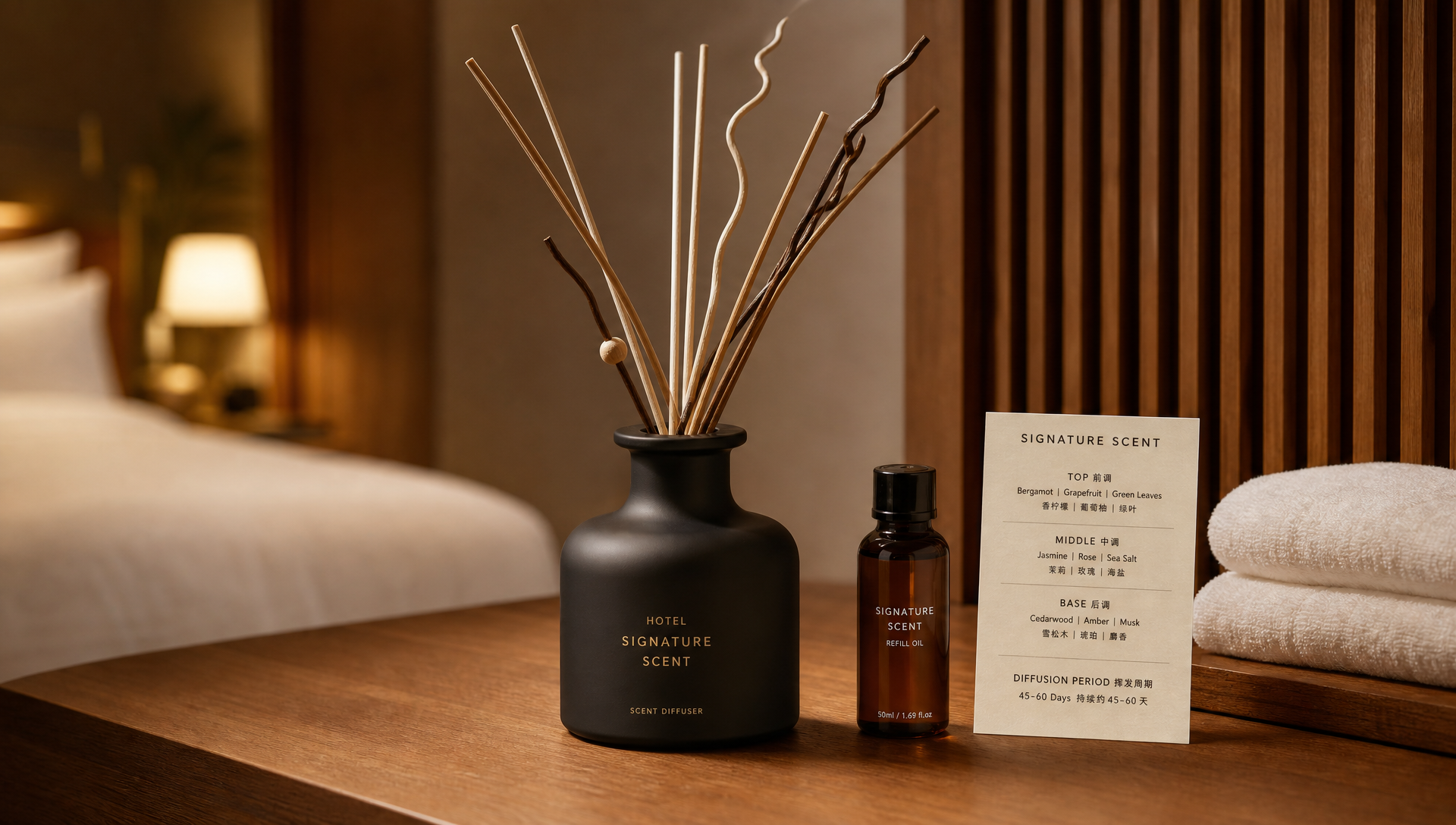
The working principle of a reed diffuser is so simple it seems unlikely to command a premium price. A bottle containing a blend of essential oils and solvent, a bundle of reeds inserted — the liquid climbs the reeds through capillary action to the tips, where it volatilizes into the air. No electricity, no heat source, no ultrasonic vibrating plate, no consumables requiring regular replacement. It works twenty‑four hours a day, seven days a week — intensity is consistent, coverage is stable, and maintenance cost is virtually zero. For a 200‑room hot spring resort, placing one in the lobby, corridors, elevator lobbies, SPA reception, changing rooms, and the entryway of each guestroom builds the entire space's olfactory system — no construction wiring, no concentration dial adjustments, no training housekeeping staff to operate equipment. Place it, add liquid, done.
But for such a simple device, there are a surprising number of details worth careful unpacking from a procurement perspective.
Let us start with the reed diffuser base. Most people focus on which essential oils are in the bottle, but the backbone of the entire reed diffuser is the base — the colorless, odorless liquid. A poor‑quality base is industrial‑grade dipropylene glycol with cheap volatile alcohols. The evaporation curve of this formulation is very aggressive in the first 72 hours — it seems to "diffuse strongly" — but after one week, the curve drops precipitously. The light components have evaporated, and the remaining heavy solvents, combined with the swollen reeds, resemble a straw that is half‑sucked and clogged — the capillary pathways are completely blocked. A good reed diffuser base uses natural plant‑derived solvents that have undergone molecular‑weight screening, combined with微量 antioxidant stabilizers and surface‑tension regulators, allowing the evaporation curve to remain nearly flat for 30‑60 days. This is not about how expensive the essential oils are — it is about the fact that the reed diffuser base itself requires R&D investment to formulate. The essential difference between a high‑end reed diffuser and a supermarket air freshener is seventy percent in the base.
The quality of the diffuser reeds themselves is another silent contest. The gap between natural rattan reeds and synthetic fiber sticks becomes evident by the third week. Natural rattan has a branched, non‑linear channel structure — as liquid moves upward, it forms micro‑eddies at each branch node, bringing aromatic molecules more fully to the air interface. Synthetic fiber sticks have parallel channels formed by straight‑line extrusion — liquid reaches the top and accumulates, volatilizing across a very small cross‑section — strong enough to be overpowering in the first half of the week, nearly undetectable in the second. Good natural rattan goes through four processes: peeling, drying, density‑range screening, and beveling — with diameter controlled at 2.8‑3.2mm, length approximately 25‑30cm, and six to eight reeds recommended per bottle, adjustable based on space size and desired evaporation intensity. Poor synthetic reeds may look similar when inserted, but two months later, you will find them softened, bent, tilting at the bottle mouth — the entire diffuser's premium feel collapses in that instant.
Next: a mistake almost every hot spring resort makes when procuring reed diffusers — using the right fragrance in the lobby but the wrong one in guestrooms.
Guestrooms are where guests spend the most time in a hot spring resort — an average of five to eight hours. This duration dictates that guestroom fragrances require a completely different diffusion strategy from public areas. Public area reed diffusers need penetration and distinctiveness — the moment guests push the door open, the scent is an unmistakable brand language. But guestroom fragrance needs low presence, high comfort, and most importantly, it must not make guests want to turn it off before bed. If you take that white‑floral reed diffuser from the lobby and place it directly on the guestroom nightstand, guests will toss and turn at 2 AM with inexplicable irritation — and they will never realize the reed diffuser is the cause.
This is why custom reed diffuser in hot spring resort procurement is not a "do we print a logo or not" question — it is an entire selection logic. Public areas: choose high‑volatility citrus or green‑note mid‑top formulas, bottle height no less than 30cm, eight to ten reeds — the visual volume needs to hold the spaciousness of a high‑ceiling lobby. Guestrooms: choose base‑note‑heavy woody or musk‑based calming formulas, bottle height controlled at 15‑18cm, four to six reeds — unobtrusive wherever placed, but guests always feel "this room smells wonderful." SPA rooms and front lounge are a middle ground — an olfactory attitude that is neither too assertive nor completely yielding — herbaceous and light white‑floral families tend to score highest here.
From a procurement specification perspective, a 200‑room hot spring resort typically requires three to four different fragrance formulas, two to three different bottle sizes and capacities, and at least one refill delivery per quarter. If you also want a retail corner where guests can purchase the same reed diffuser gift set, you will need a separate small‑bottle retail packaging line distinct from the guestroom version. This is why more and more resort procurement professionals are moving from standard off‑the‑shelf products to reed diffuser sets customized — because standard products can never simultaneously satisfy the penetration needed for the lobby, the low disruption needed for guestrooms, and the refinement needed for retail. A well‑designed reed diffuser sets customized solution should offer three to four visually consistent but specification‑different products under the same brand visual system, giving each layer of the resort the corresponding olfactory configuration.
The empty reed diffuser bottle with gift box deserves a dedicated paragraph. Reed diffusers have long been categorized under "consumables" on hotel procurement lists — because most of their use scenarios are indeed consumable: placed in guestrooms or public areas, refilled every six months. But one scenario elevates them from consumable to retail item: when guests, the night before checkout, realize that the scent from the reed diffuser by the bed overlaps with all the comfort they have felt entering and leaving the room over the past two days. They want to take that feeling home. And what you offer them is an independently packaged empty reed diffuser bottle with gift box — the resort's logo foil‑stamped on the box, containing one refill bottle of the same fragrance used in guestrooms, six individually sealed premium natural reeds, and a small card with diffusion range, recommended placement, and usage duration. This is not an additional purchase — it is an olfactory souvenir. Of all five human senses, olfactory memory has the longest retention and the most precise emotional recall — twenty years later, a guest encountering the same fragrance will instantly return to that hot spring poolside.
Bottle material selection is another variable often overlooked but critical to pricing and positioning. Glass reed diffusers are currently the mainstream choice in the hotel supplies ecosystem — the reasons are straightforward: high transparency makes it easy for staff to visually check remaining liquid levels; rounded‑edge cutting technology is mature; amber and frosted gray are the two mainstream color options that suit almost all resort interior styles; and unit costs are controllable. The downsides: weight is relatively high; breakage rates during long‑distance shipping — without adequate protective packaging — run approximately 2‑5%; and in summer, prolonged exposure to direct sunlight on windowsills can cause certain essential oil components in the liquid to undergo photo‑oxidation catalyzed by UV light. A well‑designed glass reed diffuser placed on a guestroom entryway console has a remarkably subtle presence — it does not compete for attention, but you will notice it catches the light.
As for the candle and reed diffuser gift set combination — that is another interesting topic. Earlier, we noted that the hot spring environment itself is unsuitable for any open flame — but guests' rooms are not limited to the "in‑room" scenario. Many hot spring resorts feature detached or semi‑detached courtyard‑style guestrooms with a private outdoor hot spring pool and a small garden. In winter, guests sit on the heated stone bench in the courtyard, with a scented candle lit beside them, a cup of hot tea in hand, stars overhead, and the steaming hot spring pool at their feet. In this scenario, a candle is not a safety hazard — it is an essential part of the ritual. So a candle and reed diffuser gift set in this room type is not an unnecessary addition — it closes the loop between indoor and outdoor fragrance experiences: the reed diffuser provides a continuous base note in the room, while the candle creates a highlight moment in the courtyard. We have seen resorts that include the candle and reed diffuser gift set as a standard configuration for premium room types rather than an upgrade — and the result is that negative reviews about scent for that room type are almost nonexistent on OTA platforms.
The potential of home fragrance reed diffusers in the hotel retail segment is severely underestimated. A data point: among the自有 retail revenue of premium North American resort brands, fragrance products rank in the top three in the non‑food category —仅次于 bathrobes and bed linens. The Asian market follows a similar trajectory but started slightly later — coastal hot spring resorts are now beginning to show the early signs of "olfactory retail": when guests see the same home fragrance reed diffusers on the display shelf opposite the front desk at checkout, without any sales pitch, one‑third of them will stop to pick up a bottle and smell the opening — and a considerable proportion will place it in their shopping basket. Because this is the only item from the entire stay experience that can be taken home unchanged. Bathrobes are too large to fit in a carry‑on; bed linens are too heavy to check; but a 100ml reed diffuser can slip into a bag in three seconds — and a week after you return home, it is still replaying that vacation memory for you, continuously.
Now, returning to the supply chain side. Why do most resorts' reed diffuser programs ultimately fail? Not because the products are poor — but because the procurement path is too fragmented. The bottles come from one supplier, the reeds from another, the refill liquid from a third supplier on a quarterly chase basis, the gift boxes from a fourth for custom dieline cutting — and then you have to assemble everything yourself. Five links, four suppliers, three payment terms, two logistics systems — the procurement department spends as much time coordinating this category as managing an entire guestroom linen category. This is why more and more resorts are seeking suppliers with full‑category coverage — amenities manufacturers and toiletries manufacturers — from shampoo, body wash, and lotion to reed diffusers, guestroom slippers, and bathrobes — all through a single supplier portal.
A truly knowledgeable amenities manufacturer or toiletries manufacturer who understands hot spring scenarios will not start by flipping through a product catalog when recommending a reed diffuser solution. They should first ask you six questions. What is your lobby ceiling height, and which direction has the greatest natural ventilation? What is the average guestroom size, and does it include a private hot spring pool and outdoor courtyard? Is your SPA self‑operated or outsourced — and if outsourced, is the SPA fragrance system handled separately or jointly? What is your guest demographic — primarily younger couples and friend groups, or middle‑aged families and senior travelers? Do you have a retail display area, and where is it located — with peak traffic during checkout or during evening hot spring closing hours? Have you used other brands of reed diffusers before, and have guests ever commented that the scent was too strong, too weak, or completely unnoticeable?
The answers to these six questions will lead to a completely different solution. You do not need the "best reed diffuser" — you need a complete olfactory system that matches your building's spatial character, diffuses along your natural ventilation patterns, adapts to your guests' olfactory preferences, and creates value simultaneously on the operational and retail ends.
Below are the questions we are most frequently asked in this category.
Q: How long does a bottle of reed diffuser last? Under normal indoor temperature and humidity conditions, a 100ml standard bottle with six natural reeds has an effective diffusion period of approximately 45‑60 days. A 200ml large bottle with eight reeds lasts approximately 70‑90 days. Actual performance is influenced by air circulation, space volume, and environmental humidity. The high‑humidity environment of hot spring areas typically accelerates liquid consumption by 10‑15%, but scent diffusion uniformity is actually higher.
Q: Do diffuser reeds need to be flipped? We recommend flipping the reeds every two weeks — reversing the fully saturated ends back into the bottle to keep the capillary delivery pathways clear. Frequent flipping — for example, every two to three days — will actually accelerate excessive liquid evaporation and shorten total usage duration.
Q: What is the minimum order quantity for custom bottle designs? Custom reed diffusers fall under deep customization. For glass reed diffusers with custom glaze colors and silk‑screened logos, the MOQ is typically 3,000‑5,000 units — mold opening fees for custom shapes are separate, with a lead time of 45‑60 days. Refill liquid, reeds, and gift box packaging can be ordered independently of the bottles, with flexible combinations.
Q: What exactly is the difference between a high‑end reed diffuser and an ordinary one? Three things: the stability of the reed diffuser base formulation, the purity and complexity of the essential oils, and the natural capillary quality of the diffuser reeds. A poor‑quality base will make a $30 essential oil perform like a $3 product. A poor‑quality reed will render both the base and essential oil investments wasted. On the premium version, there are no corners to cut on these three elements.
Q: What size area does a bottle of reed diffuser cover? Using a standard 100ml bottle with six natural reeds as a reference — under normal ventilation indoors, it covers approximately 15‑25 square meters. For spaces exceeding 35 square meters, we recommend a 200ml bottle with eight to ten reeds, or dual‑bottle diagonal placement.
Reed diffusers occupy a rather special position in the fragrance ecosystem of hot spring resorts. They are not the most expensive, not the most flashy — no electricity, no maintenance, so quiet you barely notice their presence, until you leave the room and return, push the door open, and that scent exclusive to this space gently wraps around you, making you believe — without any reason — that this is a good hotel. That one second of experience carries more weight than all advertisements and ratings combined.
Closing
If we break down the sensory experience of a hot spring resort into the visible landscape, the audible sound of water, the tactile temperature of the pool, and the tasted kaiseki dinner, then the scent of the space is the glue that binds these dispersed sensory nodes into a unified memory. Open flames have no place in this scenario — but being beautifully scented has never required fire.
Whether your resort is a mountain‑side private‑pool courtyard estate or a coastal Japanese‑style hot spring hotel, a reed diffuser with the right reed diffuser base, the right fragrance, and the right bottle‑to‑reed ratio will deliver — in the guest's first breath upon entering — a message that needs no translation: this space has been prepared for you.
Welcome to browse our full reed diffuser sets customized solutions, including high‑end reed diffuser guestroom editions, retail‑version glass reed diffuser empty bottle with gift box, and candle and reed diffuser gift set. As a one‑stop amenities manufacturer and toiletries manufacturer, you do not need to split this category across four suppliers with five payment terms — from base to reeds to bottles to gift boxes, a single line. Bring your lobby ceiling height and guestroom floor plans. Tell us what your hot spring pool smells like in winter. We will deliver a complete spatial fragrance solution for you within three to four working days.
latest articles
 Oct 07, 2026How Can High-End SPA Essential Oil Formulation Thinking Be Adapted for Hotel Fragrance Products?
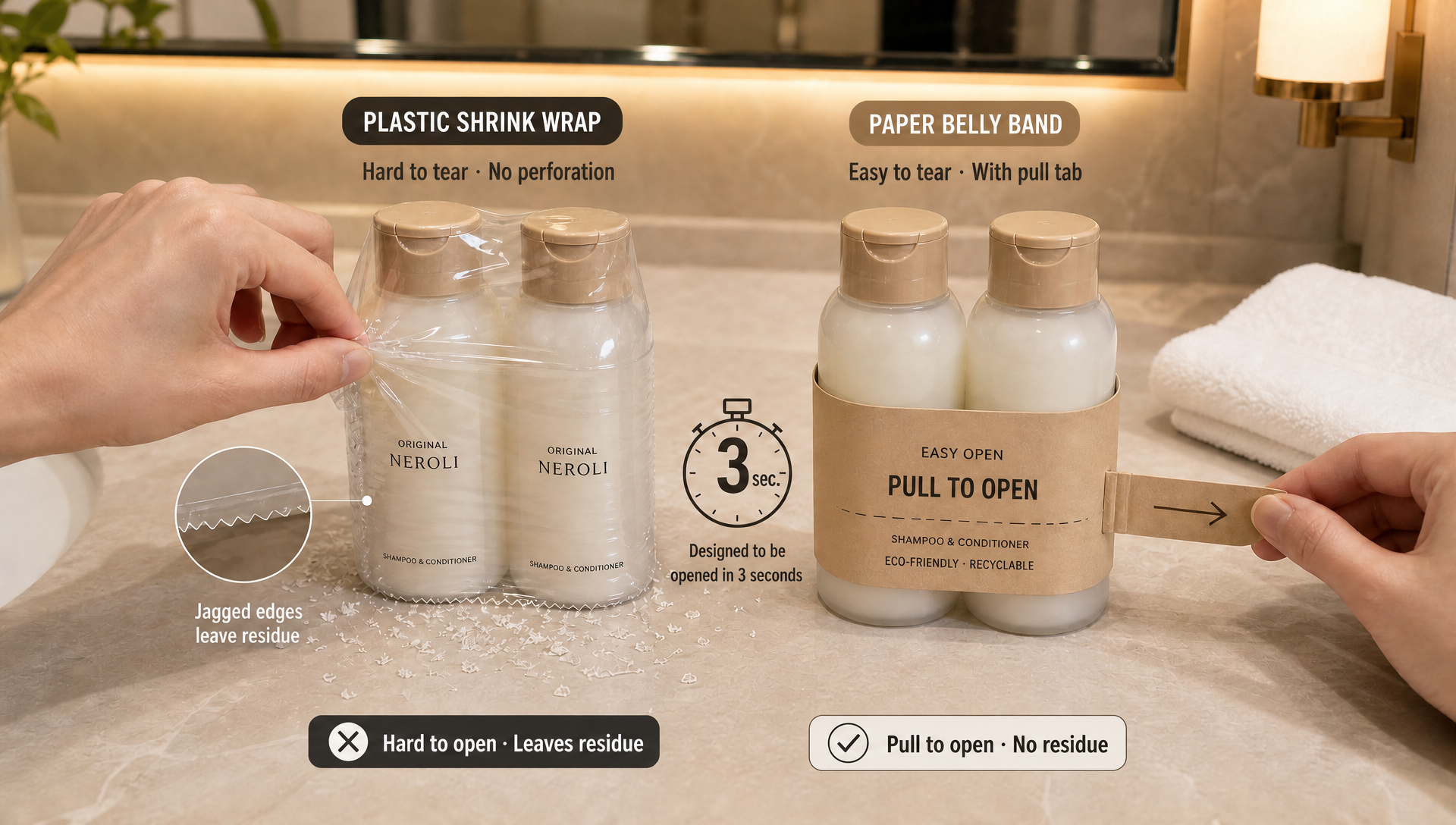
 Oct 06, 2026Those 3 Seconds When Guests Tear Open the Plastic Film on a Toiletry Set – Which Is More Annoying: Packaging That Won't Tear, or Packaging That Tears Too Easily?
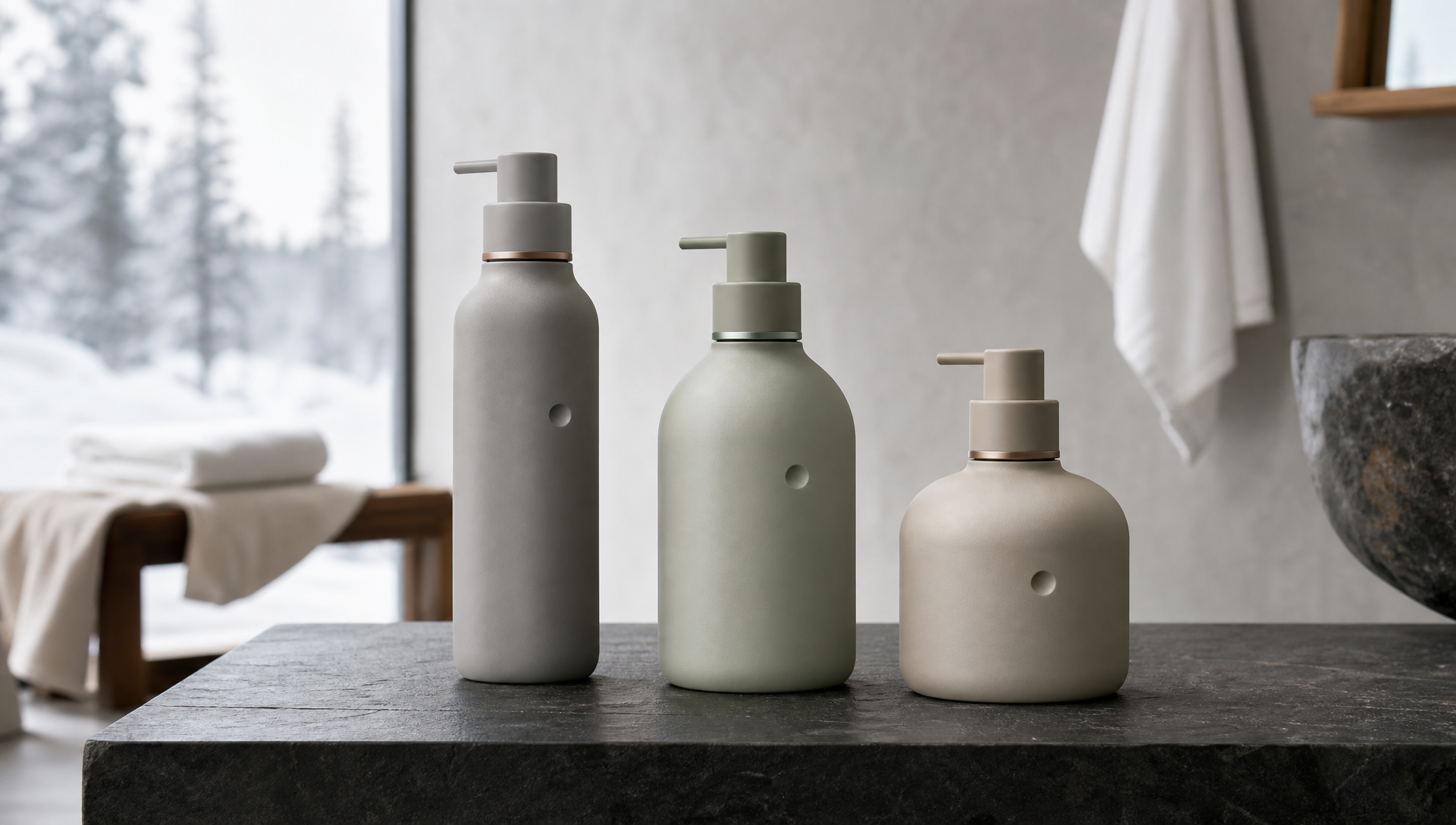
 Sep 24, 2026The "Minimalist Toiletry" Philosophy of Nordic Hot Spring Spas: Why Is There Not a Single Chinese Character on the Bottle?
 Sep 22, 2026Same Formula, Different Packaging, 3x the Price? – The Mismatch Between Formulation and Tier Perception

Ask For A Quick Quote
If you are looking for more information on our services, or how we could potentially help, we would love to hear from you!