



What Is a Reed Diffuser? A Procurement Guide for Hotels, Spas, and Public Space Buyers
After Candles Were Asked to Leave the Lobby
Three years ago, the operations director of a high‑end hot spring hotel made a decision after the quarterly fire inspection: replace all scented candles in every public area of the property. Not because of a fire safety violation – but because his fire safety manager had submitted a report. Over the previous twelve months, the lobby and corridor areas had triggered nine false smoke alarms. Six of them were ultimately attributed to combustion byproducts of scented candles. Six false alarms. Each activation automatically shut down all motorized curtains, fresh air dampers, and background music in that zone. Restoring the entire system took an average of twenty‑one minutes each time.
He replaced the candles with reed diffusers. Nine false alarms became zero. The fire safety manager was relieved, but the lobby manager noticed an unexpected change. Before the switch, someone had to be assigned every evening to trim wicks, extinguish candles, clean wax drips from holders, and wipe away soot residue – a fixed labor cost of at least thirty minutes per day. After the switch to reed diffusers, that position disappeared from the operations schedule.
For hotel buyers, a reed diffuser is not a cheaper candle substitute. It is a continuous air management tool that requires no fire, no electricity, and no one standing by every day. As amenities manufacturers and toiletries manufacturers, we have seen custom commercial space fragrance requests grow steadily over the past three years – and the inquiry growth curve for reed diffusers correlates closely with the density of fire compliance audits we handle. This is not a coincidence.
How Does a Reed Diffuser Actually Work? A Physical Process You Smell but Have Never Thought About
The core principle of a reed diffuser is simple enough for anyone to verify in any room. Layer one: one or more porous fiber sticks are inserted into a bottle containing fragrance liquid. The capillary channels inside the fibers use the liquid's surface tension to draw the liquid from the bottle bottom to the upper end of the sticks. Layer two: at the upper end exposed to air, the liquid evaporates from the fiber surface into the surrounding air. Layer three: evaporation creates a slight local concentration deficit at the stick tip, continuously pulling more liquid from the bottle bottom upward. The entire system has no pump, no electricity, and no moving parts. The only driving force is the Brownian motion of water molecules in the air – which has nothing to do with you.
Within this deceptively simple system lie three procurement decision variables.
The first variable is the fragrance base – the reed diffuser base. The base's evaporation curve determines whether the fragrance release rate from day one to day sixty or ninety follows the shape the buyer wants. An ideal base evaporation curve is not a straight decline. It maintains a relatively stable plateau from day one to day forty‑five, then begins a gentle decline after day sixty. A poor base is overpowering in week one, and by week three guests can barely smell it even when they lean close to the bottle. Such products are not just ineffective in hotel public spaces – they create a negative judgment about your brand's scent management capability.
When screening bases in the lab, we focus on three parameters: the width of the boiling point distribution window, the limiting value of surface tension on capillary rise, and the temperature sensitivity coefficient of evaporation rate between 28‑35°C. In plain language, a good reed diffuser base needs to maintain a release rate that doesn't differ by a guest‑perceptible magnitude in environments with a 7‑10°C temperature difference – such as next to the lobby's air conditioning vent versus beside the SPA's heated stone beds.
The second variable is the diffuser reed. Not just any stick can be called a reed. There are four common diffuser reed materials on the market: natural rattan, synthetic fiber sticks, bamboo fiber sticks, and reed stalks. Their core difference is not appearance – it's the pore size distribution and channel density of the fiber pathways. Natural rattan has larger pores, faster evaporation, but faster decay – suitable for small front‑of‑house spaces needing strong initial fragrance impact. Synthetic fiber sticks have controllable pore size distribution and the flattest evaporation curve – the preferred long‑cycle choice for most commercial spaces. Bamboo fiber sticks have slightly lower capillary efficiency than rattan but a more natural feel than synthetics. Reed stalks have wider channel cross‑sections, high liquid uptake, but limited adjustable fineness range.
The color of the diffuser reed is also a variable worth discussing with the spatial designer. Natural rattan ranges from light beige to deep brown – its visual effect varies dramatically in different colored bottles. Black synthetic fiber sticks in a clear glass reed diffuser look like an ink line drawn across the liquid surface – in a minimalist lobby, this adds a layer of design language precision that natural rattan cannot match. Natural rattan in amber glass – the warm rattan color refracting through the tea‑toned glass creates an organic depth that clear bottles with synthetic reeds lack.
The third variable is the bottle. The bottle is not just a container. It is the first visual anchor the guest's eye lands on when it reaches the fragrance area. The bottle's color, transparency, wall thickness, and surface finish together determine the tone in which your brand speaks to guests in this space.
Glass Bottle Bodies: Visual Layers from Clear to Amber
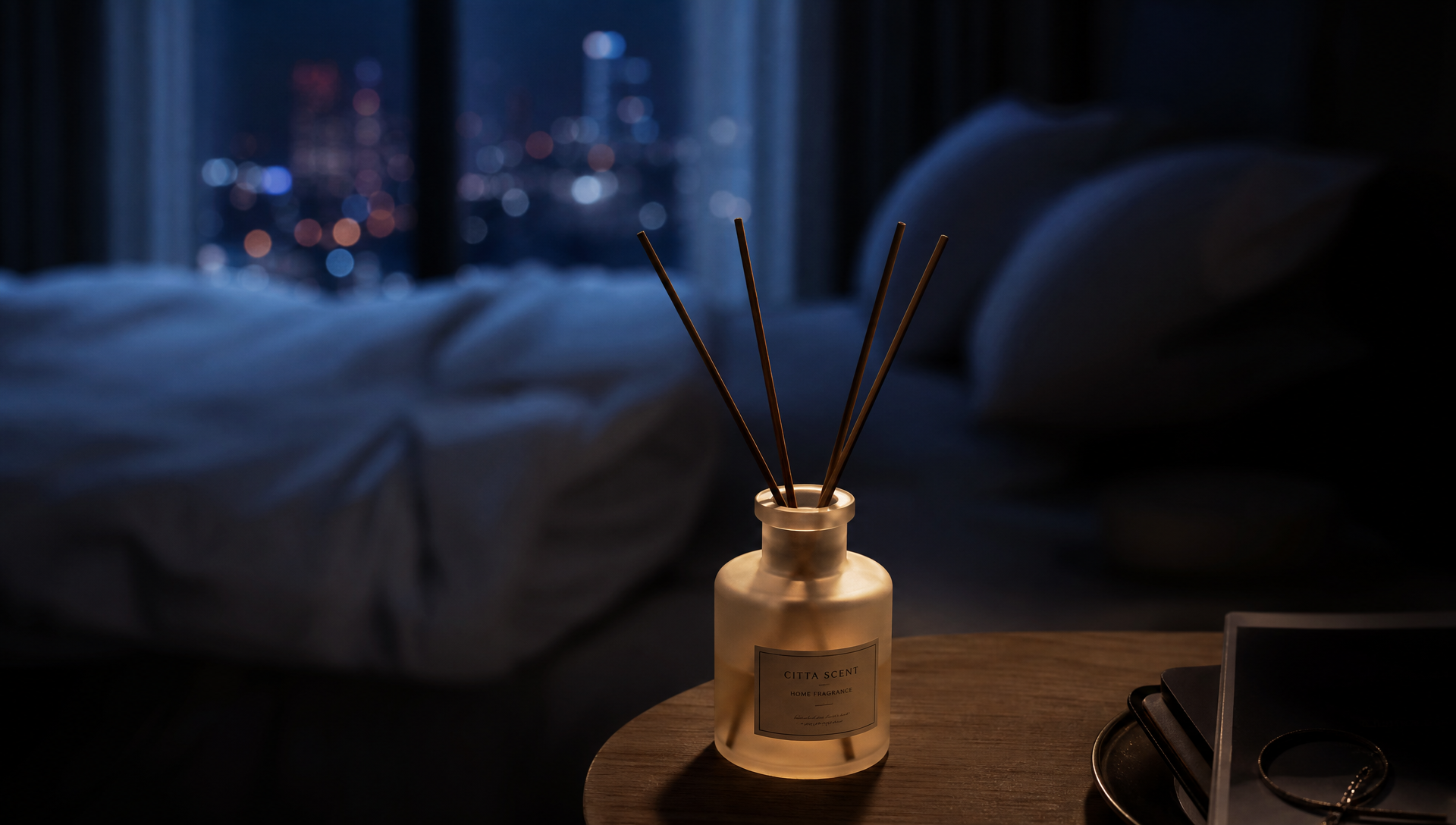
Glass reed diffusers are currently the most common bottle solution in hotel public spaces. The transparency of glass makes the liquid color part of the visual composition. In backlighting or side lighting, the liquid's own color can cast a subtle color halo on walls or surfaces. For hotel lobbies with light brand color palettes and indirect ambient lighting, the visual transparency of clear glass bottles is irreplaceable by other materials.
But glass reed diffusers have one easily overlooked detail. The thermal conductivity of glass creates a stable temperature difference of 1‑3°C between the liquid inside the bottle and the ambient temperature in air conditioning draft zones. This temperature difference physically perturbs the liquid's evaporation rate. If multiple reed diffuser placements in the lobby are respectively directly under an AC vent, far from any vent, and in areas with indirect sunlight, the same base and same reed count can produce fragrance coverage radius differences of 20‑30% across the three locations. The solution is not to change bottles – it is to conduct a hot‑cold zone coverage radius assessment before placement selection, and fine‑tune bottle sizes or reed counts per location. In our fragrance product line as toiletries manufacturers and amenities manufacturers, we have incorporated HVAC airflow modeling into the placement selection process for large commercial spaces.
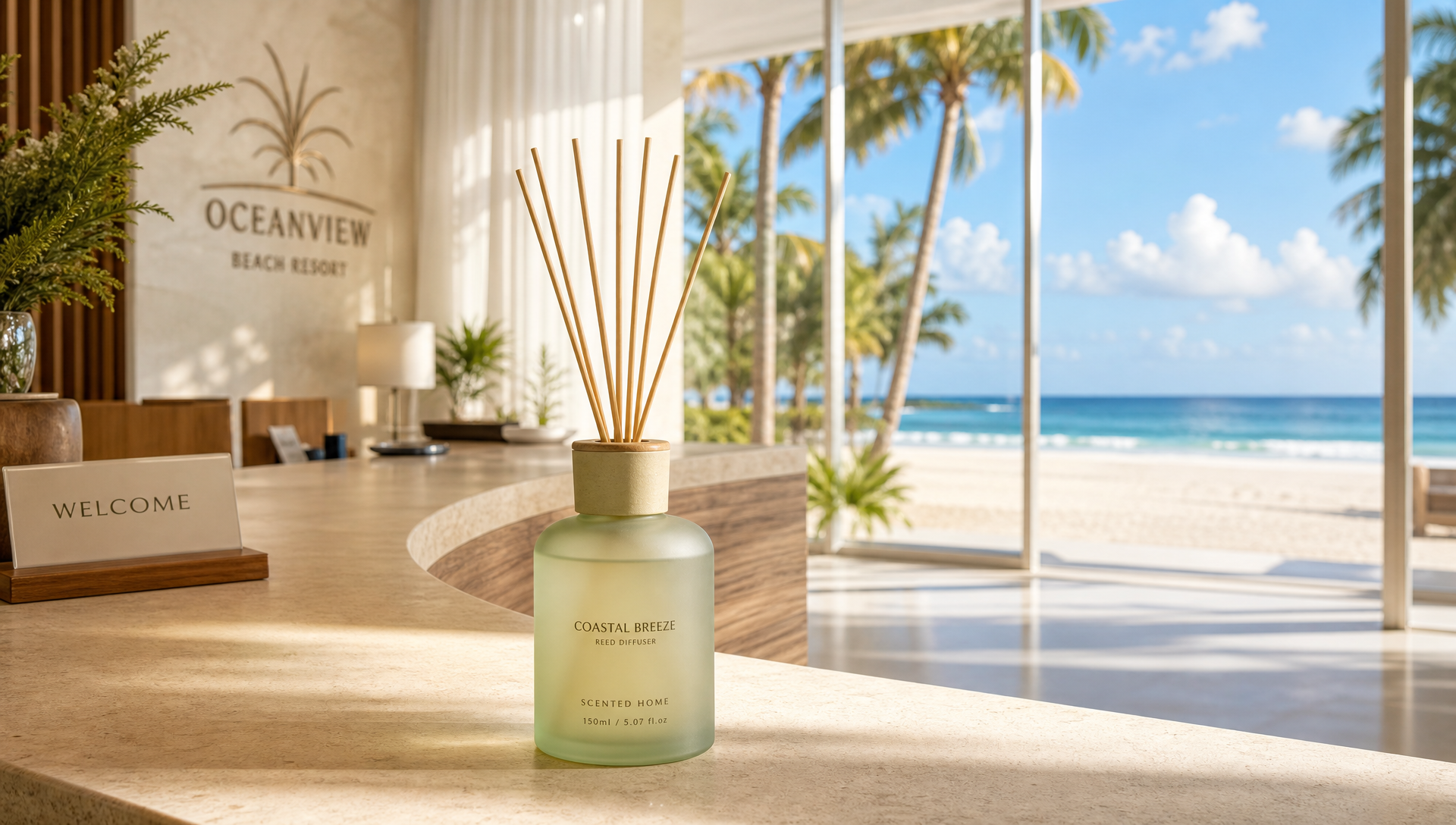
Beyond clear glass, glass reed diffusers come in three advanced color options: amber, emerald green, and frosted white. Amber glass bottles are especially popular in hot spring hotels and SPA changing rooms because tinted glass provides significantly better UV protection than clear glass – offering superior photo‑oxidation protection for natural fragrance ingredients in the liquid. Emerald green glass bottles create visual harmony with abundant greenery in tropical resort lobbies. Frosted white glass bottles offer a lightness that removes visual weight in medical‑aesthetic and cool‑toned design spaces. The different color options of the same bottle shape are not about which looks better – they are about which offers better compatibility with fragrance stability and spatial design context.
Clear glass bottles also have an operational advantage. Buyers and housekeeping staff can see the remaining liquid level directly from outside the bottle, without needing to pull out the reeds to check. In large hotels with dozens of placement points, this is a real labor cost difference during routine inspections. We recommend clear or light‑colored glass for high‑visibility inspection areas like front desk zones, corridors, and lobbies, and amber or emerald green for private spaces like SPA treatment rooms and suites. This is not inconsistency – it is matching inspection frequency and design density to each space's optimal efficiency.
Customization: More Than Just Printing a Logo on the Bottle
As one of the most frequently asked questions of amenities manufacturers, the depth of custom reed diffuser customization needs to be clarified first. Buyers typically understand customization as printing a logo on the bottle. This is possible – but too shallow.
Customization that truly affects guest perception has at least three layers.
Layer one is fragrance customization. Not selecting from the supplier's existing fragrance library – but reverse‑engineering a scent formula that smells like your brand, based on your spatial positioning and brand color palette. Warm‑toned boutique hotels are better suited to fragrance structures based on wood and amber. Cool‑toned design hotels find stronger synesthetic consistency with citrus and marine notes in relation to spatial visuals. When we do fragrance customization for custom reed diffusers, we typically ask clients for three things: the brand visual identity manual, actual photos of the lobby or main space, and the age range and gender ratio of the target guest demographic. The fragrance derived from these three inputs is far more reliable than having the procurement manager choose by subjective preference.
Layer two is reed diffuser sets customized – kit customization. A standard reed diffuser sets customized solution includes the bottle, reed set, refill liquid pouch, and an optional portable travel size. For hotels, kit customization doesn't solve product supply – it solves the question of how many times the brand can make olfactory contact with guests at different stages of their stay. First in the lobby, second in the guestroom, third when the guest takes the travel size home from the boutique. Three contacts form an olfactory brand loop from public space to private domain to home.
Layer three is packaging customization. Empty reed diffuser bottle with gift box is not just putting a bottle into a box with a logo on it. It is an unboxing experience with a ritual. Our recommended empty reed diffuser bottle with gift box solution typically uses a double‑layer structure: an outer rigid flip‑top box printed with the brand's visual identity, an inner pulp‑molded tray of the same color family holding the bottle and reed compartments, and a separately sealed refill pouch plus a glassine flyleaf printed with the brand's fragrance story. During the unboxing process, the guest's visual, tactile, and olfactory senses engage sequentially – creating one more dimension of brand memory retention than a verbal introduction at the front desk.
On premium lines, high‑end reed diffuser customization also involves bottle material upgrades. Glass upgraded from soda‑lime glass to borosilicate glass changes the refractive index – the bottle's crystal clarity visibly improves by a full grade. Borosilicate glass also offers better thermal stability, with a temperature tolerance range in SPA and hot spring spaces significantly wider than soda‑lime glass. For high‑end reed diffusers, reed material upgrades from standard fiber sticks to microporous ceramic composite sticks – more uniform pore size, smoother liquid delivery curve, and at least 20% better volatilization stability than standard reeds. In hotel brands with room rates above a certain threshold, guests' sensitivity to fragrance quality is at the same level of perception as their sensitivity to thread count.
Candles and Reeds Are Not Enemies – Three Fragrance Solutions May Work Simultaneously in One Space
Candle and reed diffuser gift sets are a severely underestimated product combination in hotel boutiques. Candles provide instant presence – within 5‑10 minutes of lighting, fragrance rapidly fills a private space. Reed diffusers provide sustained presence – a single reed diffuses fragrance continuously from day one to day sixty. In the same space, their roles are not competitive but sequential. The candle handles the welcome ritual; the reed diffuser handles the background tranquility.
For hotel boutiques, the procurement logic for candle and reed diffuser gift sets is more complex than single items – but the return is higher. After a guest purchases a candle and reed diffuser gift set and takes it home, the candle will be lit during the next family dinner or bath. The reed diffuser will sit in the entryway or on the nightstand, working continuously for 30‑60 days. This means you have sold one set and gained two different time‑scale and two different scenario olfactory exposure windows in the guest's personal living space. The product stickiness of this set is at least 30% higher than selling a reed diffuser or a candle alone – because guests won't keep the candle holder after the candle burns out, but when the reed diffuser liquid runs out, they will come back to you for refills, holding that beautiful bottle.
The home fragrance reed diffusers category has grown rapidly in retail in recent years – but its significance to hotel buyers is not just boutique retail revenue. Every home fragrance reed diffuser seen and smelled in a guestroom may trigger a guest to type "what is this scent called" into a search engine after checkout. If your brand has placed this reed diffuser in guestrooms but guests cannot find the same product at home, that search flows to your competitors. If guests buy the same product in the boutique, the moment they post a photo on social media, your home fragrance reed diffuser has upgraded from a room consumable to a user‑generated brand communication node.
Public Spaces: Coverage Radius Is Not Determined by Guesswork
In hotel lobbies, SPA reception areas, premium dining waiting zones, and fitness center entrances, reed diffuser placement is not just dropping two bottles on a coffee table. A reed diffuser's effective coverage radius is governed by three physical variables: space volume, air exchange rate, and reed count. The larger the space, the smaller the coverage radius. The higher the fresh air system exchange frequency, the smaller the coverage radius.
A practical reference line: a standard 120ml bottle with six reeds can maintain stable olfactory coverage in a 40‑60 cubic meter space with no strong convection – roughly equivalent to a standard guestroom or a small SPA single treatment room. In spaces with ceiling heights over 4‑5 meters and constant HVAC airflow – such as lobbies or atriums – the single‑bottle coverage radius may drop to within 2‑3 meters. The solution is not to add more bottles – it is to increase the reed count from six to eight or even ten per bottle, increasing evaporation surface area while keeping the liquid surface area constant.
This leads to a variable that most buyers never consider in the first round of solution comparison: diffusion intensity is not the same as diffusion area. Increasing reed count raises overall release volume, but if the base is not adjusted simultaneously, the fragrance's suspended concentration in the air may shift from pleasant to aggressive at a certain point. The base and reed count must be tuned as a combination – not independently.
FAQ
Q: What are the main ingredients of a reed diffuser base? Are there safety risks?
A: The main components of a reed diffuser base are typically a blend of several low‑volatility solvents – commonly including dipropylene glycol methyl ether, isoparaffin series, and ethoxylated alcohols. These solvents share the characteristics of being stable at room temperature, having flash points well above room temperature, and not falling into flammable hazard classifications. A qualified reed diffuser base contains no methanol or phthalate plasticizers. When used with natural or synthetic fragrance oils in normal indoor environments, it poses no health risk. Buyers can request MSDS (Material Safety Data Sheet) and IFRA (International Fragrance Association) fragrance safety certification from suppliers when comparing options.
Q: What is the lifespan of diffuser reeds? When should they be replaced?
A: After 60‑90 days of continuous use, the inner surfaces of the fiber channels gradually become coated with non‑volatile fragrance residues, and capillary efficiency begins to decline. The external signal is that the upper end of the reed, which was previously moist and glossy, becomes dry and matte. When the fragrance intensity at the reed tip is noticeably weaker than at the bottle mouth, it is time to replace with new reeds. Inserting used reeds into a new bottle of liquid will not restore evaporation efficiency to that of new reeds. Our recommendation is to treat reeds as consumables with the same cycle as the base liquid – replacing reeds with each refill. For large hotels, bulk replacement plans can bundle reeds and refill pouches as a single replacement kit, eliminating the housekeeping team's decision‑making overhead on when to replace.
Q: How long does custom reed diffuser fragrance development take? What is the minimum order quantity?
A: The full fragrance customization process typically takes 4‑8 weeks. The first two weeks are the brand olfactory profiling phase – we need brand visual materials, space photos, and guest demographic data. Weeks three to six are lab compounding and client feedback iterations – typically requiring two to three rounds of sample delivery and olfactory review. Weeks seven to eight are scaled blending and filling after finalization. If you choose from an existing fragrance library rather than custom development, the lead time shortens to 2‑3 weeks. For minimum order quantities: standard products typically have an MOQ of 2,000‑3,000 bottles per batch. Fragrance customization has a first‑order MOQ of 5,000 bottles. Bottle customization has a first‑order MOQ of 10,000 bottles.
Q: How do glass reed diffusers perform in SPA high‑humidity environments? Do they need special treatment?
A: Glass reed diffusers work perfectly in SPA spaces, but two points are worth noting. First, temperature and humidity fluctuations in SPA areas are more dramatic than in hotel lobbies – we recommend amber or frosted white glass bottles over clear for SPA treatment rooms. Tinted glass provides slightly better buffering against liquid temperature fluctuations and offers additional protection for photosensitive fragrance ingredients. Second, evaporation rate accelerates in high‑temperature, high‑humidity environments – we recommend reducing reed count from six to four or five in SPA areas, moderating the release rate to match a 40‑50 day refill cycle, aligning refill timing with guestroom consumable replacement schedules so operations teams don't need a separate inspection roster. The transparency of glass bottles allows visual liquid level checks at any time – a tangible labor saving at the operational level.
Q: How should the full‑cycle cost of reed diffusers be calculated from a hotel supplies wholesale perspective?
A: The purchase price of a single reed diffuser typically ranges from $1.50 to $6.00, depending on bottle type, packaging, fragrance customization depth, and reed material. This price should be broken into three parts: initial installation cost, refill cost, and disposal cost. Initial installation is the total expenditure on bottles, reeds, and base liquid for the first placement. Refill cost is the expenditure on refill liquid and reed replacement every 60‑90 days. Disposal cost is the end‑of‑life disposal of the bottle. Glass reed diffuser bottles can be recycled after the base liquid is exhausted – disposal cost is zero. Over a two‑year lifecycle, the daily cost difference between standard soda‑lime glass and amber glass solutions is typically less than 10%. Upgrading to borosilicate glass increases daily cost by approximately 15‑20%, but borosilicate glass bottles are virtually immune to chipping during normal use, with longer bottle life. Cost is not the single‑bottle price – it is the joint function of location, bottle type, replacement frequency, and brand narrative premium.
Whether you operate a mountain‑crossing hot spring resort or a quietly sophisticated boutique design hotel in the city center, the choice of fragrance determines the guest's first unconscious judgment at the moment they push open the door. Browse our high‑end reed diffuser collection and hotel guestroom supplies custom product line. We are pleased to offer you samples. New clients are responsible for shipping costs; upon reaching cooperation, this fee will be deducted from the formal order payment.
latest articles
 Aug 19, 2026What Do Biodegradable Bottles Actually Degrade Into in Hotel Settings? We Buried Them for 180 Days – You Won't Believe What We Dug Up
![]() Aug 17, 2026Why Do Shampoo Bottles in Semi-Open-Air Hot Springs Always Get Moldy from the Bottom First?
Aug 17, 2026Why Do Shampoo Bottles in Semi-Open-Air Hot Springs Always Get Moldy from the Bottom First? Aug 13, 2026Should Beach Resort Lobbies Use Sea Breeze Fragrance? Not So Fast – Most Sea Breeze Scents Smell Like Disinfectant
 Aug 11, 2026The Hotel Detail Solo Travelers Care About Most – The Smell of the Room After Lights Out


Ask For A Quick Quote
If you are looking for more information on our services, or how we could potentially help, we would love to hear from you!