



How Can High-End SPA Essential Oil Formulation Thinking Be Adapted for Hotel Fragrance Products?
A chief therapist at a spa handed her proudest formulation directly to a fragrance factory. The resulting reed diffuser was placed in a guest room. After three days, feedback arrived. Some said it was too sharp. Some said it was cloyingly sweet. Others said they could not smell it after a week. The problem was not the formulation itself – it was the release mechanism. Spa essential oils rely on body temperature and skin to penetrate slowly. Reed diffusers rely on capillary action to evaporate continuously, 24 hours a day. When the same ratio is moved into the air, both concentration and rhythm are wrong. This article explains, from four perspectives – guest experience, hotel operations, product competitiveness, and profitability – how high-end SPA formulation thinking should be adapted for hotel fragrance products.
Guest Experience: Why Directly Copying Formulations Fails
Therapeutic feel and fragrance intensity are never the same thing. A scent that feels comfortable in a spa may become oppressive in a closed guest room.
Massage oils at spas are diluted in plant oils – low concentration – with dosage and contact time controlled by the therapist's technique.
There is no therapist inside a diffuser bottle. It evaporates continuously on its own. High concentration equals continuous overdose.
Citrus essential oils oxidise quickly. In a bottle, they begin to change after two weeks. What guests smell is the off-note sweetness.
Resin-based essential oils are highly viscous. They clog the capillaries of the reeds. The more you use, the less you smell.
Some formulas feel comfortable on the skin but become sharp in the air – because the nasal cavity's perception threshold and the skin's are completely different.
Hotel Operations: Skin Absorption and Air Volatilisation Are Two Different Systems
One pathway goes through skin and body temperature. The other goes through capillary action and air flow. Between them lies an entire concentration logic.
Volatilisation has a curve. The first three days are the sharpest. The middle is steady. The end fades. Guests most often remember the sharpest first three days.
The number of reeds is essentially adjusting concentration. Insert two more, diffusion doubles. This is not a formulation issue – it is a usage issue.
Room volume determines how strong the formula should be. The same bottle placed in a lobby versus a guest room produces very different physical sensations.
Reed diffuser essential oil evaporates continuously in the bottle. It is a completely different consumption pattern from spa oils used by the treatment.
Skin tolerance and nose tolerance are not the same standard. A concentration that can be applied to the body may not be bearable to smell all day.
Product Competitiveness: Four Things to Change When Adapting
Laying the formulation sheet open, four dimensions of parameters need changing – not just swapping one fragrance.
Wearability matters more than pleasantness. Hotel fragrance must withstand guests staying three consecutive nights without feeling tired of it.
The top note can be made beautiful. But what truly determines the review is whether the middle and base notes can sustain an entire evening.
The approach of luxury reed diffusers is typically to subtract from fragrance layering and add to lingering time.
The evaporation curve must be measured at the sampling stage – recording fragrance intensity continuously over multiple days, not just smelling once upon opening.
Fragrance content and evaporation cycle are not always positively correlated. Solvents that evaporate too quickly can actually shorten the overall cycle.
Hotel Operations: Guest Complaints About Hotel Fragrance Almost Always Trace Back to Concentration
Fragrance is the most easily misunderstood amenity – because it is invisible. But when problems arise, they can only be described in words.
Guest room fragrance too strong – guests say they have headaches, cannot sleep. These feedbacks are hard to attribute to fragrance.
Corridors and lobbies are public spaces. Concentration must be lowered. But the memory point in guest rooms must be retained. The two cannot be one-size-fits-all.
Fragrance and cleaning product odours clash. Mixed together, they become an indescribable smell.
Olfactory fatigue causes misjudgment. When guests cannot smell it on the second day, it is not that the diffuser failed – it is that the nose adapted.
Only fragrances that can be taken away at checkout have value. Fragrance that cannot be taken away is just a background.
Hotel Operations: Reed Diffusers Are Amenities That Require Weekly Maintenance
They are different from disposable amenities. Installation is only the beginning. A whole set of maintenance actions follows.
Reeds must be flipped regularly. After flipping, diffusion volume rises noticeably. This step must go into housekeeping's daily checklist.
Guest room diffuser replacement cycles must be scheduled separately – not tied to linen replenishment.
Bottle tipping is a common repair request. Anti-tip structure at the bottle opening or a holder can save considerable handling.
Replenishment must be calculated by evaporation rate, not by room count. Summer consumption is noticeably faster than winter.
Boxed diffusers must be stored away from light. Direct sunlight causes the oil to change prematurely.
Guest room fragrance should ideally offer two concentration levels – giving fragrance-sensitive guests an option to remove it.
Product Competitiveness: Beyond the Formula Sheet – Bottle and Reeds Matter Too
Reed diffusers are continuously outputting products. The formula determines half. The bottle and reed pairing determines the other half.
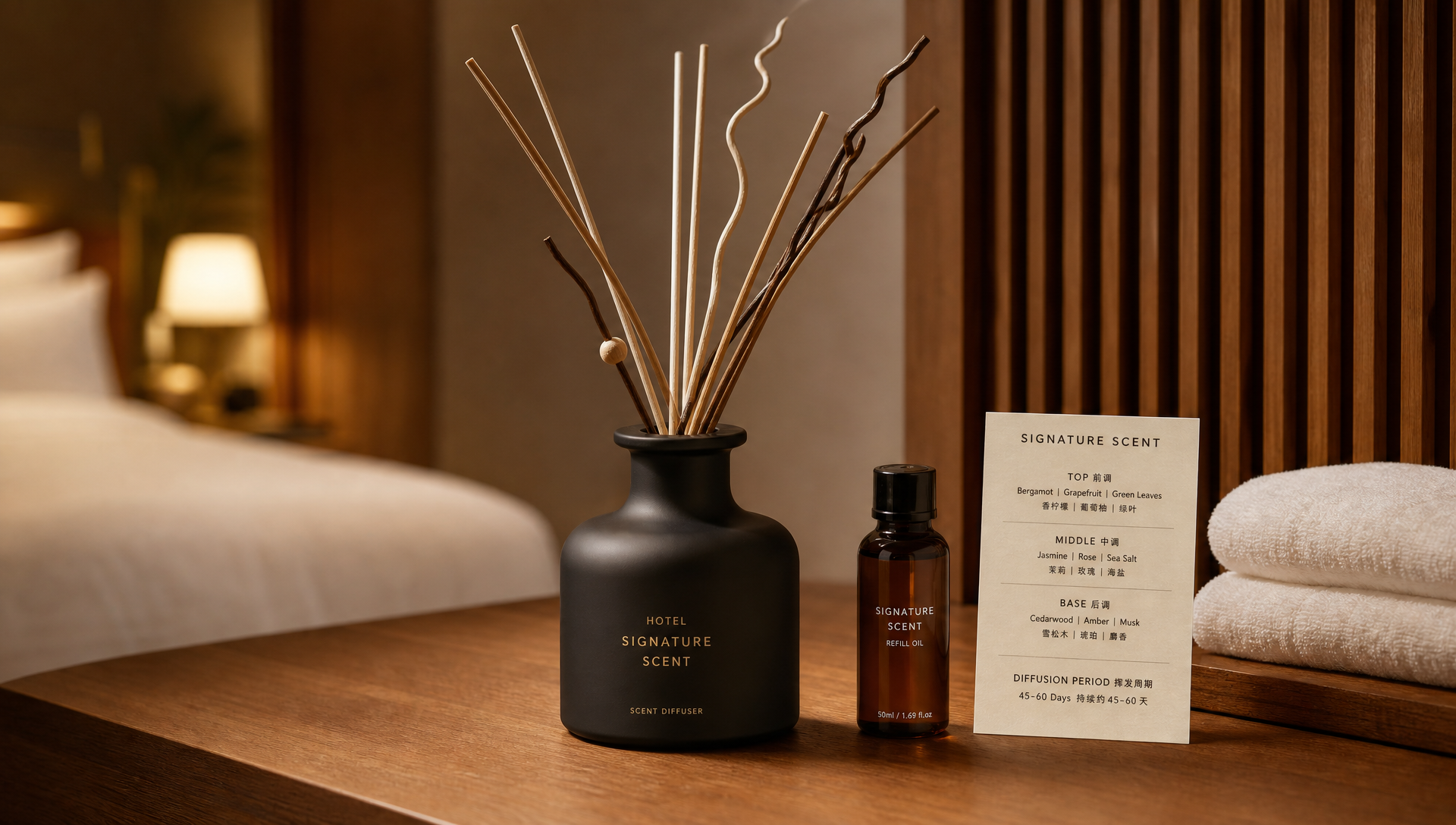
Reed diffuser essential oil must have complete top-middle-base note descriptions, plus evaporation cycle and suitable space volume marked.
The material and capillary pore size of the reeds determine whether fragrance can rise smoothly. Diameter and quantity must be paired as a system.
The direction for organic reed diffuser bottles is switching to renewable or biodegradable materials while retaining light-blocking structure.
Dark bottles both block light and slow evaporation. Bamboo bases and metal holders match spatial styles better than a single bottle.
The refill concept is worth developing. The bottle stays with the hotel for reuse. What guests take home is a small portion of scent memory.
Fragrance ingredients must provide compliant safety documentation. Guest rooms are enclosed spaces. This item takes priority over the fragrance itself.
Profitability: A Signature Scent Is the Only Memory That Can Be Taken Away
After guests return home, few can name the facilities. Many can name the scent. This is the fragrance ledger.
A remembered scent can extend to home fragrance retail. Guests are willing to buy after returning home.
A luxury reed diffuser placed in a guest room is itself a silent sales position.
Repeat booking motivations come from these scents that did not go wrong. When something goes wrong, guests cannot describe it – they only say the stay was uncomfortable.
The investment in fragrance upgrades spread across each room is small – but it affects every minute the guest spends in the room.
Once a scent is bound to a brand, it becomes a long-term asset. Continuity must be considered when changing suppliers.
Compared to repeatedly changing facilities, scent is a lower-cost and more easily remembered memory anchor.
Product Competitiveness: Four Things to Ask Clearly During Selection
First provide the volumes of the three space types – guest room, corridor, and lobby – to the supplier. Then discuss the scent. When selecting the supply chain, ask clearly about fragrance content, evaporation cycle, and reed configuration. Those who can provide multi-day evaporation curves are the most reliable. If organic reed diffuser bottles are to be made, the recyclability path and light-blocking performance of the bottle material must also be confirmed. Otherwise, the fragrance may change before its cycle is complete.
Frequently Asked Questions
Q: Can spa essential oil formulations be directly made into hotel fragrance?
A: Cannot be directly copied. The release mechanisms differ. Spa essential oils rely on skin and body temperature. Hotel fragrance relies on continuous volatilisation. Concentration, carrier, and evaporation rhythm must all be re-adjusted.
Q: Why can't I smell the hotel guest room fragrance after staying a while?
A: It is mostly olfactory fatigue, not diffuser failure. Prepare two alternating scent types, or flip the reeds. Diffusion volume will rise.
Q: How is the evaporation cycle generally determined?
A: Look at the continuous evaporation record during the sampling stage – not just fragrance content. High concentration does not equal long cycle. The solvent system has greater influence.
Q: Does the bottle material affect the fragrance?
A: Yes. Light-blocking performance directly affects the oil's rate of change. Recyclable bottles with light-blocking structure meet institutional sustainable procurement requirements and facilitate refills – actually more economical long-term.
Browse our Luxury Reed Diffuser Collection – from organic reed diffuser bottles to reed diffuser essential oil refills, and full private-label solutions, all covered in one stop. Our flexible production line supports small-batch orders with flexible MOQs.
latest articles
 Oct 07, 2026How Can High-End SPA Essential Oil Formulation Thinking Be Adapted for Hotel Fragrance Products?
 Oct 06, 2026Those 3 Seconds When Guests Tear Open the Plastic Film on a Toiletry Set – Which Is More Annoying: Packaging That Won't Tear, or Packaging That Tears Too Easily?
 Sep 24, 2026The "Minimalist Toiletry" Philosophy of Nordic Hot Spring Spas: Why Is There Not a Single Chinese Character on the Bottle?
 Sep 22, 2026Same Formula, Different Packaging, 3x the Price? – The Mismatch Between Formulation and Tier Perception

Ask For A Quick Quote
If you are looking for more information on our services, or how we could potentially help, we would love to hear from you!