



Those 3 Seconds When Guests Tear Open the Plastic Film on a Toiletry Set – Which Is More Annoying: Packaging That Won't Tear, or Packaging That Tears Too Easily?
A guest stands at the vanity, holding that toiletry set. Their fingernail scrapes across the plastic film twice without finding an opening. By the third second, half their patience is gone. This is one of the most underestimated moments in guest room amenities. If it won't tear, guests feel deliberately inconvenienced. If it tears too easily, guests feel it was done carelessly. Both frustrations point to the same variable: has the tear force been designed? This article breaks the frustration of these three seconds into verifiable craftsmanship metrics from four perspectives: guest experience, hotel operations, product competitiveness, and profitability.
Guest Experience: What Happens to the Guest's Hands and Emotions in Those Three Seconds?
The act of tearing packaging lasts only three seconds – but it engages touch, hearing, and sight simultaneously. Guests will not say anything at the time, and will struggle to recount it later. They will simply have a vague feeling about this hotel.
The fingernail slides horizontally across the film twice without finding a starting point. The person instinctively increases force – but the entire package rotates with the bottle.
The moment of excessive force – what deforms first is often not the film, but the bottle cap. Liquid runs through the fingers onto the wrist.
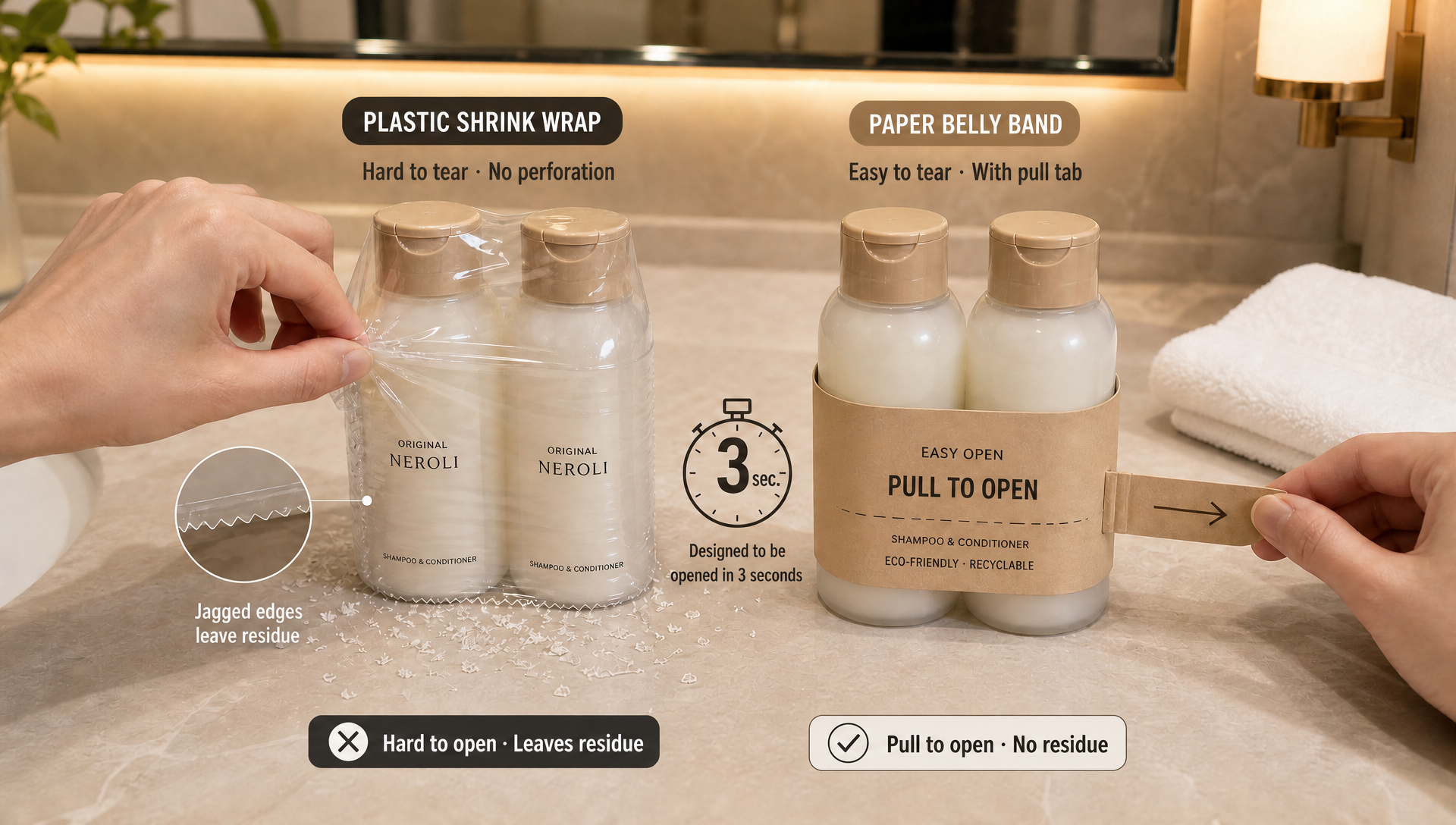
The film is torn open in an irregular triangular shape, edges with fine serrations, leaving an invisible scratch on the fingertip.
Debris carries static electricity – first sticking to the palm, then to the bottle, finally falling onto the countertop and towel.
Some guests go straight to their teeth, or dig out a room card or key to poke at it. That action alone already indicates packaging design failure.
The worst case: the package is intact but simply will not tear. The guest leaves it on the countertop – until checkout day, it has never been opened.
Hotel Operations: Won't Tear vs Tears Too Easily – The Frustrations Are Not the Same Emotion
My judgment is: won't tear is more annoying; tears too easily is more cheapening. The two frustrations appear opposite – but the root cause is the same variable: has the tear force been designed?
Won't tear consumes patience and dignity. The guest must find a tool at the vanity – even use their teeth. It is a feeling of being blocked.
Tears too easily consumes trust. The packaging falls apart in the hand, debris covers the countertop. The guest's judgment of whether this hotel is refined is set at this moment.
Guests facing "won't tear" tend to call the front desk asking for scissors – dissatisfaction follows the complaint path.
Guests facing "tears too easily" usually say nothing. They simply write that small friction into a detail sentence in a review – or do not mention it at all, but remember.
What truly annoys is never "packed tight" or "packed loose" – it is tear force being inconsistent across the entire box. In the same box, some require teeth, others fall apart at a touch.
Hotel Operations: What Housekeeping Fears Most Is the Second Thing Caused by Packaging
Housekeeping does not fear the packaging itself – it fears the second action the packaging leaves behind: either wipe, or replace, or explain.
Plastic film debris falls into bathroom countertop crevices and is especially visible. On light stone, patch by patch, it requires separate wiping – and wiping with a cloth actually spreads it with static.
Torn bottle caps and punctured aluminum tubes can only be scrapped whole. Discovered at checkout inspection – but the guest has already left, and the loss cannot be explained.
The front desk and housekeeping centre receive calls asking for help opening packaging. Once or twice is a small matter – concentrated during peak season, it becomes service pressure.
Batches with film that is too tight compress each other in the box – bottles get pressure marks. Batches with film too thin self-rupture in transit – open the box to bare bottles.
Bathroom humidity causes thin film to cling to the bottle and fog up. The tear force of hotel bathroom amenities increases noticeably in humid rooms. This must be simulated at the sampling stage.
When replenishing through hotel toiletry wholesale channels, film GSM and heat-seal temperature must be written into the order attachment. Do not just write "plastic seal."
If disposable hotel amenities use plastic sealing, transport vibration must also be factored in. Box movement causes film to crack prematurely.
In hotel amenity wholesale orders, packaging specifications should be a separate line item. Different room types can correspond to different solutions – avoid one-size-fits-all.
Product Competitiveness: Easy-Tear Can Be Broken Down into Metrics
Tear force is a measurable parameter in the factory. The problem is that many orders only write "plastic seal" – without turning it into a metric.
Custom hotel amenity packaging can be a two-tier solution. Premium room types use paper belly bands or bamboo fibre sleeves. Standard room types use film with controllable tear force.
Some premium hotel amenity suppliers have already replaced plastic film with paper belly bands. Guests pull and open – no debris on the countertop, and the look is neater.
Hotel bathroom amenity packaging must also consider humidity. Film clings to the bottle in moisture, increasing tear force. Paper belly bands are more forgiving.
Whether a hotel guest amenity supplier can provide two packaging solutions is the one thing most worth asking at the selection stage.
Opening force is best made into a range. At the sampling stage, test with both a hand-feel panel and instruments. At mass production, spot-check by batch – reject abnormal batches entirely.
Film directionality matters. Longitudinal tearing is more stable than transverse. Embossing on the mould should predefine the tear path.
Disposable hotel amenity packaging can also be tiered. Paper belly bands actually have an advantage in neatness.
Hotel Profitability: Paper Belly Band vs Plastic Film – Calculate Three Ledgers First
Switching from film to paper belly band saves not just three seconds – but hidden actions that repeat daily.
Experience ledger. Paper belly bands open in one second. Plastic film takes an average of three extra seconds. Those three seconds in a review are detail points.
Cleaning ledger. Debris cleanup is hidden labour that happens daily. Paper belly bands open as a single sheet – housekeeping collects it in one motion.
Environmental ledger. Film must be separated from the bottle to enter recycling. Guests basically never do this. Paper belly bands are more realistically disposed of with the bag.
Dust-proof ledger. Film-free solutions must ensure cleanliness from factory to room opening. This requires outer box and inner lining coordination – not just removing the film.
Hotel Profitability: Those Three Seconds Will Return in the Form of Reviews
A sentence in a review mentioning "packaging wouldn't open" has more impact than imagined. It will be treated as detail evidence by the next guest.
Conversely, a pull-open paper belly band is often written into positive reviews. Guests treat it as evidence of hotel thoughtfulness.
If a hotel guest amenity supplier can provide both film and paper solutions, the hotel can configure by room type tier – spending budget where guests can see it.
The cost of custom hotel amenity packaging upgrades spread across each room is small – but it affects a three-second moment that happens once per room per day.
If a hotel amenity supplier can provide batch retention samples and opening force data, the hotel gains another quality evidence point in group reviews – and fewer return disputes.
Hotel amenity wholesale orders can be split into two packaging types by room type. Layered delivery within the same batch is actually more worry-free long-term.
Hotel guest amenity packaging is never mentioned when nothing goes wrong. When something goes wrong, every sentence is remembered. That is how details keep accounts.
Product Competitiveness: Four Questions to Ask During Selection
When selecting a hotel amenity supplier, first write tear force into the specification as a formal metric. Then request two sets of samples: film solution and paper solution. Hotel guest amenity packaging testing must be done at your own bathroom's actual humidity. Tear twenty packs of each solution, recording handfeel and damage. Premium hotel amenity suppliers typically accept such comparison testing – those with stable parameters are not afraid of testing. In hotel toiletry wholesale orders, listing packaging as an independent line item with room type tier notation saves far more effort than post-hoc remedies.
Frequently Asked Questions
Q: Between "won't tear" and "tears too easily," which should be solved first?
A: "Won't tear" takes priority – because it pushes guests toward the help-seeking and complaint path. "Tears too easily" is more of a hidden deduction. Both actually share the same metric: whether tear force is stable.
Q: Is plastic film necessarily worse than paper belly bands?
A: Not necessarily. Plastic film has advantages in dust and moisture protection. The key is uniform film thickness and pre-set tear notches. If that cannot be achieved, paper belly bands are the more stable choice.
Q: Does bathroom humidity affect tear force?
A: Yes. Film tends to cling to the bottle in humid environments, increasing tear force. Sampling must include a separate round of testing that simulates bathroom humidity.
Q: Can hotel guest amenity packaging be tiered by room type?
A: Yes. Premium room types use paper belly bands or bamboo fibre sleeves. Standard room types use film with controllable tear force. The same production line can produce tiers – just specify separately in the order.
Browse our Custom Hotel Amenity Packaging Wholesale Collection – from paper belly bands to easy-tear film, and full private-label solutions, all covered in one stop. Our flexible production line supports small-batch orders with flexible MOQs.
latest articles
 Oct 07, 2026How Can High-End SPA Essential Oil Formulation Thinking Be Adapted for Hotel Fragrance Products?
 Oct 06, 2026Those 3 Seconds When Guests Tear Open the Plastic Film on a Toiletry Set – Which Is More Annoying: Packaging That Won't Tear, or Packaging That Tears Too Easily?
 Sep 24, 2026The "Minimalist Toiletry" Philosophy of Nordic Hot Spring Spas: Why Is There Not a Single Chinese Character on the Bottle?
 Sep 22, 2026Same Formula, Different Packaging, 3x the Price? – The Mismatch Between Formulation and Tier Perception

Ask For A Quick Quote
If you are looking for more information on our services, or how we could potentially help, we would love to hear from you!