



Reed Count, Liquid Level and Diffusion Power: How to Tune a Reed Diffuser
Placing a reed diffuser on the shelf and never touching it again is the most common—and most regrettable—way to use guest room fragrance. The scent fluctuates between strong and weak, and guest perception becomes unstable. The problem is usually not the liquid—it is three parameters that no one has ever adjusted: reed count sets concentration, liquid level sets lifespan, and flipping rhythm sets evenness. Get these three dials right, and the same bottle of fragrance can deliver a noticeably different experience. Get them wrong, and even the best fragrance cannot last through a single stay cycle. This article explains, from four perspectives—guest experience, hotel operations, product competitiveness, and profitability—how to tune a reed diffuser in one go.
Guest Experience: Three Parameters—The Dials of a Diffuser
Many people treat a reed diffuser as a disposable ornament to be opened and forgotten. In fact, it is more like a device with no buttons—all control is hidden in three visible, touchable parameters.
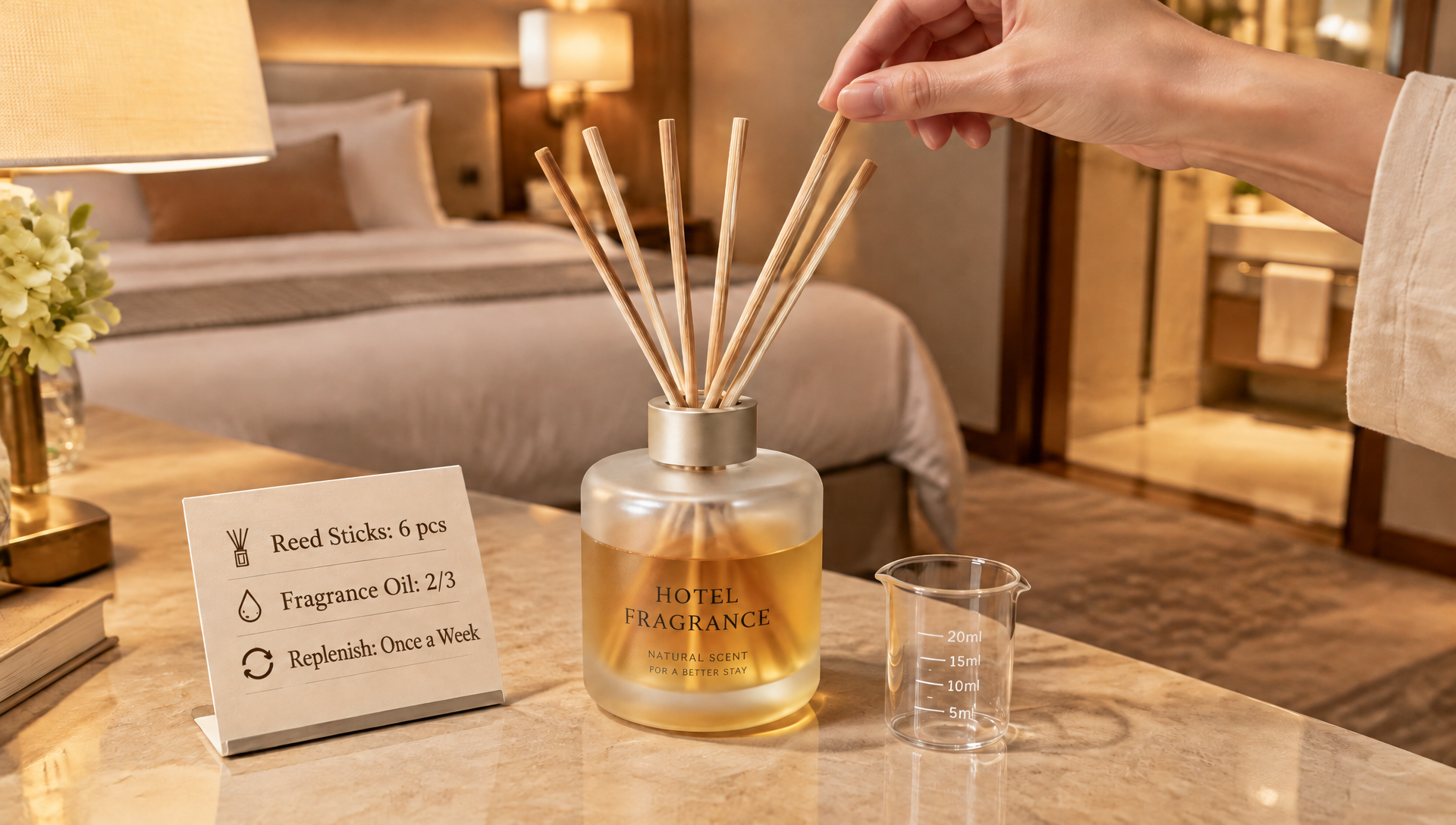
Reed count determines how fast the fragrance travels. One more reed means one notch stronger—and one day shorter.
Liquid level determines total lifespan. With the same liquid, different insertion methods can double the room-nights it lasts.
Flipping rhythm determines evenness. Strong and stuffy for the first two days, barely there for the latter half of the month—that means no flipping.
Tune these three parameters smoothly, and the fragrance concentration curve shifts from a roller coaster to a gentle slope. Every night, guests smell the same scent.
Product Competitiveness: Reed Count—The Seesaw Between Concentration and Lifespan
Reeds are the accelerator of fragrance and the brake on lifespan. More reeds and fewer reeds each carry a cost. The sweet spot lies between them.
For bottles around 100ml, five to seven reeds is the common range for guest rooms. Corridors and public areas can go to eight or more.
More reeds mean a larger volatilisation surface. Concentration rises, but liquid consumption accelerates—and lifespan shortens accordingly.
For a new bottle, start with four reeds. Smell it the next day. If too faint, add one. If too stuffy, remove one. Two days is enough to find the optimal value for your property.
Adjusting reed count requires no tools and costs nothing—yet it delivers the most direct return. This is the one item that should be written into the housekeeping manual in procurement training.
Product Competitiveness: Liquid Level—The Overlooked Lifespan Variable
Most properties only glance at liquid level during restocking. In fact, it has been affecting diffusion performance since day one.
When the liquid level is too high, reeds become oversaturated. The fragrance turns sharp, and oil stains easily form around the bottle opening.
When the liquid level is too low, reeds cannot draw enough liquid. The upper section runs dry, and diffusion becomes intermittent.
The rule of thumb is two-thirds of the bottle body. Below one-third, arrange refilling—do not wait for the fragrance to break down.
Liquid level inspection can be merged into housekeeping's periodic room checks. A one-second glance buys uninterrupted fragrance throughout the stay cycle.
Product Competitiveness: Flipping Rhythm—The Invisible Switch for Evenness
After continuous liquid absorption, a crystalline residue accumulates on the upper ends of the reeds. The fragrance channel gradually narrows—this is why the scent weakens in the latter half of the month.
Flip all reeds once a week. Let the dried ends dip back into the liquid. The channel reopens.
The first day after flipping, the fragrance will be stronger. Schedule flipping on low-occupancy mornings.
When reeds show obvious crystallisation or discolouration, replace them directly. Do not be reluctant—the cost of a set of reeds is far lower than a fragrance-related negative review.
Flipping is the most easily skipped action—and the cheapest evenness repair.
Product Competitiveness: Space Matching—How Many Reeds for How Much Room
After tuning the parameters, match the space. The same insertion method performs completely differently in a standard room versus a suite.
Beyond area, consider ventilation. Spaces with strong central air conditioning extract volatiles faster—more reeds and shorter cycles are needed.
In humid coastal properties, reeds absorb moisture and the channel dulls. Replacement frequency is higher than inland.
Fix one bottle type and one insertion method for each space. Housekeeping follows the table. Fragrance performance becomes stable and replicable.
Post this table in the linen room—more effective than any verbal briefing.
Product Competitiveness: Liquid Quality—The Baseline That Tuning Cannot Create
Parameters can tune performance, but they cannot create quality. The liquid itself sets the ceiling for all tuning.
Base liquid determines volatilisation rate and wall-clinging. Poor base liquid shows as strong-then-weak, with oil clinging to the bottle wall.
Fragrance concentration determines scent layering. If concentration is insufficient, flipping cannot save it.
Products compliant with international fragrance standards provide allergen declarations and safety data sheets—directly checkable during audit.
Write liquid specifications into the technical attachment at procurement. Only then does tuning mean anything. If the baseline is poor, turning all three dials to the max is wasted effort.
Hotel Operations: Practical Room Operations and the Operating Ledger
The value of tuning ultimately lands on two ledgers: guest perception and operating cost.
Stable fragrance means stable olfactory descriptions in reviews. Fluctuation creates memory deviation.
Refilling by the table saves more than half compared to whole-bottle replacement. Logistics and warehousing burdens decrease simultaneously.
Purchase reeds and liquid separately. Reuse the bottle body. Packaging waste and landed volume both decrease.
Write the three parameters into housekeeping training. New staff get up to speed in three days. Fragrance quality no longer depends on individual experience.
A carefully tuned reed diffuser is the lowest unit-cost experience stabiliser in the entire property.
Frequently Asked Questions
Q: How many reeds should a guest room reed diffuser have?
A: Start with five to seven for a standard room. Start low and increase. Adjust reed by reed based on actual scent perception the next day. The optimal reed count can be locked in within two days.
Q: Is weakened fragrance a sign that the liquid is used up?
A: Not necessarily. Most often, crystallisation on the upper ends of the reeds has blocked the channel. Flip all reeds first and observe for a day. If still faint, check whether the liquid level is below one-third.
Q: How often should reeds be replaced?
A: Replace when crystallisation, discolouration, or obvious diffusion decline appears. Normal use cycle is two to three months, depending on liquid quality and space humidity.
Q: Can reeds be mixed with different fragrance liquids?
A: Not recommended. Reed fibres retain the previous fragrance. Mixing causes odour cross-contamination. When changing fragrance, replace both reeds and liquid together for the most reliable result.
Browse our Reed Diffuser Wholesale Collection—from reed specifications to refill oils, and full private label solutions, all covered in one stop. Our flexible production line supports small-batch orders with flexible MOQs.
latest articles
 Oct 30, 2026Reed Count, Liquid Level and Diffusion Power: How to Tune a Reed Diffuser
 Oct 28, 2026Bulk Miniatures vs Refillable Dispensers: The Real Cost per Room
 Oct 26, 2026The Hotel's Theme Is Desert – Oceanic Notes Should Not Appear in Its Fragrance
 Oct 22, 2026Copying Lobby Fragrance Concentration into Guest Rooms Is the Most Common Mistake Luxury Hotels Make


Ask For A Quick Quote
If you are looking for more information on our services, or how we could potentially help, we would love to hear from you!