



Retail Corner Display Logic and Guest Room Placement Logic Are Two Different Systems
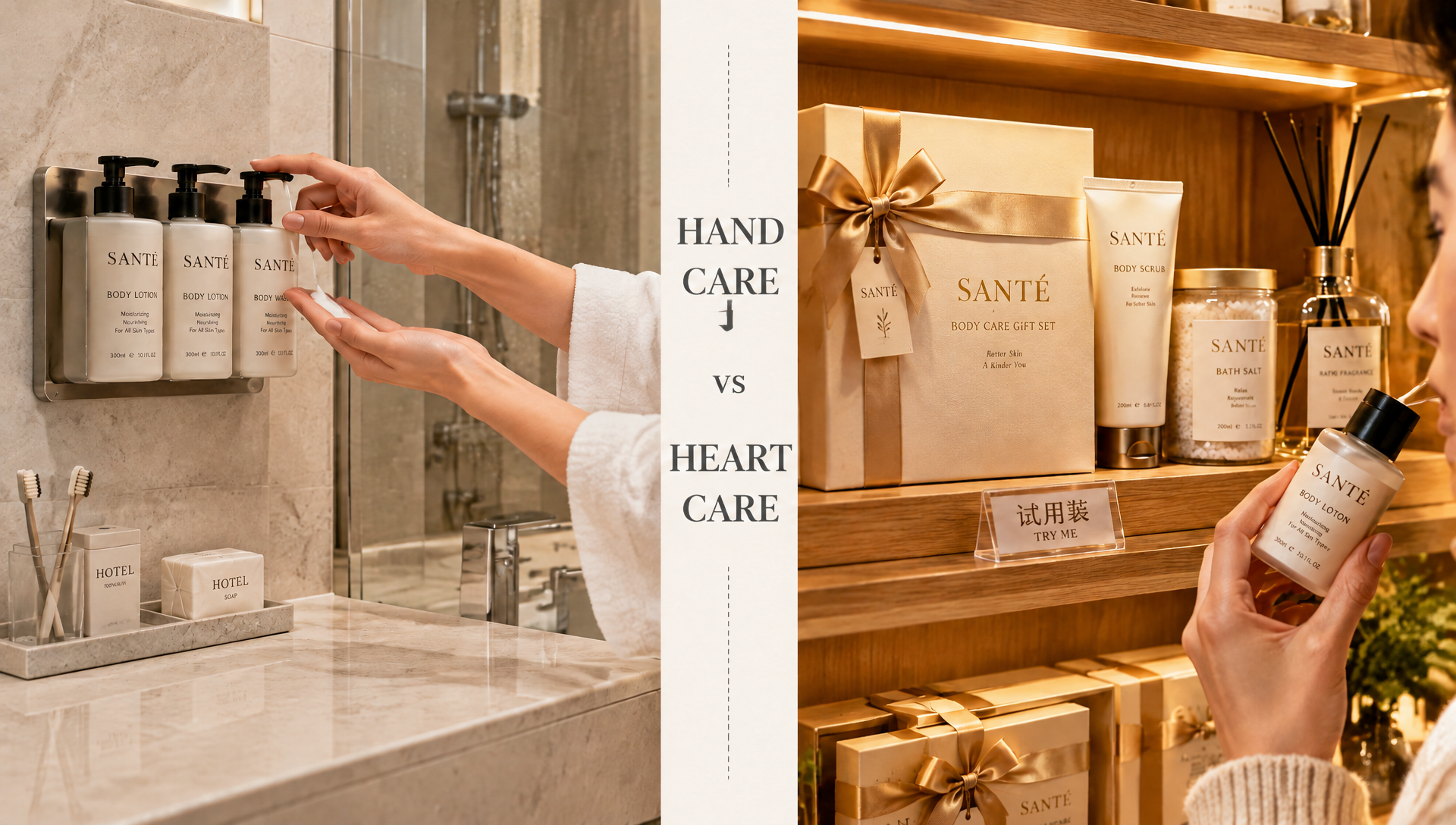
The same bottle of body lotion is a consumable in the guest room and a product in the retail corner. The former needs convenience; the latter needs desirability. These two logics are often mixed into one solution—and both sides end up dissatisfied. Many properties launch a retail corner and then cannot sell anything. In the post-mortem, they blame foot traffic or product selection. The real crack is mixing display with placement. Running retail with guest room amenity placement thinking—of course the goods do not sell. This article separates retail display and guest room placement into two distinct systems, from four perspectives—guest experience, hotel operations, product competitiveness, and profitability—helping properties turn the retail corner from decoration into a profit point.
Guest Experience: Two Identities for One Amenity
What separates an amenity from a product is not a price tag—it is a whole set of behavioural logic differences. See this clearly, and the retail corner has a chance to work.
Amenities in the guest room: the success criterion is being used up. The more convenient, the better the experience and the less waste.
Amenities in the retail corner: the success criterion is being taken away. Guests willing to sacrifice luggage space for it—that is what selling means.
The same bottle of body lotion: the guest room version cares about just-right weight. The retail version cares about whether the story is compelling enough. Different identity—everything in design follows.
Bring consumable thinking into retail, and you get silence on the shelf. Bring selling thinking into the guest room, and you get a cluttered countertop. Both directions are wrong.
Product Competitiveness: Placement Logic in the Guest Room—Convenience Overrides Everything
The first principle of guest room amenity placement is zero thinking. Guests should not need to search, guess, or reach far. This is the baseline of experience.
Toiletries follow water. Fixed at eye level in the shower area. Dental kits follow the mirror—placed directly in front of the user.
High-frequency items on the dominant-hand side. Low-frequency items in drawers. The countertop holds only what will actually be used that night.
Uniform orientation, labels facing the same way. Missing items are visible at a glance during restocking. Housekeeping movement flow shortens accordingly.
The failure signal for guest room display is clear: when guests start calling to ask where things are, the placement has already lost.
Product Competitiveness: Display Logic in the Retail Corner—Desire Overrides Convenience
The retail corner is the opposite. It must make guests stop, pick up, try, desire, and finally place the item in a shopping bag. Every step is designed.
Eye level is the golden shelf. Main products at eye level. Heavy items at the bottom. Light, high-margin items within easy reach.
Display by scenario, not category. Bath salts next to diffusers. Body scrub beside body lotion. Guests see a complete home ritual.
Leave a testing position. Diffusers can be smelled. Hand cream can be tried. Touch before purchase is the iron law of retail.
The failure signal for retail display is equally clear: guests walk past without stopping; stop without reaching; reach without paying. Each link has a corresponding solution.
Product Competitiveness: Three Typical Scenarios Where the Two Logics Clash
When the same product switches identity between the two scenarios, conflict concentrates in three places. Each has a ready-made solution.
Weight conflict solution: split specifications. Guest room version uses small weight. Retail shelf uses gift box. Same formula, two SKUs.
Opening conflict solution: change the cap, not the bottle. Retail version adds sealing inner plug and outer box. Limited cost increase, full shelf presence.
Label conflict solution: dual-version printing. Guest room version prints minimalist Braille-style instructions. Retail version leaves space for fragrance story and origin narrative.
All three scenarios point to the same thing: do not expect one packaging to serve two scenarios. Switching identity has a threshold.
Product Competitiveness: Retail Packaging—The Threshold for Switching Identity
Can guest room packaging go directly onto the shelf? Three criteria—missing one means retail packaging is required.
Complete information: beyond ingredients, origin, and usage, retail packaging needs barcodes and compliance markings. It must scan into the system to sell out the door.
Shelf durability: shelf packaging must withstand lighting and repeated touch. Materials that look old after three days in the guest room cannot go on the shelf.
Externalised value: gift boxes, hot stamping, ribbons—elements that are waste in the guest room are the source of premium in the retail corner.
Retail packaging is not about wrapping guest room packaging more prettily. It is a new design for a different set of consumer behaviour. The cost structure must also be calculated as a product.
Hotel Profitability: Selection and Pricing Principles
Not every amenity deserves a place in the retail corner. The logic of selection is choosing things guests will miss after checkout.
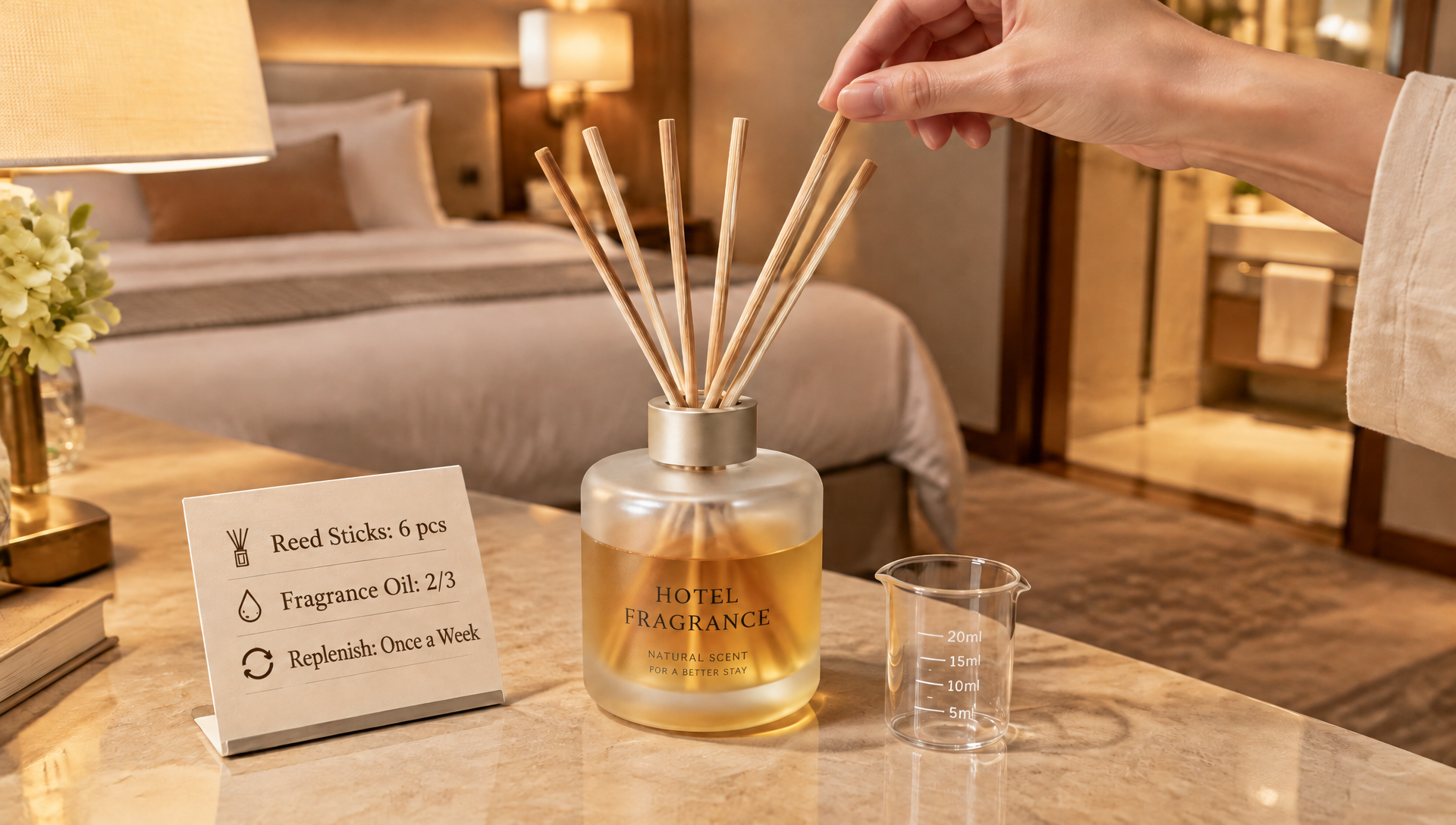
Fragrance first. Diffusers, perfumes, body sprays. Scent memory has the strongest repeat-purchase intent and naturally connects with the guest room experience.
Bath and body care second. Bath bombs, body scrubs, body lotions—categories praised in the guest room have the highest conversion rate.
Pricing anchored to guest psychology. Too much above supermarket prices and no one buys. Too cheap and it lowers the brand. The middle band leaves sufficient margin.
When selection is right, the retail corner sells not just goods—it sells an extension of the guest’s memory of this stay.
Hotel Profitability: The Revenue and Reputation Ledger
When the retail corner is done right, there are two invisible layers of return beyond revenue—both pointing in the same direction.
Retail turnover directly increases revenue per room-night. Especially during peak season and holidays. High-margin items support a small but steady profit line.
Guests take amenities home, and the brand follows the product into the home. This is a cheaper repeat-purchase entry point than any advertisement.
Guests searching for the same item online find the brand store. The retail corner becomes an offline entry point for online traffic.
The guest room is the first scene of experience. The retail corner is the extension line of experience. When both logics are right, amenities complete the journey from cost to asset.
Frequently Asked Questions
Q: Where is the best area and location for a retail corner?
A: Between the front desk movement flow and the lobby exit is optimal. A few dozen square metres is enough. The key is being on the guest’s必经 path and inviting them to stop. Location matters more than area.
Q: Can guest room packaging be used directly for retail?
A: Not recommended. Guest room packaging lacks barcodes and compliance markings, and the packaging cannot withstand shelf conditions. Formal retail should use independent retail packaging.
Q: Which categories should go to the retail corner first?
A: Fragrance categories are the most reliable. Diffusers and body care praised in the guest room have the highest conversion rate. Start with a small trial batch, then expand.
Q: How often should retail displays be adjusted?
A: Adjust by season and occupancy structure. Main display positions update with seasonal fragrance changes. Slow-moving items should yield their place promptly. The shelf should always be reserved for goods that get picked up.
Browse our Hotel Retail Amenity Wholesale Collection—from gift box packaging to display props, and full private label solutions, all covered in one stop. Our flexible production line supports small-batch orders with flexible MOQs.
latest articles
 Nov 02, 2026Retail Corner Display Logic and Guest Room Placement Logic Are Two Different Systems
 Oct 30, 2026Reed Count, Liquid Level and Diffusion Power: How to Tune a Reed Diffuser
 Oct 28, 2026Bulk Miniatures vs Refillable Dispensers: The Real Cost per Room
 Oct 26, 2026The Hotel's Theme Is Desert – Oceanic Notes Should Not Appear in Its Fragrance
Ask For A Quick Quote
If you are looking for more information on our services, or how we could potentially help, we would love to hear from you!