



When Guests Still Smell Your Hotel Lobby Scent on Their Clothes After Returning Home – That's the Repeat-Booking Driver of a Signature Scent
On the third day after checkout, a guest took out his jacket from the wardrobe – the same jacket he had worn on his business trip. On the collar, the warm woody scent of the hotel lobby still lingered. He did not think of a brand first – he named the hotel directly. This scent memory embedded in fabric is the repeat‑booking driver of a signature scent, and the very reason hotels choose a reed diffuser for the lobby instead of an ordinary air freshener. As a hotel amenity manufacturer that produces both reed diffuser base liquids and custom reed diffusers, we have documented many such cases. The longer a fragrance stays on a guest's clothes, the higher the probability the hotel will be remembered. This tracking record breaks down the complete logic of signature scents from four perspectives: guest experience pain points, hotel operational pain points, product competitiveness, and hotel profitability.
File One: Guest Experience Pain Points – The Scent on That Jacket After Checkout
Day 1 after checkout – The guest hangs the jacket back in the wardrobe and smells nothing.
Day 2 – A family member says, "That hotel you stayed at smells nice."
Day 3 – The guest lowers his head and catches the woody note on the collar. He opens the hotel's review page and writes: "The lobby scent was wonderful."
Day 4 – The fragrance fades by one layer.
Day 5 – Only the base note remains on the cuffs.
Day 6 – He starts searching for the name of that fragrance.
Day 7 – The scent is almost gone, but he has already added that hotel to his shortlist for the next business trip.
This is the complete cycle of scent memory. The fragrance of ordinary air fresheners lingers on fabric for less than half a day. The concentration and formulation structure of a reed diffuser determine whether it can last the full seven days. In our lab comparisons, the diffusion efficiency of glass reed diffusers and ceramic reed diffusers in the same space was nearly identical, but the duration of fragrance on fabric differed by as much as double.
The guest experience pain point is not about whether there is a scent – it is whether the scent can be remembered. Many hotels use fragrances but choose the wrong concentration. If the scent is too light, guests pass through the lobby without registering it. If it is too strong, it risks complaints about being overpowering. The signature scent approach keeps the fragrance at the right concentration – quietly settling into the fabric, waiting for the guest to discover it after returning home. What determines adhesion, beyond the base liquid, is the material and density of the reeds themselves – a link that is often overlooked.
File Two: Hotel Operational Pain Points – Scent Discontinuity Is What Procurement Fears Most
The operational pain points often hide in places you cannot see. The most typical is scent discontinuity. Last month, the lobby still had a rich sandalwood note. This month, after switching to a new reed diffuser set, the fragrance suddenly dropped by half. Guests do not directly complain that the scent changed – but negative reviews begin to include vague descriptions like "this hotel feels different now."
Scent discontinuity usually has three causes:
First – inconsistent base liquid batches. The same fragrance formulation with a new batch of raw materials can shift the scent off‑balance.
Second – reeds not replaced in time. Reeds that have absorbed too much base liquid lose diffusion efficiency significantly. Many hotels wait until they can no longer smell the fragrance before remembering to change them.
Third – switching suppliers mid‑stream. Different manufacturers have varying capabilities in replicating the same fragrance. They may share the same name, but the scents are two different things.
As a toiletries manufacturer, we often receive calls from hotels asking: "Can you replicate the scent from our previous supplier?" We can – but only to a point. It will never be an exact match. That is why we always advise: once a signature scent is established, do not change the scent or the supplier lightly. At the very least, build stable base liquid supply and batch‑to‑batch consistency into your procurement requirements for reed diffuser products.
File Three: Product Competitiveness – The Five Elements of a Signature Scent
A signature scent is not just a fragrance name – it is a replicable system. We break it down into five elements – each determines whether the scent will stay on the guest's clothes.
Element 1 – Scent design. The logic of custom home fragrance is to first decide what you want guests to remember at checkout. Woody notes suit business hotels. Floral notes suit resorts. Fruity notes suit family‑friendly hotels. The scent should follow the hotel's positioning – not the perfumer's personal preference.
Element 2 – Base liquid formulation. The base liquid determines concentration and adhesion. A good base liquid must balance fast diffusion with long retention – these two factors pull against each other in formulation and require repeated fine‑tuning.
Element 3 – Reed material. Reed diffuser reeds come in natural rattan, fibre‑composite, and carbonised rattan – each with different absorption speeds and diffusion efficiency. In our tests, fibre‑composite reeds showed the strongest adhesion for woody notes, making them ideal for high‑ceiling spaces like lobbies.
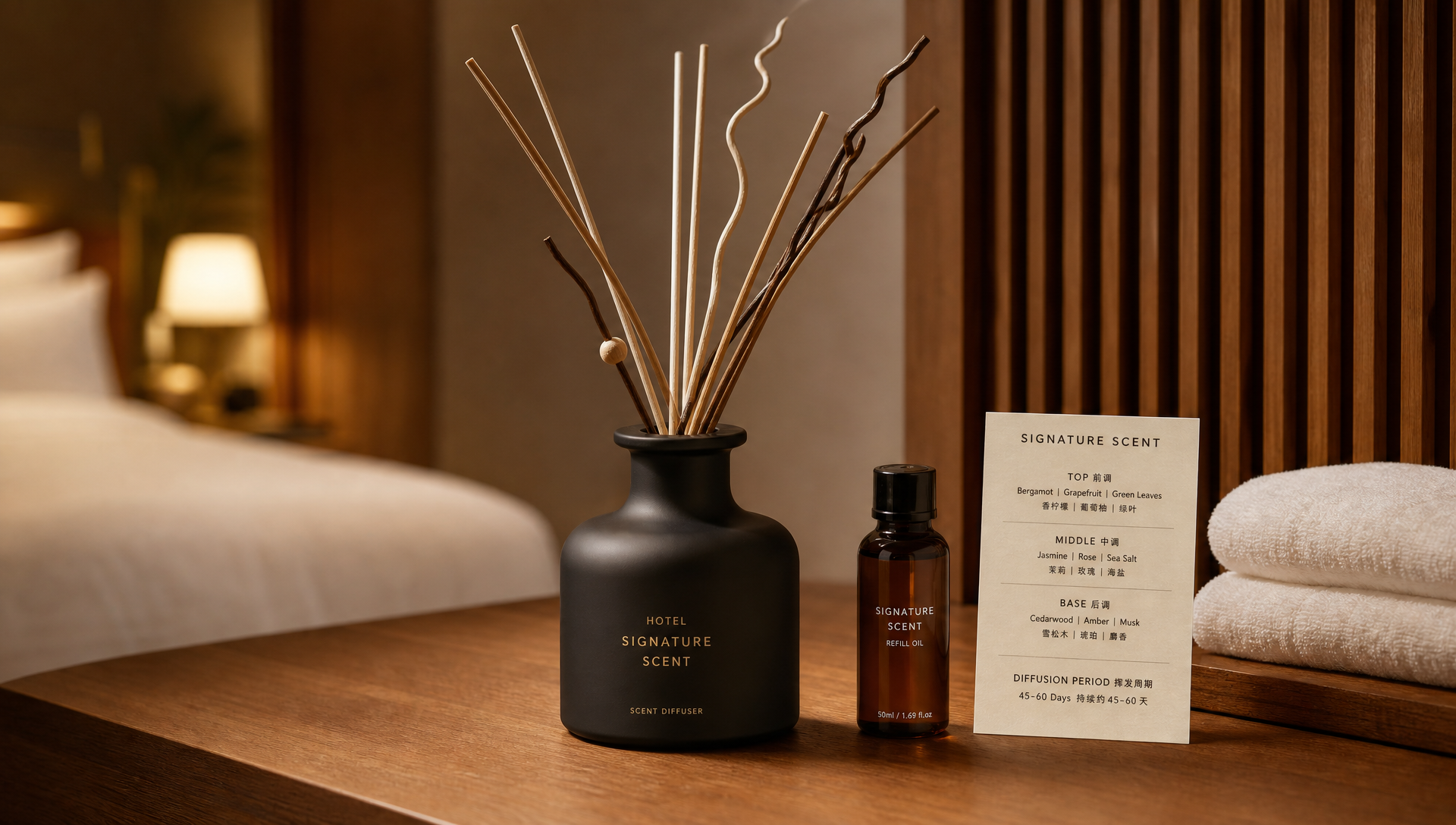
Element 4 – Vessel and packaging. Premium reed diffusers often use dark‑coloured bottles – not just for aesthetics, but because darker materials slow down fragrance evaporation. When procuring empty reed diffuser bottles with gift boxes, pay close attention to the seal structure at the opening. Poor sealing leads to leakage during transit, and the entire reed diffuser experience is compromised. Candle and reed diffuser gift sets are a common choice for suites and executive floors.
Element 5 – Concentration and placement. The same ceramic reed diffuser feels completely different at the front desk versus in the elevator lobby. A large lobby needs higher concentration with more reeds; a small elevator lobby needs only a low concentration.
Additionally, the standardisation level of reed diffuser products determines whether the hotel can purchase the exact same scent two years later – this is a hidden cost that many procurement managers overlook.
The table below compares four common configurations for easy reference.
File Four: Hotel Profitability – A Walking Advertisement
From a profitability perspective, a signature scent is a product that you pay for once but get many exposures in return. The guest walks through the airport in that jacket, takes the high‑speed train, returns to the office – the scent follows them all the way. It is not an ad you pay for, yet it is more trustworthy than an ad – because the scent is on the guest's own body, and they will talk about it proactively.
Our data shows that guests who are asked by family or colleagues "what's that scent on you?" are far more likely to name the hotel than those who book after seeing a hotel ad. The cost of placing a reed diffuser set in the lobby, when divided across each guest room, is negligible – but the repeat bookings and referrals it generates are real revenue.
There is one more ledger that is often overlooked: complaint hedging. When hard metrics like soundproofing, bedding, or breakfast go wrong, negative reviews are almost inevitable. But if a guest has a positive impression of the hotel's scent, their negative review will often include a line like "but the lobby scent was lovely." That single line can win back many potential guests. For holidays, candle and reed diffuser gift sets are also a common choice for hotels to reward loyal members.
The Closing Hook – Next Time You Check Out, Smell Your Collar
Next time you check out, take a moment to lower your head and smell your collar. If the hotel's scent is still there, it means that hotel has already moved into your memory. If you are a procurement manager and want guests to remember your hotel even after they check out, start with a custom reed diffuser. Request a sample, place it in your office for a week, and see if you still want to walk into that office on the seventh day.
Eight Questions Procurement Managers Ask Most About Signature Scents
Q: How long does the scent from a reed diffuser last on clothes?
A: It depends on base liquid concentration, reed material, and space size. Real‑world tests range from two to seven days. For longer retention, choose a high‑concentration base liquid with fibre‑composite reeds – this combination typically lasts over five days.
Q: What is the minimum order quantity for custom reed diffusers?
A: Standard reed diffuser products start at 300 sets, with sampling available before ordering. Custom scents require a sample fee, refundable upon order confirmation. Custom home fragrance has higher MOQs – for first‑time partnerships, we recommend a small batch first, then scale based on market feedback.
Q: Can the lobby and guest rooms share the same scent?
A: Yes – but concentrations must differ. Use a high‑concentration base liquid with more reeds for the lobby, and a lower‑concentration version for guest rooms. This ensures the same scent feels continuous across both spaces, avoiding the jarring contrast of a strong lobby and scentless rooms.
Q: What makes premium reed diffusers different from standard ones?
A: Primarily base liquid quality and fragrance oil purity. Premium diffusers use more stable fragrance formulations with smoother evaporation curves – the top note is not sharp, the base note lasts longer. The vessel and packaging standards are also higher, making them suitable for prominent lobby placement.
Q: When are empty reed diffuser bottles with gift boxes most suitable?
A: For suites, executive floors, and seasonal events. The gift box allows guests to take the diffuser home – usually with a scent description card inside. Once the guest places it in their home, the hotel's name enters their living space – a low‑cost form of word‑of‑mouth marketing.
Q: How often should reed diffuser base liquid be replaced?
A: It depends on reed count and air humidity. Under normal conditions, one bottle of base liquid with six reeds lasts 8 to 12 weeks. However, evaporation is slower in humid regions and faster in dry regions. We recommend checking the liquid level and scent intensity monthly.
latest articles
 Oct 07, 2026How Can High-End SPA Essential Oil Formulation Thinking Be Adapted for Hotel Fragrance Products?
 Oct 06, 2026Those 3 Seconds When Guests Tear Open the Plastic Film on a Toiletry Set – Which Is More Annoying: Packaging That Won't Tear, or Packaging That Tears Too Easily?
 Sep 24, 2026The "Minimalist Toiletry" Philosophy of Nordic Hot Spring Spas: Why Is There Not a Single Chinese Character on the Bottle?
 Sep 22, 2026Same Formula, Different Packaging, 3x the Price? – The Mismatch Between Formulation and Tier Perception

Ask For A Quick Quote
If you are looking for more information on our services, or how we could potentially help, we would love to hear from you!