



Should Beach Resort Lobbies Use Sea Breeze Fragrance? Not So Fast – Most Sea Breeze Scents Smell Like Disinfectant
Summary: We ran an experiment. We placed 6 commonly available "sea breeze" fragrances in a dark room and invited 21 guests who had previously stayed at beach resorts to smell and rate each one on two dimensions: "Does it smell like sea breeze?" and "Does it make you want to go on vacation?" The results surprised everyone – 4 out of 6 were rated as "smelling like disinfectant" by more than half the subjects, and only 1 received a "truly smells like sea breeze" rating. That fragrance was not a synthetic marine scent, but a reed diffuser blended with sea salt, ozone, seaweed, and a woody base.
As a fragrance supplier, we've studied resort lobby fragrances for 6 years and can say with confidence: most "sea breeze" scents smell like disinfectant – not because formulators are lazy, but because the "marine fragrance" category is inherently difficult to get right. This article examines why beach resort lobbies can't just buy any sea breeze scent, and what a qualified reed diffuser should actually be, from four dimensions: guest pain points, hotel operational pain points, product competitiveness, and hotel profitability.
1. The Birth of Three Sea Breeze Scents
Version 1: The "Authentic Marine Scent" Hyped by Distributors
We received an "authentic marine scent" sample from a fragrance company. The moment we opened the bottle, everyone in the office frowned. The smell was hard to describe – a strong chemical note, like disinfectant left out by a pool overnight, mixed with a faint fishy odor. We checked the formula: the main ingredient was synthetic marine fragrance molecule. At very low concentrations, this molecule does have a marine feel – but to achieve an "immediate impact when opened," the concentration is typically pushed too high. At high concentrations, marine becomes disinfectant.
Version 2: The "Fresh Sea Breeze" Assembled from Botanicals
Another approach to "sea breeze" takes a botanical route – blending mint, cypress, and lavender to simulate sea breeze with a cooling sensation. It smells clean and fresh, like freshly laundered sheets. But it doesn't smell like the sea. Sea breeze carries saltiness, humidity, seaweed notes, and the warmth of sun-baked wood. Mint and lavender can't reproduce these. This fragrance works fine in premium city hotels, but in a beach resort, guests will only think "clean" – not "I'm already at the beach."
Version 3: A Formula Rejected Multiple Times
Our own sea breeze formula went through seven versions before passing. The first five failed on the same problem – either too sweet, too fishy, or too much like disinfectant. Version six brought a breakthrough: we abandoned single-note marine fragrance and adopted a four-layer structure – a base of seaweed and ambergris notes, a middle layer of ozone and sea salt for humid air sensation, a top layer of cedar and vetiver for woody depth, and a hint of lemon to smooth the edges. These seven versions took two years, with 4,000 blind tests across 13 resorts. The final version achieved a 78% "smells like sea breeze" approval rate and 69% "makes me want to go on vacation" approval rate.
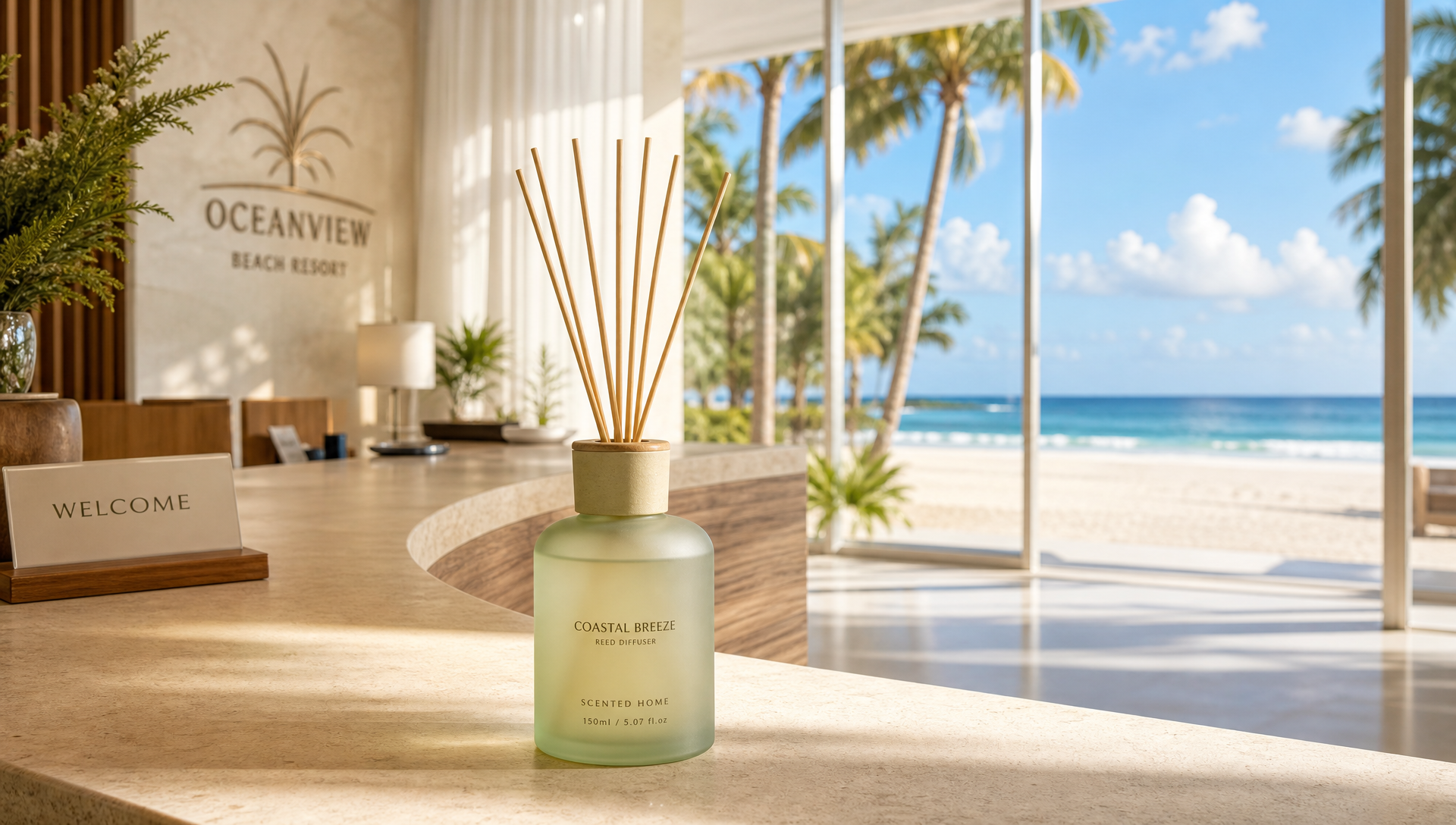
But fragrance is only the first hurdle. The same formula, in different containers, produces completely different diffusion results. We tested four delivery methods – candles, sprays, electric diffusers, and reed diffusers – measuring diffusion radius and duration under the same lobby conditions. The results varied significantly. Candles have open-flame risks and fragrance degrades during burning. Sprays push scent to the farthest reach within 5 minutes, but fade completely after 30 minutes. Electric diffusers need power and regular maintenance – if the power goes off, the lobby returns to neutral. Reed diffusers have the slowest diffusion speed, but win on consistency and stability – a 100ml reed diffuser can maintain uniform scent in a lobby for 6–8 weeks, with no electricity, no flame, and no maintenance.
2. Guest Pain Point: Disinfectant Smell Is Worse Than No Scent
The lobby is the resort's first business card to guests. In the first 30 seconds after guests walk through the door with their luggage, their olfactory system completes an unconscious scent evaluation. This evaluation directly determines the guest's initial trust in the entire hotel.
A scent-free lobby doesn't add or subtract points – guest attention shifts naturally to visual and auditory cues. But a lobby that smells like disinfectant triggers negative associations directly. Disinfectant scent is cognitively linked to "hospital," "sterilization," and "discomfort" – guests smelling it subconsciously feel "this place needs to be disinfected." But the beach resort context is "relaxation," "vacation," "escape from daily life." When the two misalign, the brain signals "something is off."
One guest we interviewed described it this way: "I frowned the moment I walked into that lobby. I couldn't say what was wrong – I just felt this resort wasn't what I expected." He couldn't name "disinfectant," but his perception had already downgraded the hotel.
From a guest needs perspective, resort guests don't just want "some scent" – they want to "know they've arrived at the beach just by smelling." There's no substitute for this. A potted plant won't do it. Ocean wave white noise won't do it. Tropical background music won't do it. Scent is the only sensory channel that operates at the subconscious level.
3. Operational Pain Point: A Lobby Scent Mistake Is a 24/7 Repeated Error
The operational problem is: lobby scent isn't a one-time mistake – it's a 24-hour loop of the same error.
We tracked one beach resort's guest reviews. Among 428 OTA reviews, 17 mentioned the lobby scent – all negative. Keywords included "strange smell," "disinfectant smell as soon as I walked in," "lobby scent is overwhelming." Seventeen negative reviews account for 4% of all reviews – which seems low, but considering only a small fraction of guests actively mention scent in reviews, the actual proportion of guests who perceived something wrong with the lobby scent is much higher.
Even more troublesome: lobby scent errors are persistent. One wrong diffuser placed for one month means one month of errors – three months means three months of errors. Every guest passing through the lobby every day receives the same negative signal. Guests might not write a negative review specifically about lobby scent, but it lowers their overall expectations for rooms, dining, and service. It's a silent deduction that quietly undermines satisfaction scores across other dimensions.
From an operational standpoint, resorts don't need the strongest scent, or the most expensive one – they need a scent validated by real guests. Before a diffuser goes into full lobby deployment, it should undergo real guest testing on a small scale. The cost of this testing is minimal – but it prevents placing a scent that smells like disinfectant throughout the entire lobby.
As a fragrance supplier, we've encountered too many clients who select fragrances solely by name – "Sea Breeze," "Ocean," "Sea Salt" – all beautiful names, but when they receive the product, it's completely different. A good name doesn't solve the problem. Whether a scent is right is for guests' noses to decide.
4. Product Competitiveness: Five Hurdles a Qualified Sea Breeze Reed Diffuser Must Clear
We break down a qualified sea breeze reed diffuser into five hard metrics:
First, the fragrance must be multi-layered. Real sea breeze isn't a single note – it's a stack of scent layers: saltiness from sea salt, freshness from ozone, humidity from seaweed, warmth from sun-baked wood. All four are essential. A single synthetic marine fragrance imitating sea breeze will inevitably reveal its chemical nature over time.
Second, concentration must be restrained. A good sea breeze scent is faintly perceptible at 3 meters, clearly detectable at 1 meter, and not pungent at nose level. This requires careful concentration calibration. Many sea breeze scents fail on concentration – too little and it's unnoticeable; too much and it becomes disinfectant.
Third, the carrier must be stable. Fragrance exposed to air oxidizes and degrades. A good formula needs an antioxidant system to maintain consistency throughout the 6–8 week usage cycle. We've tested poor-quality scents that started turning sour in week two – while premium scents remain nearly identical to week one at week eight.
Fourth, adaptability must be verifiable. Different lobbies have different areas, ceiling heights, and ventilation conditions. A diffuser that works well in one lobby may perform completely differently in an atrium. We conduct diffusion tests based on each client's actual lobby environment – adjusting reed count and fragrance concentration accordingly.
Fifth, ingredients must be traceable. Fragrance ingredient origins, purity, and batch records should all be documented. We insist clients review ingredient test reports – because a diffuser confident enough to show you its formula is the only kind that can stand long-term exposure to guests' noses.
5. Three Sea Breeze Fragrance Types – Full Comparison
This table comes from our actual test data over 6 years. As a fragrance supplier, we present it as the first document to clients – review the table first, then discuss collaboration.
6. Profitability: The Right Diffuser Earns Time for the Lobby
A resort lobby's profitability potential lies in guest dwell time.
Every extra minute a guest spends in the lobby is another minute to see activity posters, spa package introductions, and restaurant recommendations. And these displays only work when guests are willing to stop. Scent is precisely the invisible factor influencing dwell time.
We ran an experiment at one resort – switching lobby scent from synthetic marine to compounded sea breeze – and observed guest behavior at the entrance. Average lobby dwell time increased from 2 minutes 18 seconds to 3 minutes 47 seconds – over 60% improvement. As dwell time increased, the proportion of guests taking photos in the lobby rose from 31% to 47%. Every geo-tagged photo is a free social media impression.
Even more valuable is memory. A resort may host tens of thousands of guests annually – but few are remembered. Scent is one of the few carriers capable of forming long-term memory. A well-chosen diffuser in the lobby means that after guests leave, when they encounter a similar scent at a mall, they'll remember this resort. This is the lowest-cost "brand compounding."
From a profitability perspective, the cost of a diffuser is minimal relative to resort operating expenses – but it simultaneously impacts three areas: dwell time, photo sharing, and brand memory. Each of these directly or indirectly contributes to revenue. This is the logic we emphasize repeatedly when designing solutions for clients – scent isn't a consumable; it's marketing.
7. FAQ
Q: How do you tell if a sea breeze fragrance smells like disinfectant?
A: The most direct method is a blind smell test. Gather 5–10 people, have them smell both the sea breeze fragrance and actual scent samples collected from the seaside – like a towel soaked in seawater or sun-baked driftwood – and see if they can tell the difference. We use three criteria: Is it pungent on first sniff? Is it still pleasant after 30 minutes? Does it become cloying after 3 days of continuous exposure? Passing all three qualifies. As a supplier, we recommend clients request blind-testable samples during selection – don't just rely on the name.
Q: Do beach resort lobbies have to use sea breeze scent?
A: Not necessarily. Sea breeze works best for resorts with ocean views, pools, and beaches – because the scent has a natural associative bond with the setting. For city resorts or non-beach themed properties, choose a fragrance consistent with your positioning – like citrus, white tea, or woody notes. Scene matching matters more than the scent itself. However, we've found that 90% of clients choosing a beach resort theme eventually gravitate back to sea breeze – the key is getting it right.
Q: Reed diffuser vs electric diffuser – which is better for lobbies?
A: It depends on the use case. For large lobbies with high ceilings and good ventilation, reed diffusers offer the advantage of no power source, no maintenance, and 6–8 weeks of stable output – ideal for 24/7 lobbies. Electric diffusers have larger diffusion range but need power, regular cartridge replacement, and can fail entirely during outages. When designing solutions for resort clients, we typically recommend reed diffusers as the primary lobby scent, with electric devices for supplemental fragrance in specific zones. Both can be used together.
Q: How long does one reed diffuser last? When does it need replacing?
A: For a 100ml unit under standard lobby conditions, approximately 6–8 weeks. Actual duration is affected by three factors: reed count, lobby area, and air circulation speed. More reeds accelerate diffusion – larger lobbies dilute the scent faster. We recommend setting the replacement cycle at 8 weeks, tracking scent intensity changes before each replacement – allowing quarterly usage and effectiveness reviews.
Q: Will sea breeze fragrance make guests think of chemicals?
A: This is exactly why we developed the compound sea breeze formula. Pure synthetic marine fragrances can indeed produce a "chemical" feel when concentration is poorly controlled – guests may not articulate it, but their noses will judge it as disinfectant. The compound formula uses sea salt, ozone, seaweed, and woody base in multiple layers – avoiding the "chemical" feel of single-note synthetics. Our blind test data shows compound formula was rated as "natural, like real sea breeze" at 7 times the rate of single synthetic fragrances.
Q: How long does custom lobby sea breeze scent development take?
A: The standard customization cycle is 6–8 weeks, covering fragrance tuning, concentration calibration, reed count testing, and stability verification. For completely new fragrance development from scratch, the cycle extends to 12–16 weeks. We recommend resort clients start custom projects at least 3 months before peak season – allowing sufficient testing and adjustment time.
8. Conclusion
Six sea breeze fragrances, 21 guests, 4,000 blind tests. The data tells us one thing: guests' noses are more honest than fragrance companies' naming. Just because it's called "sea breeze" doesn't make it one – if it smells like disinfectant, that's what it is.
Beach resort lobby scent selection isn't about buying one diffuser and calling it done. Fragrance accuracy, concentration control, carrier stability, adaptability validation, ingredient traceability – five hurdles, none optional. An error in any one, and guests will judge within 30 seconds of walking in.
As a fragrance supplier, our creed is simple: A great lobby scent isn't about making guests think "this smells nice" – it's about making guests think "I've arrived." Arrived at the beach. Arrived at vacation. Arrived at the place where they can finally relax. This feeling needs no verbal explanation – the nose completes the entire judgment for the brain.
That's the standard of luxury hotel supplies – not the most expensive fragrance, not the most elaborate name – but the scent that makes guests naturally take a deep breath the moment they walk through the door.
latest articles
 Aug 19, 2026What Do Biodegradable Bottles Actually Degrade Into in Hotel Settings? We Buried Them for 180 Days – You Won't Believe What We Dug Up
![]() Aug 17, 2026Why Do Shampoo Bottles in Semi-Open-Air Hot Springs Always Get Moldy from the Bottom First?
Aug 17, 2026Why Do Shampoo Bottles in Semi-Open-Air Hot Springs Always Get Moldy from the Bottom First? Aug 13, 2026Should Beach Resort Lobbies Use Sea Breeze Fragrance? Not So Fast – Most Sea Breeze Scents Smell Like Disinfectant
 Aug 11, 2026The Hotel Detail Solo Travelers Care About Most – The Smell of the Room After Lights Out


Ask For A Quick Quote
If you are looking for more information on our services, or how we could potentially help, we would love to hear from you!