



The One Hotel Detail Solo Travelers Care About Most: The Smell in the Room After the Lights Go Out
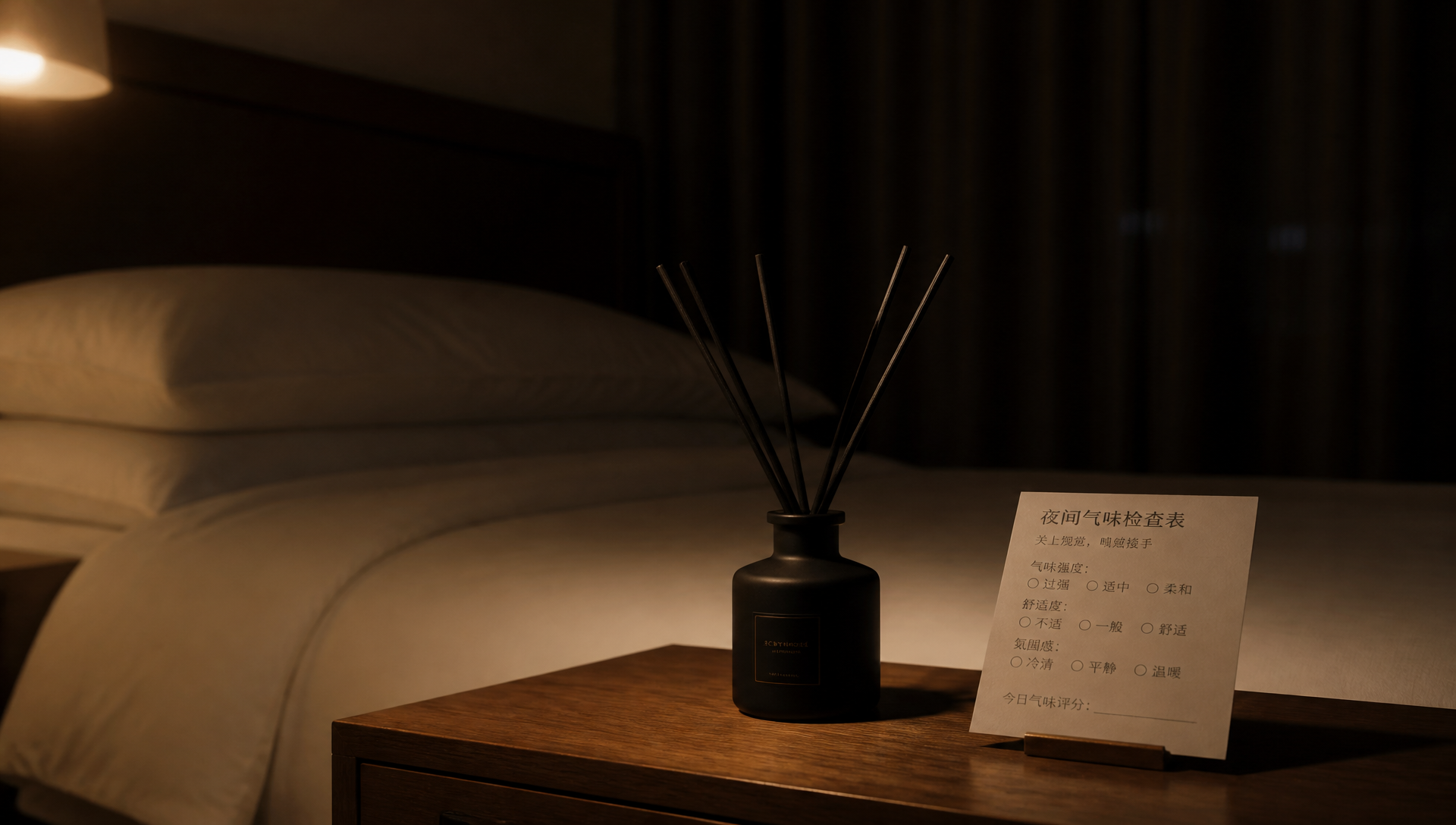
A hotel room during the day and at night can feel like two different rooms. During the day, you see curtains, lighting, and bedding. After the lights go out, all that information exits. The only sense still working is smell. Solo travelers are especially sensitive to this change – because there is no companion to distract them with conversation. Every trace of odor in the room gets amplified: dampness, smoke, moisture left by the previous cleaning, and even the fragrance treatment itself. This article explains, from four perspectives – guest experience, hotel operations, product competitiveness, and profitability – where that smell after lights out comes from, and what products like acetate fragrance diffusers can and cannot solve.
Guest Experience: During the Day You See the Room – After Lights Out, Only Smell Remains
During the day, guests make most judgments with their eyes: curtains, lighting, bedding neatness, water marks on the countertop.
After lights out, visual information disappears entirely. Smell and touch take over. The room's scoring criteria are completely swapped within minutes.
At night, doors and windows are closed, air conditioning runs at low speed, and odor has almost no dilution channel. Concentration accumulates slowly.
A fragrance treatment that felt just right during the day often becomes too noticeable in the dark.
Guests often cannot articulate what is wrong. They end up writing a vague review: "The room had a smell."
The hardest part of handling such feedback is that there is almost no evidence other than the time point. By the next day, the smell may already be gone.
Guest Experience: Why Solo Travelers Are Especially Sensitive to Smell
Staying alone means no conversation to distract attention. Every detail in the room is repeatedly perceived.
Many people's first action upon entering is to open a window. The second is to move fragrance products further away.
An unfamiliar environment itself keeps people alert. In this state, smells are more easily interpreted as threats.
Smell directly affects sleep onset and sleep depth. How they feel the next day is often attributed to the room, not their own schedule.
Long-stay guests develop path dependency. If the smell is right, they extend. If not, they change hotels – often with almost no communication in between.
Female guests and older guests have lower tolerance for odors. This appears repeatedly in review data.
Product Competitiveness: Neutralizing Odors and Spraying Fragrance Are Two Different Paths
Spraying fragrance solves the moment you smell it. Acetate fragrance diffusers solve how much odor the room originally has.
The direction of acetate systems is neutralization and reducing irritation – relying on acidic components to interact with odor molecules, not covering with stronger fragrance.
This is also why it suits nighttime: at low concentration, it does not disturb sleep, and during the day it does not leave a strong presence.
Reed carriers, spray formats, and solid forms each have their scenarios. Bedrooms and bedside areas suit slower-release carrier formats.
Whichever product is used, the prerequisite is that the source is cleaned first. Otherwise, fragrance and odor stack – and the guest experience is worse than no treatment at all.
We recommend writing suitable concentration and coverage area into the formula sheet – avoiding properties using it by feel.
Product Competitiveness: Four Smells at Night, Each with Different Sources
Damp and musty smells are usually not a linen problem. Check AC filters, floor drains, and curtain folds first.
Disinfectant smell often comes from excessive cleaning agent and insufficient ventilation. Extending ventilation is more effective than adding fragrance.
Smoke left by the previous guest adsorbs onto soft furnishings, curtains, and mattress protectors. Covering with fragrance only creates a third smell.
Fragrance that is too strong is the most easily overlooked. It may be placed too close to the bed, or the concentration was set to daytime standards.
The four smells have completely different handling sequences. Classify first, then act – more time-saving than replacing an entire batch of linen.
Write the smell category into the shift handover log. Only then does the next day's tracing have a starting point.
Hotel Operations: The Last Step of the Room-Making Process Is Most Easily Done Wrong
Many properties treat fragrance treatment as a finishing action, feeling the room is only complete after it. In fact, it most easily masks real problems.
A more reasonable sequence is ventilation, source treatment, and finally optional fragrance treatment – with concentration set to nighttime standards.
AC filter replacement cycles and room-making processes are not on the same schedule. This is the root cause of recurring odor problems.
Linen replacement and soft furnishing treatment often belong to two different positions. Rooms with smoke smell most easily miss the soft furnishing part.
Humidity changes during rainy season and seasonal transitions make the same process produce completely different results. Checklist items must adjust with the seasons.
A small bottle can be kept on the linen cart, but it is limited to temporary odor treatment. It cannot replace source treatment.
Hotel Operations: Odor Cannot Be Accepted by the Eyes
Visual acceptance has standards. Odor acceptance can only rely on the nose – and everyone's olfactory threshold differs greatly.
The same employee smelling the same room at different times may reach different conclusions. Fatigue and recently smelling something else both affect judgment.
A feasible approach is to set an upper limit for the room's odor rather than a specific fragrance type. As long as it does not exceed the limit, it passes.
Fragrance-free can also be a standard for a qualified room – especially at properties with a high proportion of sleep-sensitive guests.
Let a finished room sit for a period before entering to judge – avoiding mistaking cleaning agent smell for the original state.
Include odor in the room inspection items. Even a simple column makes this matter documented for the first time.
Hotel Operations: The Cost of Nighttime Contact for Solo Guests Is Higher Than During the Day
Calling the front desk at night has a high threshold. Many would rather endure until morning. This means feedback is swallowed in large quantities.
The result of enduring until morning is that guests do not complain – but they remember, and they do not return.
What the night shift can do is limited. Changing rooms is the most effective. The next is offering a closable or reducible option.
If the front desk can give a clear handling口径 at night, guest tolerance rises noticeably.
When housekeeping follows up the next day, it is best to bring the specific description from the previous night – not judge by experience alone.
One room's odor problem often involves adjacent rooms on the same floor – because odor flows through air conditioning and corridors.
Product Competitiveness: A Night Odor Checklist That Can Go into the Housekeeping Manual
First, ventilation: open windows or turn on fresh air upon entering. Let the air fully circulate at least once.
Second, source inspection: AC filter, floor drain, curtains, and soft furnishings – go through in sequence.
Third, linen and soft furnishing confirmation by separate positions. Rooms with smoke smell cannot just change linen.
Fourth, fragrance treatment: concentration at nighttime standard, position away from the bedside.
Fifth, settle and recheck: after completion, wait a period before entering to confirm again.
Sixth, record: write down smell category and handling actions for the next day and next shift.
The value of this table is that it turns something felt by intuition into something that can be handed over.
Profitability: Sleeping Well Is the Hardest Selling Point to Fake
Sleeping well cannot be shown in pictures, nor explained in one sentence. It can only be written by guests themselves in reviews.
Odor-related negative reviews are hardest to argue against – because guests describe physical sensations, and properties find it hard to give a convincing explanation.
Conversely, a room that lets people sleep soundly gets repeatedly recommended to similar guest groups – especially solo travelers.
Solo travelers generally have higher repeat stay intention than group guests. Their decision chain is short – rarely led by meetings or corporate rates.
A fragrance-free option and closable fragrance treatment are the lowest-cost experience upgrades for many properties.
Writing odor into room inspection standards turns a vague matter into replicable guest room quality.
Frequently Asked Questions
Q: Why does the room smell stronger after lights out?
A: After visual information disappears, smell becomes the main judgment channel. Combined with closed doors and windows and low-speed air conditioning, odor lacks dilution channels. Concentration accumulates slowly.
Q: Can an acidic system cover odors?
A: No. Its direction is neutralization and reducing irritation. Source problems must be treated first. Otherwise, after fragrance and odor stack, the guest experience is worse than no treatment.
Q: Is a fragrance-free room the safest approach?
A: Not necessarily. A more reliable approach is giving guests a closable or reducible option – handing the choice to guests. The same room can then serve people with different sensitivities.
Q: How should the night shift handle an odor complaint?
A: First determine the smell category. Change rooms if possible. Then write the room number and source judgment into the shift handover log – for next-day tracing and source treatment.
Browse our Acetate Fragrance Collection – from reed carriers to fragrance formulas, and full private-label solutions, all covered in one stop. Our flexible production line supports small-batch orders with flexible MOQs.
latest articles
 Oct 15, 2026The One Hotel Detail Solo Travelers Care About Most: The Smell in the Room After the Lights Go Out
 Oct 13, 2026An Outdoor Hot Spring Fragrance Diffuser Left in the Rain All Night – Can It Still Be Used the Next Day?
") Oct 09, 2026When Guests Pick Up the Large Toiletry Bottle to Check the Brand Name – Your Bottle Is Making a Silent Sale for You-(1)
Oct 09, 2026When Guests Pick Up the Large Toiletry Bottle to Check the Brand Name – Your Bottle Is Making a Silent Sale for You-(1) Oct 09, 2026When Guests Pick Up the Large Toiletry Bottle to Check the Brand Name – Your Bottle Is Making a Silent Sale for You
Ask For A Quick Quote
If you are looking for more information on our services, or how we could potentially help, we would love to hear from you!