



What Do Biodegradable Bottles Actually Degrade Into in Hotel Settings? We Buried Them for 180 Days – You Won't Believe What We Dug Up
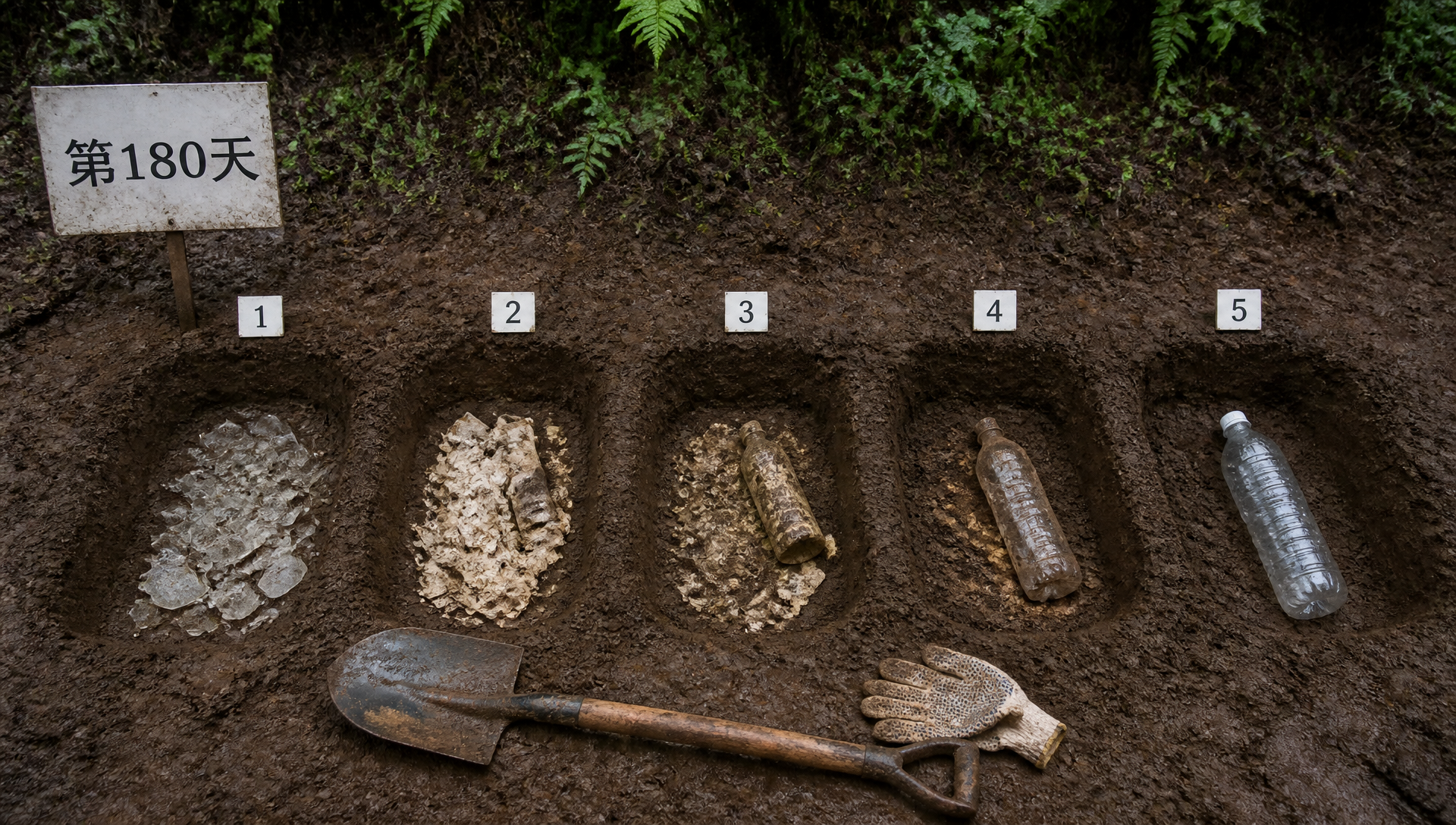
We buried 48 biodegradable bottles in five experimental pits behind a resort. When we dug them up 180 days later, the first image left the procurement manager standing there stunned for a few seconds. There was none of that dramatic powdering you see in promotional videos. The PLA‑formula bottles were still standing – but crumbled into pieces at the lightest squeeze, like soggy biscuits. What truly caught us off guard was the corn‑starch composite formula – it had all but vanished, leaving only a faint white outline in the soil. This experiment taught us that the degradation speed of biodegradable bottles depends on formulation, soil type, humidity, and even burial depth. For hotels using biodegradable bottles, you cannot just look at the label. An eco‑upgrade to biodegradable bottles is, at its core, a matter of matching formulation to scenario. As a hotel amenity supplier, we have compiled the 180‑day excavation record, a four‑dimensional analysis, and the most frequently asked questions from procurement managers – presented below for reference.
Part One: Guest Experience Pain Points – Guest Trust in Eco‑Labels Is Becoming Fragile
Guests care about environmental responsibility more concretely than many hotels realise. In a guest survey we conducted, over 60% of guests said they glance at the bottles on the bathroom counter when checking in. Seeing the words "biodegradable" puts them at ease. Not seeing it doesn't make them angry – but if they see it and find something wrong, their reaction is fierce.
The guest's pain point is that they cannot tell authentic from fake. Biodegradable bottles and ordinary plastic bottles feel almost identical to the touch – guests can only rely on labels, smell, and appearance. One guest wrote in a review: "Labelled biodegradable but feels no different from regular plastic – isn't this a wolf in sheep's clothing?" The bottle packaging had a green leaf pattern, but the bottle itself was hard and glossy. This disconnect actually damages trust.
The reverse case is even more concerning. One resort stored biodegradable and ordinary bottles in the same warehouse, and they got mixed together during disposal. A detail‑oriented guest filmed it and posted online with the caption: "Green packaging, grey recycling" – undoing the work of dozens of promotional articles. What guests truly want is not complicated environmental declarations – it's visible sincerity. A bottle that is brittle but doesn't shed fragments, uniform wall thickness, clear labelling of shelf life and degradation conditions – these are details guests can see.
The small bottles on the bathroom counter are the guest's only window into a hotel's genuine commitment to sustainability. When this window is well‑kept, guests will speak up for the hotel. When it is not, the eco‑label itself becomes a liability. For hotels, switching to biodegradable bottles is not simply a packaging change – it is a promise that guests can verify at any time.
Part Two: Hotel Operational Pain Points – Three Additional Ledgers After Switching Bottles
The biggest difference between biodegradable and ordinary bottles is that biodegradable bottles have a limited lifespan. Ordinary plastic bottles last two to three years without issue. Biodegradable bottles, stored in a high‑humidity warehouse for a few months, quietly become brittle – housekeepers find that the neck cracks with a gentle twist. When a guest receives a cracked bottle, their first thought is not "the bottle is faulty" – it's "the hotel has poor management."
The first ledger – inventory management changes. Biodegradable bottles require a dry, light‑proof storage environment, with a shorter shelf life than ordinary bottles. Procurement managers must calculate turnover days. Warehouses must designate a separate dry storage area. Hotels with fluctuating room occupancy must also prevent overstocking and expiry. These are all new operational workloads.
The second ledger – room wastage rate rises. Thin‑walled biodegradable bottles tend to collapse when pump dispensers are installed – the body deforms, and this becomes quite noticeable on the countertop. Our measurements show that bottles with substandard wall thickness from the same batch can have a room wastage rate over 20% higher.
The third ledger – procurement comparison becomes harder. Both labelled "biodegradable," but formulations vary widely. Some are corn‑starch based, others are filled with various additives – price and performance rarely match. Procurement managers find that their old comparison tables no longer work – they now need to check test reports, formulation descriptions, and even bury test samples themselves. Replacing hotel amenities is rarely a simple swap – changing the bottle material means the pump head, label, and sealing process all need to be revalidated – an entire chain must be retested.
These added costs make many hotels hesitate at the eco‑upgrade threshold. The procurement manager's real dilemma is: afraid to switch entirely in case problems arise halfway, but also unable to stay put, because both environmental audits and guest reputation are pushing forward. The key to breaking the deadlock is to turn the decision into a data‑driven experiment – not a guess.
Part Three: Product Competitiveness – The 180‑Day Excavation Record
We divided 48 bottles into five groups, corresponding to five experimental pits. All pits were dug to a depth of 30 cm, but soil type and moisture content varied. Pit 1 was on a sunny slope with drier soil. Pit 2 was in a shaded area with higher humidity. Pits 3 to 5 were buried along the same line for easy comparison. We excavated observation points every 30 days to record changes, with the final excavation on Day 180.
On the final excavation day – an overcast day – we crouched by the pits. No one spoke when the first shovel went in. Here are the results from all five pits.
Pit 1 – PLA formulation, dry soil. The bottles showed the least change – only fine cracks on the surface. They still had some strength when squeezed. This shows that dry environments barely trigger degradation.
Pit 2 – PLA formulation, moist soil. The bottles were visibly brittle – crumbling into pieces with a squeeze. But the fragments still held the bottle shape – the degradation was at the fragmentation stage, not yet fully mineralised.
Pit 3 – Corn‑starch composite formulation, moist soil. This group came closest to complete disappearance. The bottles had shrunk and curled, leaving only a faint white outline – they crumbled to powder at the lightest touch.
Pit 4 – Thick‑walled PLA formulation, moist soil. The bottles were bent and deformed but did not fragment. The thicker walls actually impeded degradation – greater toughness meant slower decomposition.
Pit 5 – Ordinary plastic control bottle. Completely intact after 180 days – could still be used after wiping clean. The contrast with Pit 3, which had all but dissolved, was stark.
This experiment answered the question that hotels care about most: how long does it actually take for biodegradable bottles to disappear? The answer: some can turn to powder within a quarter, others take years – it all depends on formulation and burial environment. PLA formulations have a long enough shelf life in dry guest rooms, and only begin to accelerate decomposition once they enter a wet landfill – exactly the behaviour hotels want. But when purchasing, pay close attention to wall thickness and filler ratios – these two parameters directly determine degradation speed and in‑room performance.
The table below compares the three most common biodegradable solutions.
The experiment proves that biodegradable bottles should not degrade as fast as possible. Too fast – the in‑room performance collapses first. Too slow – the eco‑label becomes hollow. A qualified biodegradable bottle must hit the sweet spot: long enough shelf life to perform in rooms, yet degradable after disposal. This balance depends entirely on formulation.
Part Four: Hotel Profitability – How to Make the Eco‑Move Pay Off
The financial return of eco‑upgrades is not about saving money – it's about accumulating value over time. We tracked resorts that switched to qualified biodegradable bottles. In the first quarter, loss data was slightly higher than the same period before the switch. But from the third quarter onwards, three key indicators all moved in a positive direction.
The first is reputation. Mentions of eco‑keywords in reviews rose significantly. Some guests even took photos of the biodegradable marks on the bottles and shared them on social media – this organic word‑of‑mouth is something advertising budgets cannot buy.
The second is risk mitigation. If the wrong biodegradable bottle is chosen and cracks occur mid‑stay, complaints will surge – the total cost of handling a single negative review far exceeds the cost of hundreds of bottles. Choosing the right bottle closes off that risk in advance.
The third is repeat bookings. Eco‑conscious guests have stronger repeat‑booking intent – they are willing to pay more for visible green practices and are more likely to recommend a genuinely eco‑friendly hotel to friends.
The fourth is regulatory compliance. More and more regions are including guest room amenity sustainability in their procurement reviews. Biodegradable bottles are becoming an entry ticket, not just a brand enhancer. Hotels that complete the switch early remove one shortcoming during these reviews.
The hardest part of an eco‑upgrade in hotel amenities is not changing the bottle – it's ensuring the entire chain runs without a hitch – from procurement, storage, and usage to disposal, each link is connected. Our recommendation to hotels is to phase the transition: start with one building as a pilot, run a quarter's worth of loss data, and then decide the roll‑out pace. Turning the eco‑upgrade into a data‑driven experiment, rather than a reputational gamble, is how the numbers add up.
Frequently Asked Questions
Q: How long can biodegradable bottles last in hotel guest rooms without problems?
A: In normal guest room conditions, qualified biodegradable bottles have a shelf life of approximately 12 months. Storage should be dry and away from light. For warehouses with humidity above 60%, we recommend faster turnover and FIFO (first‑in‑first‑out).
Q: If the bottle could still stand after 180 days buried, does that mean the supplier exaggerated their claims?
A: No. Degradation requires three conditions to be met simultaneously: temperature, humidity, and microorganisms. The dry environment of a hotel guest room is not supposed to trigger degradation. True decomposition begins after the bottle leaves the hotel and enters a landfill.
Q: Which is better for hotels – corn‑starch composite bottles or PLA bottles?
A: It depends on what you prioritise. Corn‑starch composite bottles degrade faster and look better environmentally, but the bottle walls are softer and prone to deformation when pump dispensers are installed. PLA bottles have better toughness and more stable in‑room performance – most hotels choose PLA formulations.
Q: How do I tell if a supplier's bottles are genuinely biodegradable or just greenwashing?
A: Check three things: (1) degradation test reports, (2) formulation composition documentation, and (3) actual burial test results. Suppliers willing to provide detailed burial cycle data and soil analysis are far more credible than those that just print an eco‑label.
Q: Will biodegradable bottles leak during guest use?
A: Not during the intended usage period – provided the formulation and wall thickness meet standards. Our tested PLA formula bottles showed no issues during six months of room use, including pressing, inversion, and transportation vibration. Focus on wall thickness and sealing quality when selecting.
Q: Should a hotel switch all shampoo bottles to biodegradable at once?
A: Not recommended. Start with one room type or one building as a pilot, collect a quarter's worth of loss data, and then decide the roll‑out pace. A full switch all at once carries many times more risk than a controlled pilot.
Q: Are biodegradable bottles significantly more expensive?
A: With bulk procurement, the cost gap narrows considerably. The real added investment is in improved storage conditions and the time cost of vetting suppliers – but that investment pays back through reputation gains and regulatory compliance.
Q: Will biodegradable bottles get mixed with ordinary plastic bottles after disposal?
A: This depends on the local recycling system. We recommend confirming the sorting process with the recycler in advance and labelling the bottle material clearly. We are also helping clients connect with local recycling channels to close the loop more completely.
latest articles
 Aug 19, 2026What Do Biodegradable Bottles Actually Degrade Into in Hotel Settings? We Buried Them for 180 Days – You Won't Believe What We Dug Up
![]() Aug 17, 2026Why Do Shampoo Bottles in Semi-Open-Air Hot Springs Always Get Moldy from the Bottom First?
Aug 17, 2026Why Do Shampoo Bottles in Semi-Open-Air Hot Springs Always Get Moldy from the Bottom First? Aug 13, 2026Should Beach Resort Lobbies Use Sea Breeze Fragrance? Not So Fast – Most Sea Breeze Scents Smell Like Disinfectant
 Aug 11, 2026The Hotel Detail Solo Travelers Care About Most – The Smell of the Room After Lights Out


Ask For A Quick Quote
If you are looking for more information on our services, or how we could potentially help, we would love to hear from you!