



0.8 Seconds: The Time It Takes for Hotel Lobby Fragrance to Form a Guest's First Impression
When guests push open the hotel door, it takes only 0.8 seconds to form a first impression. In that brief moment—barely long enough to register consciously—the brain is already processing multiple sensory signals: the brightness of the light, the temperature of the space, the texture of sound, and above all, scent. Some hotels have a fragrance that makes guests want to breathe deeply; others make guests unconsciously hold their breath. The difference between these two reactions is not luck—it's design. When the first breath a guest takes in 0.8 seconds feels good, their tolerance for service, cleanliness, and quality goes up significantly. When that first breath feels off, every subsequent effort must first repay that "sensory debt." Lobby fragrance isn't a bonus item in hotel supplies—it's the first sentence your hotel says to guests. And it says that sentence before guests have seen anything at all.
1. Guest Experience Pain Point: 0.8 Seconds Decides Everything
An architect friend once told me something that stuck: "The lobby isn't the entrance to the rooms—the lobby is the entire hotel's first impression." He felt that many hotels are already doing a good job with lobby design—flooring, lighting, furniture, floral arrangements—all carefully considered. But "there's one thing they forget—scent. Scent is the fastest sensory signal to enter the brain, even faster than vision."
There's scientific backing for this. Olfactory signals go directly to the brain's limbic system, bypassing the cerebral cortex, which handles rational thinking. Visual and auditory signals first go through the cortex for "review," but olfactory signals skip that step entirely, heading straight to the emotional and memory centres. So when guests walk into a lobby, the first signal that determines whether they like the hotel isn't the chandelier they see—it's the scent they smell.
I once stayed at a hotel that had been open less than two months. The design was good, the public spaces had strong visual appeal—clearly, thought had been invested. But the moment I walked in, I caught that lingering "newly renovated" mix—paint, adhesive, fresh carpet, all blended together. Not pungent, but not pleasant either. The thought that came to mind was: this hotel isn't quite ready for guests yet. The rest of the stay was actually fine—the room was clean, the service was decent—but until checkout, my overall impression of that hotel was still tinted with that "new construction smell."
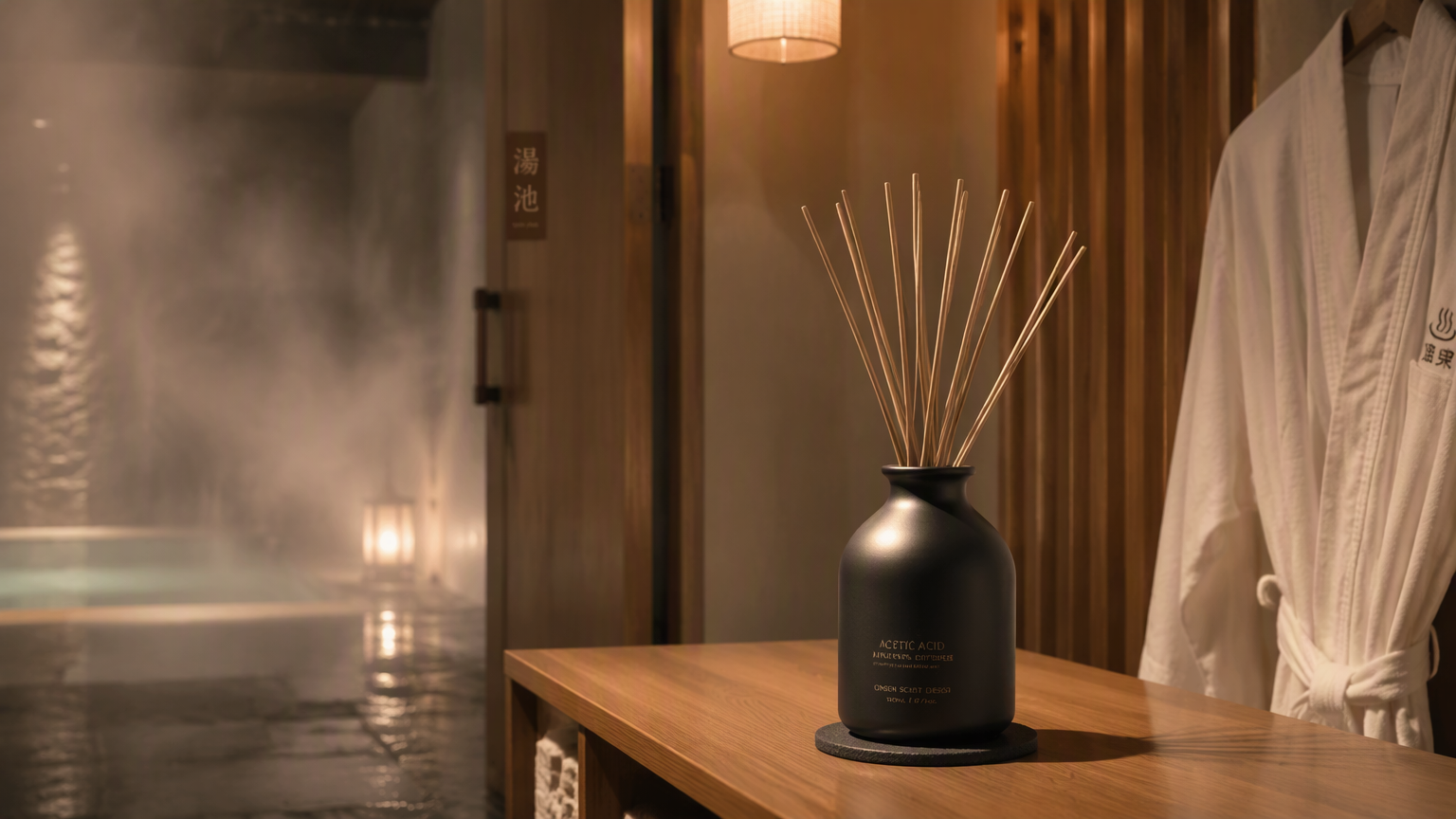
When you give guests a negative scent experience in those 0.8 seconds, every positive experience that follows has to first overcome that negative impression. Whether designed or neglected, the scent signal will always transmit information about what tier of hotel this is before any visual element does. Among hotel supplies, reed diffusers have become the most reliable scent management tool for lobbies, corridors, and public areas—they require no electricity, no complex installation, just consistent, sustained fragrance release. Managing scent properly with reed diffusers is how you wipe out that "sensory debt" in one go.
2. Hotel Operational Pain Point: One Diffuser System Solves Multiple Management Issues
Hotels often make a common mistake in scent management: thinking it's as simple as buying a scent machine and placing it in a corner of the lobby. This approach misses a few real operational challenges.
Scent consistency across different times of day. Morning foot traffic differs from evening foot traffic, and the HVAC system operates differently too. The same machine can produce different scent concentrations at different times. If you rely on manual adjustment, consistency is hard to guarantee. Reed diffusers require no electricity, no complex installation—they rely on natural rattan reeds to absorb and release fragrance. One bottle of liquid, a few reeds, placed there to work consistently for weeks. For hotel operations, a solution that needs no maintenance, no equipment tuning, no frequent intervention—that's the most efficient solution.
Scent adaptation across different areas. The lobby, corridors, elevator lobbies, and guest rooms each have different foot traffic, ceiling heights, and ventilation conditions. One central scent system applied everywhere will produce uneven results. Reed diffusers can be configured independently for each area—one per zone, with concentration and fragrance type adjustable separately, without interference. Zone independence—no central equipment, no piping, no pre-installed interfaces—makes this an extremely low-barrier deployment strategy.
I once saw a boutique hotel do this cleverly. They used a slightly stronger reed diffuser in the lobby, concentration a bit higher than standard, emphasising "welcome." In the corridors, they switched to a more restrained fragrance at a lower concentration—only noticeable when passing by. In the guest rooms, they didn't use diffusers at all, leaving that space for guests' own preferences. This zone-based strategy controlled costs while giving guests a layered olfactory experience across different spaces. In practice, this was the most fuss-free solution—no daily plugging in, no frequent monitoring, and housekeeping staff barely needed to attend to it, just flipping the reeds occasionally.
3. Product Competitiveness: What One Reed Diffuser Can Do Is More Than You Think
A good reed diffuser solution needs to get three things right: the right fragrance, the right concentration, and the right vessel.
Fragrance determines "fit." The scent logic for business hotels and resorts is completely different. Business hotel guests want to feel "professional, fresh, efficient" the moment they enter—woody notes (cedar, sandalwood) or green tea notes work better for this. Resort guests want to feel "relaxed, enveloped, temporarily disconnected from everything"—floral notes (white tea, gardenia) or herbal notes (lavender, chamomile) are more appropriate. Choosing the wrong fragrance is like wearing the wrong outfit to an event—the outfit itself isn't bad, but the context is wrong.
Concentration determines "enough." Two very different guest reactions can occur in a lobby with poorly managed fragrance concentration: "too light, I can't smell anything—it's like it's not even there" or "too strong, it's giving me a headache—I want to leave quickly." The advantage of reed diffusers is that their evaporation is continuous and even—no "just-refilled-too-strong, a-few-days-later-too-weak" fluctuations. The capillary action of the rattan reeds ensures a constant release rate as long as there's liquid in the bottle, the concentration remains stable. Among hotel supplies, reed diffusers achieve the most efficient stable diffusion using the simplest physical principles—no timers, no atomisers—the reeds themselves are the "controller."
The vessel determines "presentation." The reed diffuser bottle is not just a container—it's part of the design. A diffuser sitting in a hotel lobby is within the guest's line of sight; it's not a tool, it's part of the space decoration. A thoughtfully designed reed diffuser lets guests notice that "this hotel even put thought into its diffuser." A generic plastic bottle makes guests feel that "this hotel's supplies are just thrown together."
When a reed diffuser gets the fragrance, concentration, and vessel right all at once, it's no longer a consumable—it becomes part of the lobby design. The logic of custom hotel amenities applies here too—it's not just about putting a logo on the bottle, it's about letting the object itself express your brand language.
4. Hotel Profitability: Scent Is the Cheapest "Quality Signal"
Back to the original question: what can 0.8 seconds decide?
It decides what expectations guests have formed about your hotel before they've actually experienced your service.
Those expectations set the baseline for everything that follows. If guests receive a positive scent signal in those 0.8 seconds, they walk in with the expectation that "this hotel probably pays attention to details." Under that expectation, a clean room, attentive service, and comfortable bedding are all "as expected." But if the scent signal in those 0.8 seconds is negative, they walk in with the expectation that "this hotel might not care about details." Every subsequent experience then becomes an effort to "make up for previous dissatisfaction."
Scent management is one of the highest-ROI investments a hotel can make in perceived quality. The cost of a reed diffuser solution is minimal within the hotel's overall operating budget—but it affects every single guest's very first breath. And every breath is a transmission of brand information.
Think of fragrance as the starting point of the guest experience. Everyone who walks through the lobby is already scoring you with their nose. The score from those 0.8 seconds determines whether they'll look for strengths or look for flaws for the rest of their stay.
Frequently Asked Questions
Q: What fragrance should a lobby reed diffuser use?
A: It depends on your hotel's positioning. Business hotels should consider woody notes (cedar, sandalwood) or green tea for a professional, fresh feel. Resort hotels should consider floral or herbal notes for a relaxing, therapeutic feel. Family or lifestyle hotels could consider citrus notes for an energetic, welcoming vibe.
Q: Where should the reed diffuser be placed in the lobby?
A: Place it near the main foot traffic flow, but not dead centre. Good spots include the side of the reception desk, near the entrance corner, or on a side table next to the seating area. The principle is: guests should notice it when passing by, but not be刻意 aware of its presence.
Q: How do you control concentration with reed count?
A: Generally, 100ml reed diffusers work with 5-7 reeds; 200ml with 7-10 reeds. More reeds = faster evaporation = stronger scent. If the scent feels too light, add 1-2 reeds. If it feels too strong, remove 1-2 reeds. The standard concentration means "doesn't overwhelm."
Q: How much space can a reed diffuser cover?
A: Depends on bottle size and reed count. A 100ml reed diffuser typically covers 15-20 square metres—suitable for corridors or small seating areas. A 200ml diffuser covers 30-40 square metres—suitable for standard hotel lobbies. For larger lobbies, consider placing multiple bottles across different zones.
Q: How long does one reed diffuser last?
A: A 100ml reed diffuser typically lasts 4-6 weeks under standard conditions; a 200ml lasts 8-12 weeks. Actual duration depends on room temperature, ventilation, and reed count. Evaporation is slightly faster in summer (higher temperature) and slower in winter. Housekeeping can periodically check the liquid level and plan replacement timing.
0.8 seconds. Guests push the door open, breathe, and judge. This judgment bypasses logic, bypasses analysis, and goes straight to intuition. And the scent in that breath is the only basis for that intuition. Designing that breath is designing the starting point of the entire experience. If 0.8 seconds is enough to form a first impression, then let scent answer that window of time—and guests will remember the answer. Every time they encounter a similar fragrance later, they'll recall that moment after the door swung open—and the reed diffuser is the first object to speak in that moment.
latest articles
 Sep 15, 2026The Scent Memory of a Hot Spring Resort: What Do Guests Remember After Leaving – Sulfur or Your Fragrance?
 Sep 11, 2026Fragrance Design at the Entrance of a Hot Spring Resort Bathhouse: From "Smelling It Makes You Want to Take Off Your Shoes" to "Walking Out with Your Own Scent"
 Sep 09, 2026Waterside Resorts Have More Mosquitoes Than Mountain Resorts? – Mosquito-Repellent Fragrance Solutions for Water-adjacent Environments
 Sep 07, 2026Hotel Toiletry Sets: Bottle, Tube, Pouch, or Bar? – The Real Differences Between 4 Packaging Formats in Guest Experience and Cost


Ask For A Quick Quote
If you are looking for more information on our services, or how we could potentially help, we would love to hear from you!