



Blending Fragrance Liquid Is Not Stirring: Get the Sequence Wrong, and the Scent Notes Flip Front to Back
The same bottle of fragrance liquid – blended in the right sequence versus the wrong sequence – smells like two different things.
The appearance of scent notes is designed: top notes open, middle notes take over, base notes close. The ingredient addition sequence must follow this script. Reverse the order, and the appearance sequence scrambles – the scent notes naturally flip front to back. What guests smell the moment they push open the door might be the sour note that should have been pressed to the bottom. Half an hour later, the rich main scent that should be present has drifted away thinly.
Blending fragrance liquid isn't as simple as stirring several liquids together – especially for vinegar-based fragrance categories like acetic acid aromatherapy, which are more sensitive to sequence and temperature. This article explains the lesson of sequence thoroughly, helping you understand the order design behind a bottle of fragrance liquid.
What Can Be Smelled from a Bottle of Reversed Fragrance Liquid
Guests' first impression is often "sharp." The moment they push open the door, sourness or alcohol rushes out first, overpowering the originally designed floral and fruity notes. This is the top note stealing the show.
Half an hour later, the fullest middle layer is gone – only a faint base note remains. This is the middle note absent.
By evening, the entire room holds only a monotonous sweetness – the woody or musk closure that should have been in the base note has nowhere to land. All three stages scrambled. Guests can't explain the principle – they'll just leave a sentence "the smell is weird," or simply open the window. A bottle of sequence-reversed fragrance liquid consumes guests' patience three times across three time periods.
The Appearance Sequence of Scent Notes Is Designed
When a perfumer designs a fragrance type, they never pile favorite smells together – they seat them according to volatility speed.
Top notes: small molecules, fast evaporation – responsible for the bright opening. Commonly citrus and herbs.
Middle notes: medium volatility – the main body of the fragrance. Florals and spices mostly in this layer.
Base notes: large molecules, slowest evaporation – wood, amber, and musk responsible for closing and lasting.
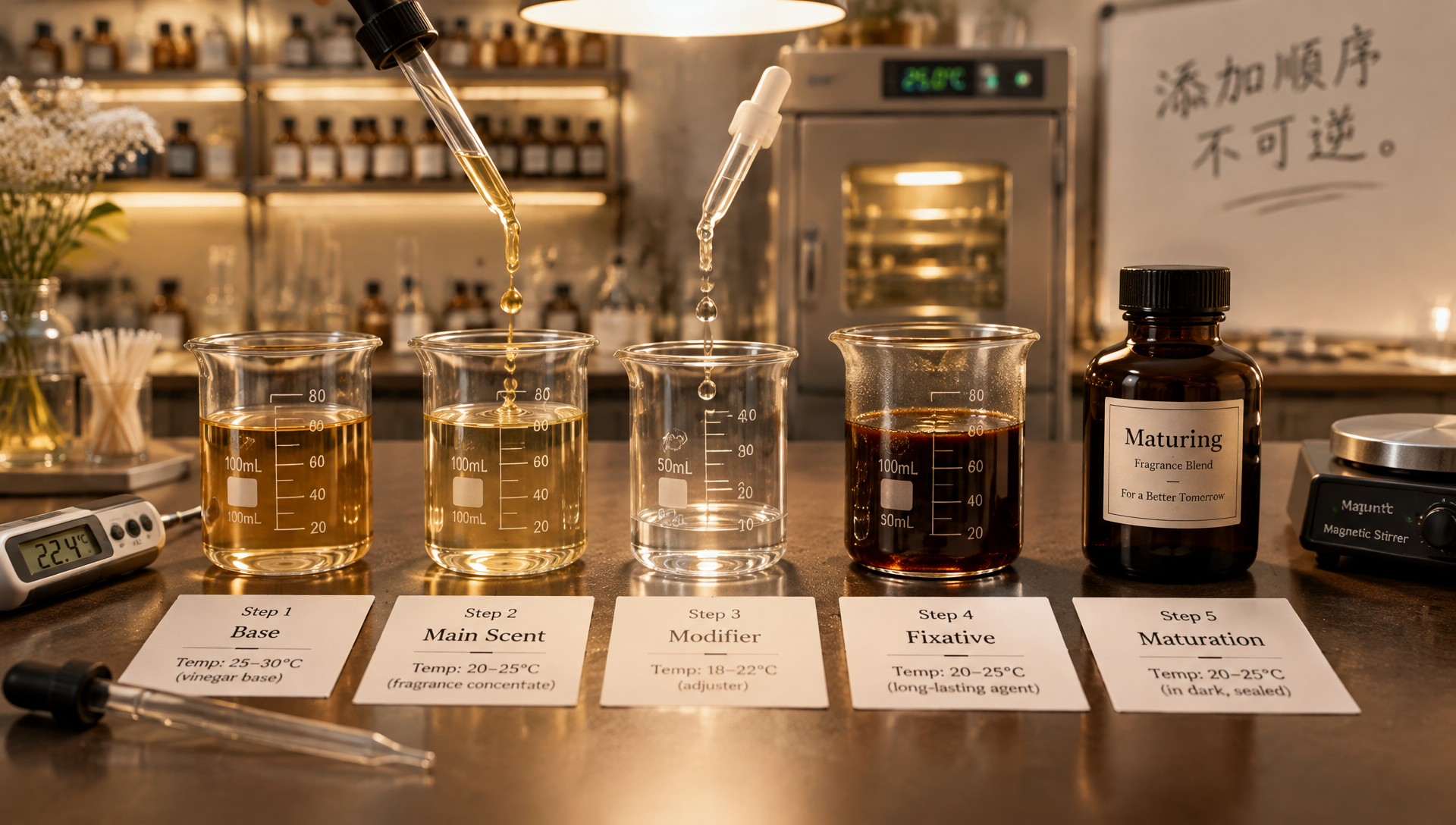
During blending, the ingredient addition sequence must serve this seating: base first, main scent following, modifier in small amounts, fixative last to lock the edges. Reverse the order – light molecules get wrapped by heavy molecules. What should leave first can't leave; what should stay can't stay. The entire appearance sequence falls into chaos.
The Correct Blending Sequence – Not One Step Out of Order
Qualified blending is a one-way assembly line.
Step one: Base liquid into the tank – vinegar-based, water-based, or oil-based – temperature adjusted to target first.
Step two: Main fragrance slowly added, low-speed dispersion while adding – letting fragrance molecules evenly hang on the base.
Step three: Modifier added in small amounts per formula – this step demands trace amounts. One part more steals the show.
Step four: Fixative closes – locking the entire fragrance skeleton in place.
Step five – the most easily skipped step: Standing maturation – letting molecules of each layer fully interlock. Generally stored away from light for several days. Fragrance liquid blended on demand and used immediately hasn't grown its scent type properly at factory release.
Stirring is only responsible for uniformity. Sequence is responsible for layering. The two cannot substitute for each other.
The Special Temperament of Vinegar-Based Fragrance Liquid
Fragrance with fermented vinegar as base – advantages: natural, alcohol-free, gentle diffusion. Increasingly welcomed by health-oriented hotels in recent years.
But it has a temperament. The acidic environment is selective about fragrance solubility – not all fragrance types can stand steadily in vinegar base. Citrus and herbal-woody fragrance types have high compatibility. Heavy sweet fragrances tend to separate.
Vinegar base is equally sensitive to temperature. Adding fragrance at high temperature – acid and fragrance directly contact – top notes turn sharp and pungent. Responsible factories lower the base to below room temperature before addition, pre-disperse the fragrance in a small amount of carrier first, then merge into the vinegar base main tank, and finally mature for the full period.
With this sequence completed, the vinegar's slight sourness recedes into the background, carrying the main scent slowly forward. This is what acetic acid aromatherapy should be.
On-Site Blending Is the Source of Fragrance Drift
Many hotels, for emergency response, have staff add fragrance directly into large drums on site – stir a few rounds and put on the shelf.
This approach saves a moment – and scrambles the long term. Every on-site blend: input amounts by feel, sequence by habit, standing maturation basically nonexistent. The same batch of rooms can smell like two or three versions.
Guests' memory of fragrance type is built on consistency. This time smelling one version, next time another – the brand's olfactory label can't stand up. More troublesome: staff olfactory fatigue – can't smell the drift. By the time complaints reach the front desk, the scent has already been off for half a month.
Replenishing liquid replenishes quantity – destroys blending. This kind of ledger can only be reconciled through month-end reviews.
Three Locks at the Factory End
Sequence locked. Ingredient addition sequence written into the process card – base, main scent, modifier, fixative – four steps must not be reversed. Each tank has traceable input records.
Full maturation period. Each batch stored away from light for the specified number of days. Not released until maturation is complete – not compressed due to urgent orders.
Temperature controlled. Base temperature and workshop temperature included in records. Vinegar base and heat-sensitive fragrance types have separately set addition windows.
Retention sample blind smell. Each batch retained. At intervals, personnel not involved in blending conduct blind smell comparison against standard samples. Drift exceeding limits triggers full batch review.
Fragrance archive. Formula, input records, maturation dates, and retention sample results archived by batch number – traceable at any time.
Light-blocking seal. Dispensing bottles protected from light, sealed against oxygen – slowing fragrance aging during transport and shelf life.
When Fragrance Type Is Stable, Hotels Earn Memory
Guests can't remember the wall color after checkout – but they remember that scent. The prerequisite is: every time they come, it's the same scent.
Fragrance type consistency is the hotel's cheapest membership system. Smelling a familiar scent – familiarity arrives before rationality.
The same holds on the retail line. Lobby-identical fragrance liquid sells – relying on the restoration degree of the version in the guest room. On-site blended versions can't stand on the retail end.
Factory end locks sequence and maturation. Hotel end only does placement and replacement – no secondary creation. The restraint on both ends earns that review sentence "smelled the familiar fragrance the moment I walked in." The repeat guests those five words bring – calculated qualitatively throughout – are all net gain.
FAQ
Q: The fragrance liquid smells sharp right after opening – will it improve after a few days?
A: No. The maturation that should have been completed before factory release can't be remedied by shelf life. After opening, the volatility sequence is already set. Sharpness indicates top note imbalance – contact the supplier to verify process records by batch.
Q: Will adding more fragrance during on-site replenishment make it smell better?
A: Not better – only messier. Excess fragrance overwhelms the middle and base note ratios, producing thin sharp notes. Replenishment should use factory pre-dispersed same-batch refill packs.
Q: Is slight fragrance difference between batches normal?
A: Natural raw materials have reasonable fluctuation. But perceptible differences constitute drift. Legitimate factories intercept drift before factory release through retention sample blind smell. During procurement, request comparison of two adjacent batch retention samples.
Q: Is vinegar-based fragrance liquid safe to store in a car or high-temperature warehouse in summer?
A: Not recommended. High temperatures accelerate top note evaporation and let sourness rise. Store away from light in a cool place. Dispensed bottles should avoid direct sunlight. Rotate onto shelves as soon as possible after opening.
Leave the blending sequence to the factory. Leave the maturation period to time. Only then will the fragrance type not flip front to back in front of guests. One stable bottle of fragrance liquid beats ten expensive ones. Browse our acetic acid aromatherapy wholesale collection – from base maturation to fragrance archives to full private-label solutions, all covered in one stop. Our flexible customization production line supports small-batch flexible MOQs.
latest articles
 Nov 06, 2026Blending Fragrance Liquid Is Not Stirring: Get the Sequence Wrong, and the Scent Notes Flip Front to Back
 Nov 04, 2026Resort Fragrance Solution Design: A Full-Scenario Olfactory Experience from Lobby to Spa
 Nov 02, 2026Retail Corner Display Logic and Guest Room Placement Logic Are Two Different Systems
 Oct 30, 2026Reed Count, Liquid Level and Diffusion Power: How to Tune a Reed Diffuser
Ask For A Quick Quote
If you are looking for more information on our services, or how we could potentially help, we would love to hear from you!