



The Scent Memory of a Hot Spring Resort: What Do Guests Remember After Leaving – Sulfur or Your Fragrance?
On the third day after checkout, when guests open their luggage to unpack, they bring a jacket cuff close to their nose. Only two possibilities remain: the sulfur of the hot spring, or the fragrance you arranged. Sulfur is the identity of the hot spring – it cannot be erased, and does not need to be. But the memory after leaving should not be only sulfur. The truly portable memory medium for a hot spring resort is scent. Whoever places fragrance along the guest's movement flow ahead of time occupies that place in the suitcase. This article follows the complete movement flow of one hot spring visit and explains where sulfur and fragrance should each stand.
Guest Experience: A 72-Hour Scent Timeline of One Hot Spring Visit
Guests' memory of scent is far more stubborn than photos. Photos turn the page; scents suddenly reappear. A trace of a similar fragrance on the subway brings the entire weekend back. Breaking down one stay, scent completes its memory inscription at three nodes – and at each node, the resort has a chance to act.
During the hot spring soak, sulfur molecules attach to hair and bathrobe fibres with the steam. At this moment, it is identity – the very thing guests paid for.
On the way back to the room, passing the changing area and corridor, the sulfur smell begins to mix with moisture – the texture slowly turns into a nuisance.
On the third day after checkout, opening the luggage, the remaining scent on the cuff gives the resort its final statement.
Hotel Operations: The Two Faces of Sulfur – The Movement Flow Determines Whether It Is Texture or Nuisance
The same sulfur smell – by the pool it is texture, in the changing room it is a nuisance, in the suitcase it is a negative review. The most common operational mistake is a single scent policy across the entire property – either letting sulfur follow guests home, or using heavy fragrance to suppress it across the board. Both fail. Letting it go – guests bring sulfur home and write it into reviews; the hot spring becomes a complaint about smelling like medicine. Suppressing it – heavy fragrance and sulfur stench stack into an even stranger blend, especially obvious when steamed in the wet zone. The correct approach is segmenting by movement flow, each managing its own segment.
By the hot spring pool, retain a light sulfur note – that is the language of the hot spring; do not interfere.
The changing area and hair-drying zone are handed to neutralising fragrance – sulfur exits, cleanliness takes over.
Guest rooms and corridors finish with a gentle fragrance – light, not competing.
Product Competitiveness: Masking Is Addition, Neutralisation Is Reaction
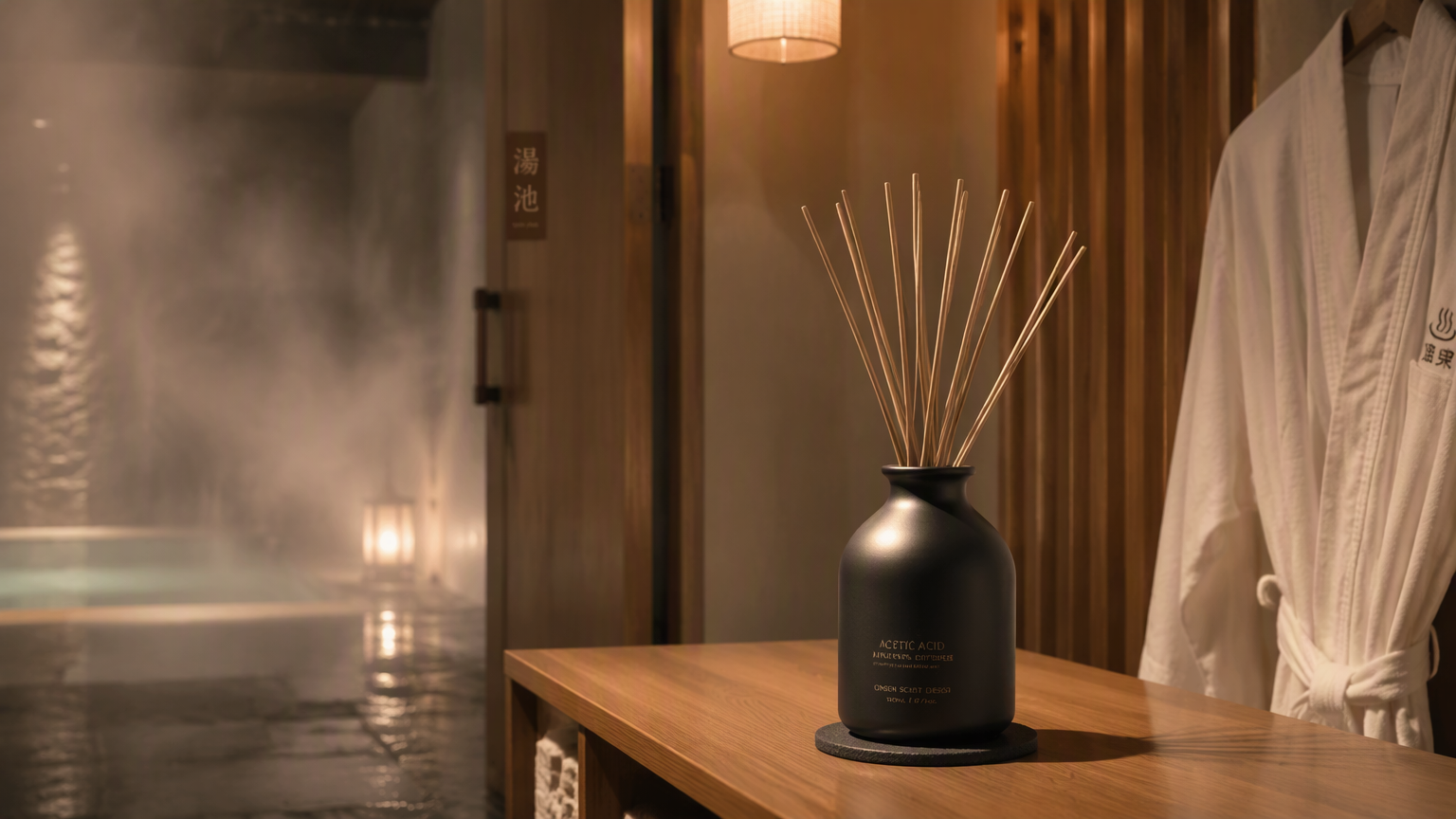
Many fragrance solutions fail in hot spring scenarios because they use a masking approach. Sulfur odour molecules are mildly alkaline – layering more fragrance on top leaves both odours coexisting. The nose receives two sets of signals simultaneously – the result is an indescribable smell. The neutralisation approach works in reverse: acidic volatiles react with alkaline sulfur odour, both odours exit together, and the fragrance then takes over. This is exactly why we set the main solution for wet-zone corridors as acetate reed diffusers – after the acid-base reaction, guests smell only the clean base note. In high-humidity environments, alcohol bases evaporate quickly but do not last; acidic carriers have a flatter evaporation curve and hold longer.
Product Competitiveness: How to Choose the Base – One Table Makes It Clear
Temperature and humidity vary greatly across different positions. Choose the wrong base, and even the best fragrance is wasted. Before selecting, take the movement flow diagram and mark wet and dry zones segment by segment, then match according to the table below.
Containers follow the position – ceramic or metal vessels in wet zones with narrowed rims to prevent steam backflow and anti-slip pads at the base. Dry zones can use rattan styles that diffuse slowly.
Profitability: Letting Scent Follow Guests Home
Scent is the only medium that follows guests home without any advertising cost. The suitcase is a mobile display position. The last hundred metres of the checkout movement flow – from the changing area to the front desk to the souvenir shelf – is the closing segment of lingering scent design, and the most easily overlooked.
Scent follows guests home for free – the display position is set in the suitcase; every unpacking is a reminder.
Place lobby-matched products at the souvenir station – guests buy the resort's memory home, extending the trip into daily life.
More guests write about scent in reviews each year – a pleasant scent is an experience that can be recorded in words, and so is a negative one.
Frequently Asked Questions
Q: Does sulfur smell need to be completely removed?
A: No. Sulfur is the identity of the hot spring. A light sulfur note by the pool is actually texture. What needs to be addressed is the residue in the changing area, guest rooms, and the checkout movement flow.
Q: Does acetate fragrance smell like vinegar?
A: No. The acidic carrier is only the evaporation channel. Once blended with fragrance, what remains is a clean base note. Its function is to neutralise sulfur odour – what you smell will not be vinegar.
Q: How often should wet-zone diffusion be replenished?
A: High-temperature, high-humidity environments consume quickly. Rattan styles need liquid replenishment every two weeks; solid balms are replaced seasonally. During peak season, double inspection frequency by foot traffic.
Q: Should fragrance also be placed in guest rooms?
A: Yes, recommended. Guest rooms are the final segment of checkout memory. Use plant oil blends or solid balms in dry zones, avoiding positions directly in the steam path.
Browse our Hot Spring Resort Fragrance Wholesale Collection – from neutralising diffusion formulas to custom fragrances, and full private-label solutions, all covered in one stop. Our flexible production line supports small-batch orders with flexible MOQs.
latest articles
 Sep 15, 2026The Scent Memory of a Hot Spring Resort: What Do Guests Remember After Leaving – Sulfur or Your Fragrance?
 Sep 11, 2026Fragrance Design at the Entrance of a Hot Spring Resort Bathhouse: From "Smelling It Makes You Want to Take Off Your Shoes" to "Walking Out with Your Own Scent"
 Sep 09, 2026Waterside Resorts Have More Mosquitoes Than Mountain Resorts? – Mosquito-Repellent Fragrance Solutions for Water-adjacent Environments
 Sep 07, 2026Hotel Toiletry Sets: Bottle, Tube, Pouch, or Bar? – The Real Differences Between 4 Packaging Formats in Guest Experience and Cost


Ask For A Quick Quote
If you are looking for more information on our services, or how we could potentially help, we would love to hear from you!